Guide to Carbon Steel Forging in Modern Manufacturing

In modern industrial manufacturing, the quality of metal components directly determines the performance, safety, and service life of mechanical equipment. Carbon steel forging, as a metal forming technology with a long history and continuous development, has become an indispensable fundamental manufacturing process in many industries such as automotive, construction, energy, shipbuilding, and more, due to its unique material strengthening mechanism and reliable mechanical properties. This article starts from the basic concept of carbon steel forging and systematically introduces its process flow, material selection, core advantages, application fields, and quality control methods, helping readers gain a comprehensive understanding of this critical industrial technology.
Carbon steel forging is a manufacturing process in which carbon steel billets are heated and then formed under external compressive force. Its key characteristic is that no material is removed during processing; instead, the metal shape is changed through plastic deformation.
Carbon steel is mainly composed of iron and a small amount of carbon. It is widely used in industrial manufacturing because it achieves a good balance between strength, reliability, and cost efficiency.
During forging, the heated carbon steel is shaped under controlled pressure, and the internal grain structure of the metal is refined. The grain flow lines are rearranged along the stress direction of the part. This structural transformation significantly improves the mechanical properties of the material. Compared with casting or machining from bar stock, forged carbon steel parts have higher structural integrity and better fatigue resistance, making them widely used in shafts, flanges, gears, valve components, and other load-bearing industrial parts.
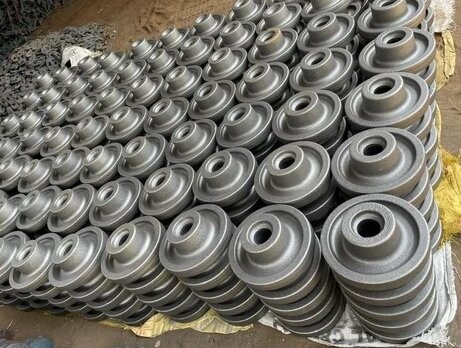
Forging and casting are two fundamentally different metal forming processes. Forging produces a continuous grain structure, and the metal flow lines follow the shape of the part, significantly reducing internal defects such as porosity and increasing strength. It is therefore suitable for load-bearing components.
Casting, on the other hand, has a more random grain structure and relatively lower strength, and may contain defects such as porosity. However, it is more suitable for manufacturing complex shapes. Therefore, in applications requiring high strength and reliability, forging is usually the preferred process.
The forging process of carbon steel includes three main stages: billet selection and heating, forming and trimming, and heat treatment and finishing. Temperature control runs through the entire process and plays a decisive role in product quality.
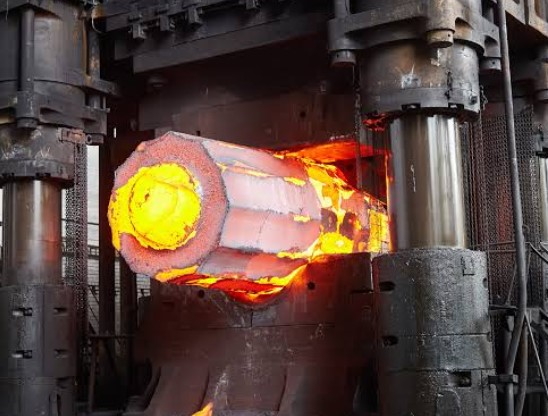
The forging process usually begins with selecting appropriate carbon steel billets. The material grade is determined according to engineering drawings and actual operating conditions. The billet is then heated to forging temperature.
The typical forging temperature range is 1000°C to 1250°C. Low-carbon steel and medium-carbon steel are usually processed at 1100°C to 1200°C, while high-carbon steel is forged at relatively lower temperatures. Proper temperature control ensures sufficient plasticity while preventing excessive grain growth.
After heating, forming is carried out through open-die forging or closed-die forging. Under high-temperature pressure, the metal grains are rearranged along the stress direction of the part, improving overall structural performance.
After forging, trimming is performed to remove flash and excess material. Surface treatments such as sandblasting may also be applied to prepare for subsequent machining.
If required, forged parts can undergo heat treatment processes such as normalizing, quenching, or tempering to achieve specific mechanical properties. Finally, CNC machining is used to ensure dimensional accuracy, followed by inspection of dimensions and material properties to ensure stable product quality.
This multi-process continuous production method ensures material consistency and dimensional precision.
Forging temperature has a decisive impact on the quality of carbon steel forming. If the temperature is too low, the material lacks plasticity and cracks may occur. If the temperature is too high, grain coarsening may occur, reducing strength.
Different materials have different forging temperature ranges. For example, A36 steel is typically forged at 1150°C to 1250°C, AISI 1018 and 1045 at around 1100°C to 1200°C, and 4140 alloy steel at 1050°C to 1150°C. Therefore, precise temperature control must be applied according to material characteristics.
Forged carbon steel materials are mainly divided into low-carbon steel, medium-carbon steel, and high-carbon steel. Different grades are used for different applications. Material selection must consider strength requirements, machinability, service environment, and heat treatment response.
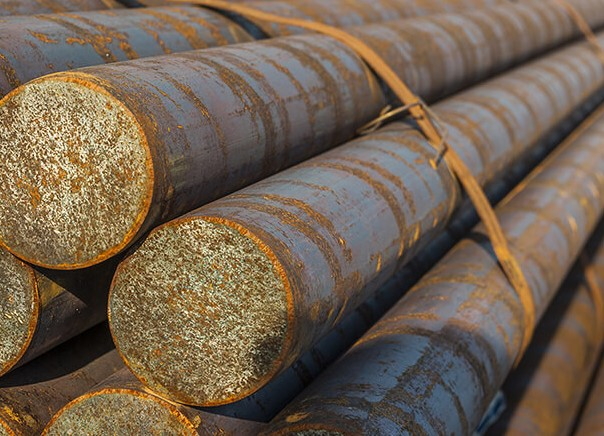
Low-carbon steel is suitable for components requiring good machinability and moderate strength. Medium-carbon steel is used for higher strength and wear-resistant applications. High-carbon steel is used in high-hardness and high-stress conditions.
In addition, carbon-manganese steel offers better toughness and load-bearing capacity and is also a commonly used forging material.
Material selection depends on operating load, working environment, and heat treatment requirements. Strength, toughness, machinability, and actual working conditions must be considered comprehensively.
Different carbon steel grades are used for different forging applications:
- ASTM A36 / A105: structural forgings, pipe fittings, and valve components
- AISI 1018: good machinability, suitable for parts requiring extensive machining
- AISI 1045: higher strength and wear resistance, used for shafts and gears
- 4140 alloy steel: high-strength mechanical parts under heavy load
- 1095 steel: high-hardness cutting tools
Selection is based on engineering drawings, operating conditions, and heat treatment requirements.
Material selection is influenced by multiple factors:
First is strength requirement—high-load conditions require medium-carbon or alloy steels.
Second is machinability—parts requiring extensive machining need easier-cutting materials.
Third is service environment, including temperature, corrosion, and impact load.
Finally, heat treatment response must be considered to achieve the desired final performance.
Carbon steel forging is widely used due to its significant technical and economic advantages, mainly reflected in structural strength, fatigue resistance, internal quality, material utilization, and cost efficiency.
Forged carbon steel parts have continuous grain flow aligned with the part shape, resulting in higher structural strength. Under cyclic loading, forged parts show excellent fatigue resistance and can withstand long-term repeated stress without failure. This is particularly important for shafts, gears, and valve components.
During forging, metal flows under high temperature and pressure, significantly reducing internal defects such as porosity and improving material density.
In addition, forging has higher material utilization because it forms parts close to the final shape, reducing material waste and subsequent machining requirements.
Compared with alloy steel or stainless steel, carbon steel offers cost advantages and abundant raw material supply. Although initial die and energy costs are higher, reduced material waste and machining volume make forging highly cost-effective in mass production.
Due to its advantages, carbon steel forging is widely used in automotive, construction, agricultural machinery, oil and gas, and other industries. Each industry has different performance requirements, and forged carbon steel provides suitable solutions.
Carbon steel forging plays a critical role in automotive manufacturing, widely used in crankshafts, connecting rods, and gears.
The crankshaft converts piston reciprocating motion into rotational motion and must have extremely high strength and reliability. Forging provides the necessary durability to withstand high engine loads.
Connecting rods transfer force between piston and crankshaft and are subject to continuous high stress. Gears transmit power and control speed, requiring high reliability and long service life.
In construction, carbon steel forgings are used for beams, columns, and structural supports. These components form the core load-bearing system of buildings and bridges.
Forged beams and columns can withstand large loads and offer excellent bending and fracture resistance. Fasteners such as bolts and nuts also rely on forging to ensure structural stability and safety under wind and seismic loads.
In agricultural machinery, forged carbon steel is used in tractors, plows, and harvesters.
Plowshares must withstand soil impact and wear, requiring both hardness and toughness. Tractor shafts and gears must handle torque and shock loads under harsh outdoor conditions, requiring high durability and reliability.
In the oil and gas sector, carbon steel forging is widely used for valves, flanges, and pipelines.
Valves must withstand high pressure and corrosion resistance requirements. Flanges require sealing integrity and strength to prevent leakage. Forged pipelines ensure safe and stable long-distance transport under high pressure and temperature conditions.
Carbon steel forgings include several main product types: shafts, flanges and structural parts, valves and pump components, gears and fasteners.
- Shaft Components: Shafts are among the most common forged parts, including drive shafts, spindles, crankshafts, and camshafts. Forged shafts have continuous grain flow and excellent resistance to torsion and bending stress.
- Flanges and Structural Parts: Flanges are used for pipe and equipment connections requiring high sealing and strength. Structural parts such as beams, columns, and brackets must withstand heavy loads and impact, which forging can reliably support.
- Valves and Pump Components: Forged valve components provide high strength and pressure resistance for demanding conditions. Pump and gearbox parts also rely on forging for performance under high pressure and high-speed operation.
- Gears and Fasteners: Gears require high strength, wear resistance, and precise tooth profiles. Forged gears are widely used in automotive, machine tools, and engineering machinery. Fasteners such as bolts, nuts, and pins, though small, are critical for structural connections and require high reliability.
Strict quality control systems are essential to ensure stable and reliable forged products.
Each batch of raw material must be accompanied by material certificates, recording chemical composition and mechanical properties. A full traceability system ensures each forging can be traced back to its original heat number and batch.
After machining, dimensional inspection ensures compliance with drawings using coordinate measuring machines and precision gauges. Non-destructive testing methods such as ultrasonic and magnetic particle inspection detect internal and surface defects such as cracks, inclusions, and porosity.
Hardness testing using Brinell, Rockwell, or Vickers methods verifies material properties after heat treatment. Tensile testing, impact testing, and metallographic analysis may also be conducted to comprehensively evaluate mechanical properties and microstructure.
Carbon steel forging, as a mature metal forming process, plays an irreplaceable role in industrial manufacturing. By optimizing grain structure and flow lines, it significantly improves strength, toughness, and fatigue resistance.
From automotive and construction to oil and gas, agricultural machinery, and shipbuilding, carbon steel forgings are widely used in critical equipment and structures. With continuous advancements in process technology and quality control, carbon steel forging will continue to provide high-quality and highly reliable components for industrial development. For applications involving heavy loads, high pressure, and complex stress conditions, carbon steel forging remains one of the preferred manufacturing processes. Understanding its principles, material selection, and process control is essential for better application in modern industry.
