Guide to Shell Mold Casting: Process, Benefit & Applications

In the field of metal component manufacturing, how to achieve high precision while controlling cost is a common challenge faced by engineers and procurement professionals. Some parts have complex geometries, thin walls, and extremely high surface finish requirements. However, traditional sand casting often cannot meet the required accuracy, while investment casting may result in long lead times due to its complex process steps.
Shell mold casting is a process that balances precision and efficiency, effectively addressing this contradiction. It uses resin-coated sand to form a thin but rigid shell mold on a heated metal pattern, enabling high-quality mass production of castings. This article begins with the basic definition and working principle of shell mold casting, then explains its advantages, limitations, and applicable materials in detail. It also compares shell mold casting with investment casting and wet sand casting to help readers choose the most suitable process based on their specific part requirements.
Shell mold casting is a metal casting process that uses a thin layer of sand mixed with resin to create a mold. This mold is formed around a pattern of the desired part. When the pattern is heated, the resin-sand mixture cures on its surface, forming a hard shell mold. Molten metal is then poured into the cavity, and after cooling, the final casting is obtained.
Shell mold casting is also known as the Croning process, named after its inventor. This process can produce parts with complex details and excellent surface finish—features that are difficult to achieve with many other casting methods.
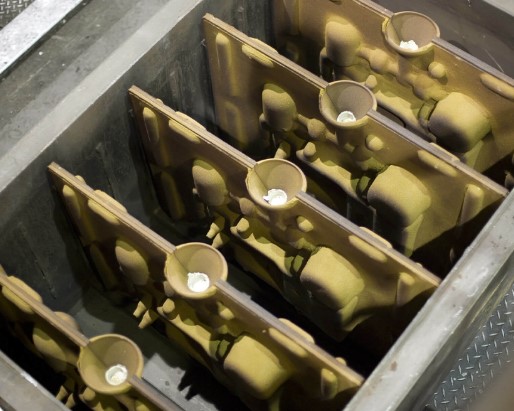
The shell mold casting process consists of five main steps, each of which plays a critical role in determining the final quality of the casting.
The first step is to manufacture a metal pattern based on the final part design. The pattern is very close in size and shape to the finished product. It is typically made from steel or cast iron because it must withstand repeated heating and cooling cycles.
The surface quality of the pattern directly affects the surface finish of the final casting. Therefore, the pattern must be machined with high precision.
A resin-coated sand mixture is applied to the surface of the heated metal pattern. This mixture consists of fine sand particles blended with a thermosetting resin.
The pattern is usually heated to 200–300°C. When the resin sand comes into contact with the hot pattern, the resin cures and hardens, forming a rigid shell layer on the surface. The shell thickness is typically 5–10 mm, and the curing time is about 30–60 seconds. Once the required thickness is achieved, the shell-coated pattern is removed from the heating furnace.
After curing, the shell is removed from the pattern. It is divided into two halves: the upper shell and the lower shell. These two halves are then joined together to form a complete mold cavity.
Clamps or adhesives are used to secure the assembly, preventing molten metal from leaking through the parting line during pouring.
Molten metal is poured into the cavity. Once filled, the metal begins to solidify during cooling. Because the shell mold has good rigidity, it is not easily deformed during pouring, which ensures high dimensional accuracy of the casting.
The cooling time depends on the wall thickness of the casting and the type of metal used.
After the metal has fully solidified, the mold is opened and the casting is removed. Excess material such as gates and risers is removed. If necessary, surface finishing and machining are performed.
Since shell mold castings already have a relatively smooth surface, post-processing work is usually minimal.
Shell mold casting offers several significant advantages, which are outlined below.
The process uses fine sand particles combined with resin, resulting in a smooth and hard mold surface. The surface finish of castings typically reaches 125–250 RMS microinches, indicating a relatively smooth surface.
Dimensional tolerance can be controlled to approximately ±0.002 inches per inch. Due to its high precision, the amount of post-machining required is significantly reduced, saving both time and material costs.
Shell mold casting is well suited for complex structural parts. During curing, the resin sand slightly shrinks and detaches from the pattern, allowing smaller draft angles—typically as low as 0.5° to 1°.
This enables the production of parts closer to their final geometry. It is also effective in reproducing thin-wall features, which is why it is widely used in aerospace and automotive industries.
Shell mold casting can be applied to a wide range of metals, including carbon steel, stainless steel, aluminum alloys, and copper alloys. This versatility allows it to meet the requirements of different industries.
Compared with processes that require expensive permanent molds, shell mold casting is more economical for medium and small production runs.
Although a metal pattern must be made, it has a long service life and can produce thousands or even tens of thousands of castings. The molds are relatively lightweight and easy to handle, and the process can be highly automated, reducing labor costs per unit.
Shell mold castings have relatively clean surfaces with fewer burrs. Gates and risers are also easier to remove, reducing cleaning and finishing work.
Despite its advantages, shell mold casting also has several limitations.
The resin and specialty sand used in the process are more expensive than those used in conventional sand casting. Although some sand can be recycled, resin and fresh sand must still be continuously added, increasing overall material cost.
Shell mold casting is generally suitable for small to medium-sized castings. The economical weight range is typically from a few ounces up to 50–100 pounds (about 20–45 kg). Larger castings are less suitable due to the difficulty of forming large thin shells.
For large-scale mass production, the efficiency of shell mold casting is relatively limited. Each mold cycle takes time, including heating and resin curing, which restricts output per unit time and increases cost.
Specialized equipment is required, including heating furnaces for patterns, shell-forming machines, and curing systems. The initial investment is relatively high, making it less suitable for small-scale or prototype production.
During resin curing, gases such as formaldehyde may be released, requiring proper ventilation and exhaust treatment systems. Additionally, because the shell mold is thin and less permeable than wet sand molds, improper process control may lead to gas porosity defects.
Shell mold casting is compatible with several common metals:
- Carbon Steel: Carbon steel offers high strength and wear resistance. Shell mold carbon steel parts are commonly used in components such as camshafts and valve bodies, which must withstand high mechanical stress.
- Stainless Steel: Stainless steel provides excellent corrosion resistance. Shell mold stainless steel castings are widely used in food processing equipment and medical applications, including surgical instruments.
- Aluminum Alloys: Aluminum alloys are lightweight and have good thermal conductivity. Shell mold aluminum parts are often used in automotive engine components and aerospace structures where weight reduction is critical.
- Copper Alloys: Copper alloys have excellent electrical and thermal conductivity. Shell mold copper alloy castings are commonly used in electrical connectors and heat exchangers.
Shell mold casting is often compared with investment casting and wet sand casting. Each process has its own ideal application scenarios.
Investment casting, also known as lost-wax casting, uses wax patterns to create a ceramic shell mold. The wax is melted out after shell formation, leaving the cavity for metal pouring.
- Dimensional accuracy: Investment casting achieves ±0.005–0.01 inches per inch, while shell mold casting achieves ±0.002–0.06 inches per inch. Wet sand casting is around ±0.06 inches per inch. Investment casting provides the highest precision.
- Surface finish: Investment casting is excellent, shell mold casting is good, and wet sand casting is relatively rough.
- Cost: Investment casting has complex processes and high labor costs. Shell mold casting has moderate labor cost but higher tooling cost. Wet sand casting has the lowest overall cost.
- Production scale: Shell mold casting is suitable for medium to high production volumes, investment casting is better for low-volume high-precision parts, and wet sand casting is ideal for large-scale production.
Overall, shell mold casting provides a balanced solution between precision, surface quality, and efficiency.
Wet sand casting is a traditional and widely used method where sand is bonded using clay and moisture. Unlike shell mold casting, wet sand molds do not require baking.
- Advantages: Wet sand casting has low cost and low equipment investment. It is widely used in high-volume industries such as automotive manufacturing.
- Disadvantages: It produces rougher surface finishes and lower dimensional accuracy compared to shell mold casting. It also has limitations in producing complex geometries.
No casting process is universally superior. Selection should be based on requirements such as dimensional accuracy, production volume, surface quality, and cost.
If high precision and good surface finish are required with medium-to-high production volume, shell mold casting is an excellent choice. If ultra-high precision with low volume is needed, investment casting is more suitable. If extremely high volume and low cost are the priority, wet sand casting is the most economical option.
Several factors significantly influence casting quality.
- Pattern Material: The pattern material directly affects surface quality and dimensional accuracy. Metal patterns are typically used to withstand repeated thermal cycles, and their surface finish is transferred directly to the casting.
- Resin-Sand Ratio: The resin content determines shell strength. Too much resin increases cost and gas emissions, while too little reduces shell strength. Sand grain size also affects surface finish—finer sand produces smoother surfaces.
- Pouring Temperature: Pouring temperature affects metal flowability. Too low may result in incomplete filling, while too high increases shrinkage and may damage the shell mold.
- Cooling Rate: Cooling rate influences microstructure and mechanical properties. Faster cooling produces finer grains and higher strength, but excessive cooling speed may cause cracks.
Shell mold casting is a high-quality casting method suitable for producing precision parts with complex geometries. Its main advantages include good surface finish, high dimensional accuracy, suitability for medium-scale production, and broad material compatibility. It is widely used in aerospace, automotive, and medical industries.
However, it also has limitations such as higher material cost, lower efficiency for large parts, and higher equipment investment. Compared with investment casting, it offers slightly lower precision but better cost efficiency. Compared with wet sand casting, it provides significantly higher accuracy but at a higher cost.
When selecting a casting process, factors such as precision requirements, production volume, material type, and cost must be considered comprehensively. Shell mold casting offers a balanced solution between accuracy, surface quality, and efficiency, making it an ideal choice for many precision casting applications. Understanding its working principles, advantages, and limitations helps ensure correct process selection in real-world applications.
