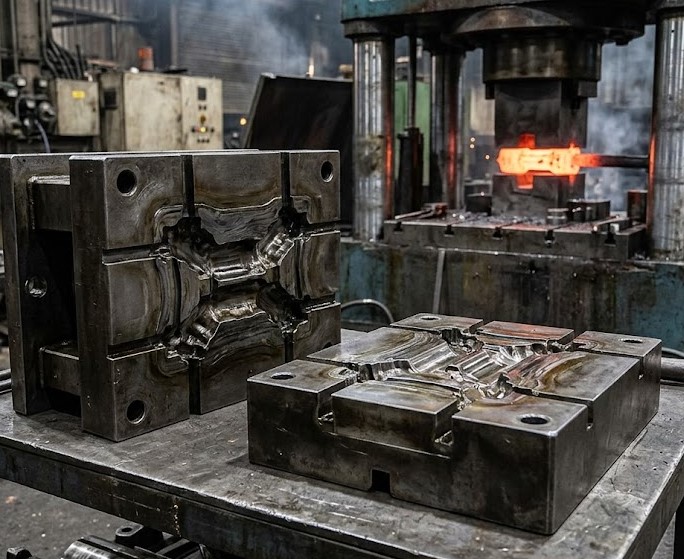
Forging die design is a core technology in metal forming processes. Simply put, a forging die is a tool used to shape metal during the forging process. Just as making moon cakes requires molds, forging dies determine the final shape of the metal. There are three main forging methods: cold forging, closed-die forging, and open-die forging. Each method has different requirements for die design. Cold forging is carried out at room temperature and is suitable for manufacturing parts with high precision and smooth surface finish; such dies must have extremely high pressure and wear resistance. Closed-die forging fully encloses the metal during the forging process, allowing the production of complex parts with strict tolerances. Open-die forging is suitable for producing parts with simple shapes and large dimensions.
The selection of die materials directly affects the die's lifespan and performance. Dies must withstand high temperature, high pressure, and wear during the forging process.
Tool steel is currently the most commonly used die material because it offers balanced performance in hardness, toughness, and heat resistance. High-speed steel is also commonly used in cold forging dies, as it maintains hardness at high cutting speeds. Material cost is also a factor that must be considered. For small-batch production, relatively inexpensive materials can be chosen; however, for large-batch production, investing in high-quality die materials is usually worthwhile, as longer die life can result in a lower overall cost.
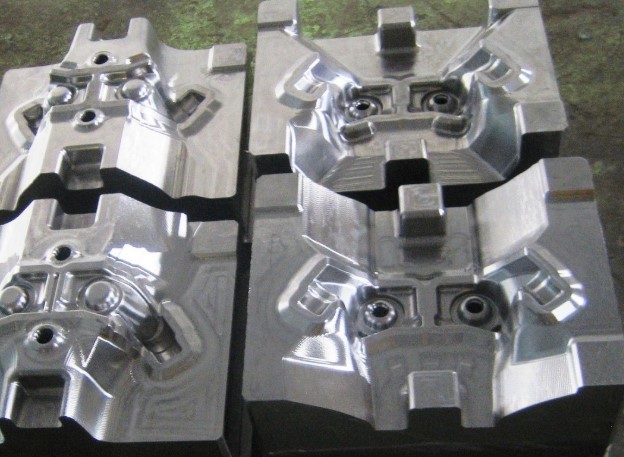
Ensuring smooth metal flow is one of the key points in die design. If metal does not flow correctly, it can cause defects such as cracks, porosity, and uneven thickness, directly affecting product quality.
Optimizing metal flow requires designing the cavity according to the part shape, forging type, and metal properties. Sometimes multiple cavities or multiple forging operations are needed to ensure correct metal flow. Draft angles in the cavity are also important, as they help the part eject smoothly and prevent damage to the part and the die.
Cooling and lubrication are often overlooked in die design, but they are actually very important. Forging generates a large amount of heat, and if the die overheats, it can accelerate wear or even fail. Therefore, a cooling system must be designed, such as internal water channels in the die or using air cooling.
Lubrication can reduce friction between the die and metal, improve metal flow, reduce die wear, and prevent metal from sticking to the die. Lubricants can be oil-based, water-based, or graphite-based, depending on the forging type, metal type, and working conditions.
Tolerance and precision are crucial in die design. Dies must ensure that the dimensions and tolerances of the parts meet the requirements; even slight deviations can cause the part to fail.
High-precision die design requires the use of CAD and CAM tools to create detailed three-dimensional models and simulate the forging process, identifying potential problems in advance. Close cooperation with the manufacturing team is also important. Using high-precision processing methods such as Electrical Discharge Machining (EDM) and grinding can ensure surface finish and dimensional accuracy.
Cost-effectiveness is a factor that must be considered in die design. Simplifying die design and reducing the number of cavities and features can reduce manufacturing, maintenance, and repair costs.
Extending die life is also an important way to save costs. Using high-quality materials, designing metal flow properly, and implementing effective cooling and lubrication systems can extend die life, thereby reducing die cost per unit product.
Prototyping and testing are important steps before mass production, allowing design defects to be found and adjusted in time. Prototypes can be rapidly produced using 3D printing, or small dies can be made from low-cost materials for trial forging.
Testing includes the forging operation and inspection of part defects. Non-destructive testing methods such as ultrasonic testing and X-ray inspection, as well as visual inspection, can be used. Die design can be adjusted according to test results to ensure there are no problems during formal production.
Optimizing die design requires team collaboration, including design engineers, manufacturing engineers, metallurgical experts, and quality control personnel. Design engineers are responsible for the initial design and need to cooperate with manufacturing engineers to ensure manufacturability; metallurgical experts provide advice on metal properties; quality control personnel ensure that finished parts meet specifications. Regular meetings and open communication are key to ensuring coordination among all parties.
Flash design is vital in forging, directly affecting part quality, mechanical performance, and production costs.
- Closed-Die Forging Dependence: Benefits like reduced secondary processing and consistent part quality rely on strict process control, including die design. Dies consist of two halves, each with a cavity representing half the part. Heated billets flow into the cavity under pressure, forming the final part. Proper metal flow and flash control are essential.
- Cavity Filling & Metal Flow: Uncontrolled flash can prevent vertical areas from filling completely. Dies include features to limit flash and ensure uniform cavity filling while allowing some lateral flow. Billet size must match expected flash volume.
- Part Height & Complexity: Taller parts and deeper cavities are harder to fill due to increased vertical deformation, requiring stronger lateral flow resistance. Complex parts need higher press force, raising equipment demands and limiting capable forging companies. Reducing part height lowers cost.
- Grain Flow: Flash influences grain orientation. Initial pressing aligns grains horizontally; flash restriction redirects metal upward, altering grain flow. Proper flash control ensures desired mechanical properties.
- Thermal Effects: Flash cools faster than cavity material, aiding flow but creating temperature gradients that may induce stress or deformation. Optimizing flash thickness balances cavity filling and cooling.
- Material Waste & Costs: Flash must be trimmed, increasing costs. Recycling helps but adds energy and heating costs. Minimizing flash reduces waste and cost.
- Die Life: Flash-induced temperature gradients and lateral flow resistance increase die stress, leading to wear or cracking.
Designing dies for forging presses is a complex but critical process, directly affecting the quality, efficiency, and cost-effectiveness of metal forging operations.
Before delving into die design, it is essential to have a clear understanding of metal forging. Metal forging is a manufacturing process in which compressive forces are applied to shape metal. There are various types of forging presses, such as mechanical forging presses, each with its characteristics and applications. Dies are tools used in presses to shape metal, including open and closed dies. Open dies allow metal to flow freely between dies, while closed dies confine metal within predefined cavities to achieve more precise shapes.
Product analysis is the first step in die design and requires a comprehensive evaluation of the part to be forged, including dimensions, tolerances, surface finish, and final mechanical properties. Forging material is also critical, as different metals exhibit different flow behaviors, which affects die design. For example, steel behaves differently from aluminum during forging.
Choose the appropriate forging process based on part complexity, production volume, and available equipment. Closed-die forging is generally preferred for complex, high-volume parts, while open-die forging may be more suitable for simple shapes or low-volume production.
Die geometry is one of the most critical factors in design. It must be precisely calculated to ensure smooth metal flow and complete cavity filling. Dies should have smooth transitions and fillets to prevent stress concentration and cracking. Draft angles are also important to facilitate part ejection, and their size depends on part shape and forging process.
Die manufacturing follows the design stage, including machining, heat treatment, and surface finishing. Precision machining ensures die dimensions and surface quality, heat treatment improves hardness and toughness, and grinding and polishing enhance surface quality.
Die testing involves trial forging before mass production to evaluate die performance, monitoring forging force, temperature, and speed. Problems such as incomplete cavity filling or excessive wear can be identified and corrected at this stage.
Quality control begins with product analysis and continues through die manufacturing and testing. Measures include dimensional checks, material testing, and performance evaluation to ensure dies meet standards and produce high-quality forgings.
Optimizing forging die design requires consideration of metal flow, material selection, cooling and lubrication, tolerance and precision, cost control, and team collaboration. Proper die design is essential for high-quality, efficient, and cost-effective forging production.
Flash design is particularly critical in forging, affecting cavity filling, grain flow, mechanical properties, production cost, energy consumption, and die life. Through a systematic design process and rigorous quality control, forging dies can meet production requirements, creating significant value for enterprises.
