
Differences Between Flexible Wedge and Solid Wedge Gate Valves
In industrial and mechanical engineering systems, gate valves are widely used for flow control and process media isolation. According to the structure of the gate disc, gate valves are mainly divided into two types: flexible wedge gate valves and solid wedge gate valves. Although these two gate valve types appear very similar externally, they differ significantly in internal structure, operating performance, and applicable service conditions. Proper understanding of these differences is of great importance for engineering selection and the safe operation of industrial systems.
Flexible vs. Solid Wedge Gate Valve: Structural Differences
To understand the performance differences between flexible wedge gate valves and solid wedge gate valves, it is first necessary to examine their basic structural designs. The integral structure of the solid wedge gate valve, the flexible structural design of the flexible wedge gate valve, and the distinction between flexible wedges and split wedges together form the basis for understanding these two valve types.
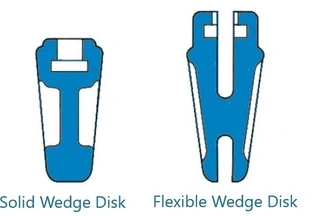
1. Integral Structure of the Solid Wedge Gate Valve
A solid wedge gate valve uses a one-piece integral gate disc structure. The gate is machined from a single piece of metal material, resulting in a simple and robust design. After the valve is installed, the relative position between the gate and the valve seat remains fixed and cannot self-adjust. Since there are no movable flexible components inside the valve, the mechanical structure of the solid wedge gate valve is highly stable and experiences relatively little wear during long-term operation.
The main advantages of the integral gate structure are its high mechanical strength and relatively low manufacturing cost. Under stable operating conditions, this simple and durable structure can provide reliable sealing performance while requiring relatively little maintenance. However, it is precisely this non-adjustable rigid characteristic that limits its ability to adapt to temperature fluctuations and pressure variations.
2. Structural Design of the Flexible Wedge Gate Valve
Although the gate disc of a flexible wedge gate valve is also manufactured as a one-piece metal structure, precision grooves or relief cuts are machined around the outer perimeter of the gate. These grooves are not intended for media flow; instead, they are designed to provide the gate with a limited degree of elastic deformation capability. When the valve closes, the gate can deform slightly, allowing it to conform more effectively to the valve seat surface.
This flexible structure enables the gate to undergo slight compression or bending under the influence of pressure or temperature changes, automatically compensating for minor variations in seat position. As a result, flexible wedge gate valves can achieve more reliable sealing performance in high-pressure applications and systems with significant pressure fluctuations. Furthermore, because the gate possesses a certain degree of self-adjustment capability, these valves are also suitable for applications requiring more frequent flow regulation.
3. Difference Between Flexible Wedges and Split Wedges
It is important to clarify that a flexible wedge gate and a split wedge gate are two completely different structural concepts. A split wedge structure consists of two separate components that achieve sealing through independent movement, whereas a flexible wedge gate always remains a one-piece structure and relies only on precision grooves to achieve elastic deformation. Consequently, flexible wedge structures generally provide higher mechanical strength and better adaptability in high-pressure and cryogenic applications.
Comparison of Operating Performance & Sealing Characteristics
The structural differences between these valve types directly determine their operating performance and sealing characteristics. The sealing behavior of solid wedge gate valves, the sealing advantages of flexible wedge gate valves, and the performance of both types under high-pressure and pressure-fluctuating conditions are three critical aspects that must be considered during valve selection.
1. Sealing Characteristics of Solid Wedge Gate Valves
The sealing performance of a solid wedge gate valve depends heavily on maintaining an ideal geometric relationship between the valve body, valve seat, and gate disc. Under stable operating conditions, the integral gate structure can provide stable sealing performance, and in certain applications, the sealing capability can be extremely effective. Due to its rigid and robust structure, this valve type performs well in systems where pressure changes are minimal and operating conditions remain relatively constant.
However, rigid sealing structures have very low tolerance for geometric deviations. If the valve body or gate deforms because of temperature changes, or if the seat position shifts slightly, the gate cannot automatically adjust its orientation to accommodate these changes. As a result, sealing performance may deteriorate.
2. Sealing Advantages of Flexible Wedge Gate Valves
Because the gate of a flexible wedge gate valve can deform elastically, it can achieve better contact with the valve seat during closure. Even if the seat surface has slight irregularities or the valve components experience minor deformation due to mechanical stress, the flexible gate can compensate through limited deformation and maintain an effective seal.
This self-compensating capability allows flexible wedge gate valves to maintain reliable sealing even when the valve seat undergoes minor deformation or positional deviation. For applications where strict prevention of media leakage is essential, this characteristic is particularly valuable.
3. Performance Under Different Pressure
In high-pressure systems, flexible wedge gate valves can withstand substantial pressure shocks without being easily damaged. The flexible structure of the gate helps absorb impact loads caused by pressure fluctuations, thereby reducing fatigue damage to mechanical components. By contrast, when pressure changes rapidly, solid wedge gate valves may experience uneven contact stress distribution between the gate and the seat, which can lead to localized wear or sealing failure.
Effects of Temperature Changes on Two Wedge Gate Valves
Temperature variation is one of the most important factors affecting the operational reliability of gate valves. The causes of thermal binding, sealing leakage caused by thermal deformation, and the ability of flexible structures to absorb thermal stress together form the core of how temperature affects these two valve types.
1. Causes of Thermal Binding
Thermal binding is one of the most common problems encountered with solid wedge gate valves under changing temperature conditions. When the valve operates in either low-temperature or high-temperature environments, the valve body and gate expand or contract at different rates due to differences in mass and structural geometry. In cryogenic conditions, the valve body may shrink at a different rate than the gate, causing the gate to become tightly jammed after closure.
Once thermal binding occurs, the valve may no longer open normally. In field operations, operators sometimes resort to using extension bars or excessive force to reopen the valve. This not only increases operational risks but may also damage the actuator, valve stem, or sealing surfaces, potentially causing more severe equipment failure.
2. Sealing Leakage and Thermal Deformation
In addition to thermal binding, temperature changes may also lead to sealing leakage. When a valve remains open during cooling, the valve seat contracts as the temperature decreases. When the valve is subsequently closed, the rigid gate may no longer align precisely with the contracted seat, resulting in gaps between the gate and seat and causing internal leakage.
Under high-temperature operating conditions, thermal expansion can also disrupt the original sealing geometry. Once the temperature exceeds a certain range, the disadvantages of rigid structures become increasingly evident, and sealing reliability may decrease significantly.
3. How Flexible Structures Absorb Thermal Stress?
The relief groove design of flexible wedge gate valves can effectively absorb thermal stress generated by temperature changes. When the valve body contracts under cryogenic conditions, the flexible gate can adapt to dimensional changes through slight deformation, preventing the gate from becoming jammed inside the valve body. Likewise, under high-temperature expansion conditions, the gate can release thermal stress through limited deformation while maintaining proper contact with the valve seat.
This buffering capability enables flexible wedge gate valves to maintain reliable operating performance in cryogenic service, high-temperature steam systems, and applications involving frequent thermal cycling. For this reason, many cryogenic gate valve manufacturers widely adopt flexible wedge structures to reduce common low-temperature failure problems.
Applicable Service Conditions and Industrial Applications
Based on the performance differences discussed above, these two types of gate valves have developed distinct application ranges. Selection requirements for cryogenic and high-temperature systems, the economical choice for stable ambient-temperature service, and standard solutions for frequent thermal cycling applications are three key scenarios that guide practical valve selection.
1. Requirements for Cryogenic and High-Temperature Systems
In cryogenic media transportation systems, such as liquefied natural gas (LNG) and liquid nitrogen applications, flexible wedge gate valves have become an industry standard. The operating temperatures in these systems are extremely low, and thermal contraction effects are significant, making rigid structures highly susceptible to thermal binding. Flexible wedge gate valves effectively prevent such problems and ensure safe system operation.
For high-temperature steam systems, particularly those operating above 450°C, flexible wedge gate valves also offer significant advantages. Elevated temperatures cause expansion of valve body materials, and the compensating capability of the flexible gate allows the valve to adapt to these changes while maintaining sealing performance and ensuring reliable opening and closing.
2. Economical Choice for Stable Ambient-Temperature Service
In ordinary utility systems such as ambient-temperature water supply pipelines, where pressure, temperature, and flow conditions remain stable over long periods, solid wedge gate valves remain an economical and practical option. Due to their simple structure and lower manufacturing cost, these valves can provide reliable sealing performance with minimal maintenance requirements when temperature variation is not a major concern.
For projects with limited budgets and relatively simple operating conditions, selecting solid wedge gate valves can reduce procurement costs while still meeting functional requirements. However, this approach is only appropriate if it can be confirmed that the system will not experience significant temperature fluctuations or thermal cycling throughout its service life.
3. Solution for Frequent Thermal Cycling Applications
In batch processing systems and other applications involving frequent startup and shutdown cycles or alternating hot and cold conditions, the system repeatedly experiences heating and cooling processes. Such thermal cycling continuously causes expansion and contraction of valve components, imposing repeated stress on rigid structures. Because flexible wedge gate valves possess flexible compensation capability, they are better suited to adapt to these dynamic conditions and have therefore become the standard configuration for such applications.
Cost, Maintenance, and Long-Term Reliability
Valve selection decisions should consider not only technical performance but also economic factors. The balance between procurement cost and operating cost, maintenance requirements and failure risk, and long-term economic benefits are the core dimensions for evaluating the value of these two valve types from a lifecycle perspective.
1. Balancing Procurement Cost and Operating Cost
In terms of initial purchase price, solid wedge gate valves are generally slightly less expensive than flexible wedge gate valves. This initial cost advantage makes solid wedge valves attractive for certain non-critical applications. However, economic evaluation should not focus solely on purchase price; it should also consider the total operating cost throughout the valve’s service life.
The losses associated with a single thermal binding incident—including downtime, repair expenses, safety risks, and potential equipment replacement costs—often far exceed the initial savings achieved through lower procurement costs. Therefore, selecting a solid wedge gate valve for critical industrial applications solely based on price is often not economically justified.
2. Maintenance Requirements and Failure Risks
In practice, maintenance requirements largely depend on how well the valve structure matches the operating conditions. Even if the initial purchase cost is low, an improperly matched valve may later generate high maintenance expenses and downtime risks due to thermal binding, unstable sealing performance, or frequent repairs.
Because flexible wedge gate valves can prevent stem damage and actuator failure caused by thermal binding in thermal cycling applications, they often require less maintenance in such environments. Conversely, under stable operating conditions, the simpler structure of solid wedge gate valves can also provide reliable operation with relatively low maintenance complexity.
3. Long-Term Economic Benefit Analysis
From a long-term operational perspective, the reliability advantages of flexible wedge gate valves in demanding service conditions can translate into substantial economic benefits. Reduced unplanned downtime, lower maintenance frequency, and extended equipment service life all contribute to the higher overall value of flexible wedge gate valves in critical applications. For ordinary ambient-temperature pipelines, the simpler structure of solid wedge gate valves may result in lower maintenance investment and long periods of trouble-free operation.
Gate Valve Selection Decision Guide
After understanding the structural differences, performance characteristics, service applications, and economic considerations, it is necessary to establish a systematic selection methodology. Evaluating the stability of operating conditions, understanding relevant industry standards and quality requirements, and avoiding common selection mistakes are three key elements in the decision-making process.
1. Key Factors for Evaluating Operating Condition Stability
The first step in valve selection is accurate evaluation of service conditions. Important considerations include whether the system experiences temperature fluctuations, whether frequent thermal cycling occurs, whether pressure remains stable, whether the valve requires frequent flow regulation, and whether pipeline deformation is possible.
If system pressure, temperature, and internal valve geometry can remain stable over long periods, a solid wedge gate valve is often a straightforward and practical choice. However, if the system experiences significant thermal cycling, frequent startup and shutdown, or major temperature changes, a flexible wedge gate valve is generally the better option.
2. Relevant Industry Standards and Quality Requirements
When selecting industrial gate valves, it is important to ensure that the products comply with relevant industry standards. For steel gate valves, reference can be made to the American Petroleum Institute API 600 standard; for forged steel valves, API 602 may be used as a reference. These standards establish clear requirements for valve design, materials, manufacturing, and testing, helping users identify reliable products.
Valves manufactured in accordance with recognized standards undergo rigorous verification of structural strength, sealing performance, and durability, ensuring that they can deliver expected performance within specified operating conditions. Regardless of whether a flexible wedge or solid wedge structure is selected, product quality and compliance remain fundamental requirements.
3. Common Selection Mistakes and Recommendations
A common engineering mistake is selecting a solid wedge structure in applications where a compensating flexible wedge structure should have been used. Such selection errors often result in operational difficulties caused by thermal deformation, seat displacement, or problems reopening the valve after closure.
The key issue in valve selection is not which valve technology is more advanced, but whether the operating conditions can remain stable throughout service. For critical industrial applications, flexible wedge structures are no longer merely optional configurations; they have become standard solutions for ensuring operational reliability. Users are therefore advised to thoroughly analyze service conditions during valve selection and consult professional manufacturers or engineers when necessary to avoid operational problems caused by improper valve selection.
Conclusion
The differences between flexible wedge gate valves and solid wedge gate valves extend far beyond structural design and directly affect valve performance under real operating conditions. With their simple and robust construction, solid wedge gate valves offer excellent economy and reliability in stable ambient-temperature applications. Flexible wedge gate valves, on the other hand, demonstrate clear advantages in systems involving temperature fluctuations, pressure variations, and thermal cycling through their ability to provide flexible compensation.
Proper valve selection should always be based on an accurate evaluation of operating conditions while comprehensively considering procurement cost, operational risk, and maintenance requirements. Only by matching the valve type to the actual application can long-term safety, reliability, and economic efficiency be achieved.
Send your message to this supplier
Related Articles from the Supplier
Differences Between Plug Valves and Butterfly Valves
- May 14, 2026
Use and Difference of R and G Pipe Threads
- Dec 14, 2024
Related Articles from China Manufacturers



Related Products Mentioned in the Article

Zhejiang Kosen Valve Co., Ltd.
- https://www.kosenvalve.com/
- Business Type: Industry & Trading, Manufacturer,
Supplier Website
Source: https://www.kosenvalve.com/media-hub/differences-between-flexible-wedge-and-solid-wedge-gate-valves.html