
Differences Between Single-Plate and Double-Plate Check Valves
In industrial piping systems, the check valve is a widely used automatic valve whose core function is to ensure that the medium flows in only one direction, preventing backflow that could damage critical equipment such as pumps and compressors. Whether in water treatment, petrochemical processing, power generation, or HVAC systems, the selection of check valves is directly related to system efficiency, operational safety, and maintenance costs.
Among various types of check valves, single-plate check valves and double-plate check valves are the two most common structural forms in industrial applications. Because they often appear similar in external appearance, engineers may easily confuse them during selection, which can lead to excessive pressure loss, severe water hammer effects, or increased maintenance frequency.
This article systematically analyzes the core differences between single-plate and double-plate check valves from the perspectives of structural principles, performance characteristics, application scenarios, maintenance costs, and material standards, providing clear and practical guidance for engineering selection.
Detailed Explanation of Wafer-Type Check Valves
In practical engineering communication, the concepts of “single-plate/double-plate” and “wafer type” are often intertwined. In fact, “wafer type” refers to a specific installation method. It can be combined with either single-plate or double-plate internal structures.
1. Basic Characteristics of Wafer Check Valves
A wafer check valve is a compact, space-saving non-return valve typically installed between two flanges. Compared with traditional swing check valves, wafer check valves are more lightweight in structure, occupy less installation space, and use fewer materials, thereby reducing overall cost. Their faster response to flow direction changes and compatibility with multiple international flange standards make them widely used in modern industrial piping systems, especially in applications requiring compact design and high system efficiency.
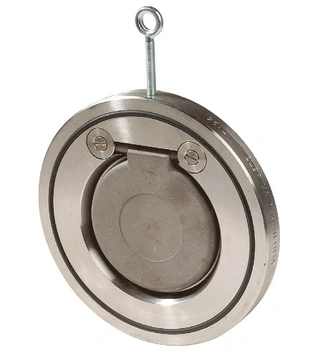
2. Single-Plate Wafer Check Valve
The single-plate wafer check valve adopts a single circular disc structure connected through a hinge pin. When the medium flows in the forward direction, the disc opens; when flow stops or reverse pressure occurs, the disc returns to the seat by gravity or backflow pressure, achieving non-return functionality.
This design is characterized by simplicity, fewer components, and easy maintenance. It is typically manufactured from cast iron, ductile iron, carbon steel, or stainless steel. Single-plate wafer check valves are mainly used in horizontal installations and can also be applied in certain vertical pipelines. They are commonly found in water supply networks, HVAC systems, irrigation systems, and fire protection pipelines.
3. Double-Plate Wafer Check Valve
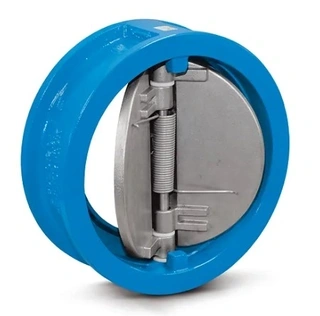
The double-plate wafer check valve uses two semi-circular discs controlled by a central hinge and spring mechanism. When the medium flows forward, the two discs open; when flow decreases or reverses, the spring quickly forces the discs to close.
Compared with the single-plate structure, the double-plate wafer check valve offers faster response, lower pressure loss, and stronger water hammer suppression. Its flow path design allows the medium to pass smoothly through the center, making it more efficient in high-flow and high-pressure systems. It can also be installed in both horizontal and vertical pipelines, making it suitable for complex or space-limited piping layouts. It is widely used in oil and gas pipelines, power systems, chemical processing, offshore engineering, and high-pressure pumping stations.
Structure and Characteristics of Single-Plate Check Valves
After understanding the fundamental differences between single and double plate designs, this section provides a deeper analysis of the single-plate check valve. This long-established valve structure remains widely used due to its simplicity and reliability.
1. Single-Plate Check Valve Structure and Working Principle
The single-plate check valve, also known as a swing check valve, consists of a single disc connected via a hinge pin. When fluid flows in the correct direction, inlet pressure exceeds outlet pressure, pushing the disc open and allowing flow. When flow stops or reverses, the disc falls back onto the seat due to gravity or backpressure, preventing reverse flow.
This simple structure relies on differential pressure at both ends of the valve to complete opening and closing actions, with relatively few moving parts.
2. Single-Plate Check Valve Advantages and Limitations
The main advantages of the single-plate check valve are its simple structure, stable operation, and high reliability. With fewer components, the probability of mechanical failure is low, resulting in good durability during long-term operation. Additionally, its manufacturing cost is relatively low, making it suitable for budget-sensitive projects.
However, it also has clear limitations. The disc requires a certain amount of time to complete opening and closing, resulting in slower response speed. In some operating conditions, the slow closing process may cause water hammer effects, impacting pipeline systems. Furthermore, the single disc partially obstructs the flow path, resulting in relatively higher pressure loss.
3. Typical Applications for Single-Plate Check Valve
Single-plate check valves are suitable for medium to low flow systems or cost-sensitive applications. In water treatment systems, they are commonly installed at pump outlets to prevent backflow. In oil and gas pipelines, they help maintain one-way flow and protect critical equipment. In HVAC systems, they prevent refrigerant backflow and ensure system efficiency.
They are also widely used in sanitary process pipelines in the food and beverage industry to ensure safe and stable fluid transport. Due to their simple structure and easy maintenance, they are extensively used in basic industrial facilities.
Structure and Characteristics of Double-Plate Check Valves
Unlike the simplified design philosophy of single-plate valves, double-plate check valves adopt a more refined dual-disc structure to handle more demanding operating conditions. The following sections explain their design advantages and performance benefits.
1. Double-Plate Check Valve Structure and Working Principle
The double-plate check valve, also known as a dual-plate or wafer-type check valve, consists of two semi-circular discs mounted on a central hinge. When fluid flows forward, the two discs open like butterfly wings. When flow direction changes or decreases, the spring mechanism rapidly forces the discs to close, achieving quick shutoff.
Compared with single-plate designs, the flow path is more optimized, allowing smoother passage of the medium through the central region.
2. Double-Plate Check Valve Advantages and Limitations
The key advantages of double-plate check valves include fast response, low pressure drop, and strong water hammer resistance. The spring-assisted mechanism allows rapid closure at the moment of flow reversal, effectively reducing backflow impact.
The optimized flow path reduces resistance, lowering energy consumption and equipment wear in pumping systems. Additionally, the dual-plate structure distributes stress more evenly, ensuring smoother operation.
However, its structure is more complex, with more moving parts. The initial procurement cost is higher than that of single-plate valves. In corrosive or abrasive media conditions, the spring mechanism may require more frequent maintenance.
3. Typical Applications for Double-Plate Check Valve
Double-plate check valves are suitable for systems requiring fast response and low pressure drop. In petrochemical high-pressure pipelines, they prevent backflow and contamination. In power plants, they protect boiler feedwater and steam systems. In mining slurry transport systems, their compact structure and reliability perform well under complex conditions.
They are also widely used in offshore platforms and refinery units where space is limited. In systems with frequent flow changes or high safety requirements, their rapid closing performance is particularly important.
Comparison Between Single-Plate and Double-Plate Check Valves
Based on the structural analysis above, we now compare the two valve types across key engineering performance indicators.
1. Pressure Loss and Flow Efficiency
Single-plate check valves have higher pressure loss due to the larger obstruction caused by the single disc. In contrast, double-plate check valves allow flow through the central region with a more streamlined path, significantly reducing pressure drop and improving system efficiency.
In pumping systems, lower pressure loss translates into reduced energy consumption and less equipment wear, providing long-term energy-saving benefits.
2. Response Speed and Water Hammer Protection
Single-plate check valves rely mainly on gravity for closing, resulting in slower response and potentially stronger water hammer effects. Double-plate check valves, assisted by springs, achieve rapid closure at the moment of flow reversal, significantly reducing water hammer risk and improving system safety.
In systems with frequent flow fluctuations, fast response helps prevent damage to pipelines and equipment.
3. Installation Flexibility and Space Requirements
Single-plate check valves have stricter installation requirements and are generally more suitable for horizontal installation. Double-plate check valves are more compact and flexible, suitable for both horizontal and vertical installation.
In space-constrained environments such as offshore platforms, ships, or densely packed industrial facilities, the compact design of double-plate valves provides a significant advantage.
Selection, Maintenance, and Cost Analysis
Performance comparisons provide theoretical guidance, but engineering decisions must ultimately consider real operating conditions, budget constraints, and lifecycle costs.
1. Selecting the Appropriate Type Based on Operating Conditions
Selection should consider fluid characteristics, pressure rating, installation space, and system conditions.
In chemical industries involving corrosive media and requiring fast response, double-plate check valves are generally more suitable. In pharmaceutical systems with low flow and high hygiene requirements, single-plate valves may be preferred.
In water supply networks and HVAC systems, single-plate valves meet basic requirements at lower cost. In oil and gas pipelines and high-pressure pumping stations, double-plate valves are preferred due to their fast closing and low pressure drop.
2. Maintenance Considerations
Single-plate check valves require relatively low maintenance due to their simple structure. Routine checks include hinge pin wear, sealing surface condition, and operational flexibility.
Double-plate check valves require more attention, especially on spring mechanisms and sealing components. In corrosive or abrasive media conditions, more frequent inspection and replacement may be necessary.
Both types should follow regular inspection schedules to detect seal wear and component loosening.
3. Initial Cost vs. Long-Term Operating Cost
Single-plate check valves typically have lower initial costs, making them suitable for basic applications. Double-plate check valves have higher upfront costs but may deliver lower total lifecycle costs due to improved efficiency and reduced energy consumption.
In high-frequency or safety-critical systems, the long-term advantages of double-plate valves become more significant.
Conclusion
Single-plate and double-plate check valves both serve the essential function of preventing reverse flow in industrial piping systems, but they differ significantly in structure and performance.
Single-plate check valves are simple, cost-effective, and easy to maintain, making them suitable for low to medium pressure applications with stable flow conditions. Double-plate check valves offer faster response, lower pressure drop, and superior water hammer suppression, making them ideal for high-pressure, high-flow, space-constrained, or safety-critical systems.
In practical selection, decisions should not be based solely on price or appearance. Instead, engineers should consider fluid properties, system pressure, installation space, operating frequency, and long-term maintenance costs. Proper material selection and compliance with international standards such as API and ASME are also essential to ensure long-term stable operation. Through systematic comparison and rational selection, engineers can choose the most suitable check valve type for different industrial systems, achieving a balance between operational safety, efficiency, and economic performance.
Send your message to this supplier
Related Articles from the Supplier
Differences Between Plug Valves and Butterfly Valves
- May 14, 2026
Use and Difference of R and G Pipe Threads
- Dec 14, 2024
Related Articles from China Manufacturers

Related Products Mentioned in the Article

Zhejiang Kosen Valve Co., Ltd.
- https://www.kosenvalve.com/
- Business Type: Industry & Trading, Manufacturer,
Supplier Website
Source: https://www.kosenvalve.com/media-hub/differences-between-single-plate-and-double-plate-check-valves.html