
Differences Between Forged Steel Valve and Cast Steel Valve
In industrial piping systems, valves serve as critical devices for controlling fluid flow, and their materials and manufacturing processes directly affect the safety and reliability of the entire system. Forged steel valves and cast steel valves are two of the most common valve types. Although both use steel as their primary material, they differ significantly in manufacturing methods, physical properties, and application scenarios. This article provides a multi-dimensional analysis of these differences to help engineering professionals make more informed decisions during valve selection.
The Fundamental Contrast in Manufacturing Processes
To understand the essential differences between these two valve types, it is necessary to examine their production processes in depth. Manufacturing methods not only determine physical characteristics but also directly influence the operational boundaries of each valve in industrial environments.
1. Casting Process: The Art of Liquid Forming
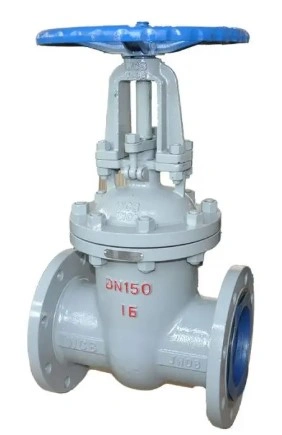
The manufacturing process of cast steel valves belongs to liquid forming technology. Specifically, steel is heated until it melts into molten metal, which is then poured into pre-prepared sand molds or metal molds. After the molten steel cools and solidifies, the valve takes on its preliminary shape. It is subsequently cleaned, polished, and machined to produce the finished valve.
The greatest advantage of this process lies in its ability to manufacture components with complex geometries. Because liquid metal has excellent fluidity, it can fill every corner of the mold. As a result, casting is particularly suitable for producing valves with intricate structures, internal cavities, or irregular shapes. For certain specially shaped valves, forging would present enormous technical challenges and high economic costs, making casting the more practical choice.
2. Forging Process: The Power of Plastic Deformation
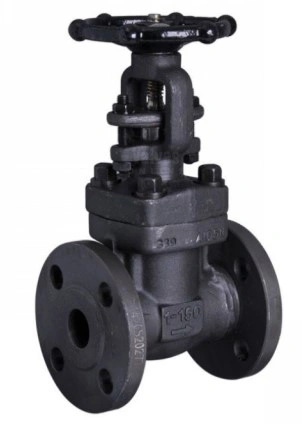
Forged steel valves are produced using an entirely different method, forging. This process begins by heating solid metal raw materials until they reach a plastic state, typically at high temperatures. Massive compressive forces are then applied using forging hammers or presses, causing the metal to undergo plastic deformation and ultimately form the desired valve shape.
Forging is essentially a process of metallic reorganization. Under high temperature and pressure, the internal grain structure of the metal is refined and rearranged, resulting in a denser and more uniform microstructure. Common forging methods include open-die forging, which is suitable for small-batch production, and closed-die forging, which is ideal for manufacturing larger quantities of relatively regular-shaped components.
Material Properties Comparison
Differences in manufacturing processes ultimately manifest in material performance. If casting and forging represent two different birth methods, then density and microstructure reflect the “physical constitution” that emerges over time. This process-to-performance relationship defines the operational limits of each valve under real working conditions.
1. Density Differences: Forged Steel Takes the Lead
The most fundamental distinction between forged steel and cast steel valves is material density. Forged steel typically exhibits significantly higher density, primarily due to the way each process affects the metal’s internal structure.
During casting, molten metal cools from the outside inward, which can lead to defects such as gas pores and shrinkage cavities near the center of the component. These internal voids reduce overall density. In contrast, forging compresses solid metal, effectively eliminating internal gaps and creating a more compact structure. Consequently, forged steel valves feature higher density and tighter material integrity.
2. Internal Structure: Grain Refinement and Uniformity
Forged components demonstrate markedly improved structural strength. As the metal undergoes plastic deformation during forging, coarse grains are broken down and recrystallized into fine, uniform equiaxed grains. This refined grain structure promotes consistent mechanical performance in all directions.
By comparison, cast components are more susceptible to structural segregation, an uneven distribution of alloying elements during solidification that results in variations in chemical composition and material properties. Casting may also introduce defects such as porosity, inclusions, and shrinkage, all of which can negatively affect valve performance.
3. Mechanical Performance: Strength and Toughness Compared
Due to these structural differences, forged steel valves generally outperform cast steel valves in mechanical properties:
Impact toughness: Forged valves can withstand greater impact forces without fracturing, which is especially important during water hammer events or pressure fluctuations.
Plasticity and ductility: Forged steel deforms more effectively under external stress, absorbing energy through plastic deformation rather than failing in a brittle manner.
Pressure strength: Forged valves possess significantly higher pressure resistance, enabling safe operation under more demanding conditions.
Specification Parameter Differences
Material superiority is ultimately reflected in specification parameters. Variations in density and structure not only determine intrinsic performance but also define manufacturing boundaries; how large a valve can be produced and how much pressure it can withstand. These practical engineering considerations are the direct result of the interaction between material and process.
1. Nominal Diameter Limitations
Forged and cast steel valves differ noticeably in size range. Forged steel valves typically have smaller nominal diameters, generally below DN50. This limitation arises because forging demands far more from equipment and tooling than casting. Producing large-diameter forged valves requires ultra-large forging machinery, resulting in substantial investment and technical complexity that significantly increase both cost and production barriers.
Casting, on the other hand, has a natural advantage in manufacturing large-diameter valves. With properly designed molds, valves exceeding DN50, and even reaching DN1000 or larger, can be produced relatively easily.
2. Pressure Rating Classification
Pressure rating is another key differentiator. Due to material and process constraints, cast steel valves are typically used in medium- to low-pressure applications, with common nominal pressure ratings such as PN16, PN25, PN40, or ANSI Class 150–900.
Forged steel valves are primarily designed for high- and ultra-high-pressure systems, with typical ratings including PN100, PN160, PN320, and ANSI Class 1500–3500. This high-pressure capability makes forged steel valves the preferred choice for critical systems.
Appearance Characteristics and Leak Prevention Performance
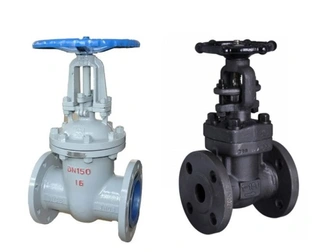
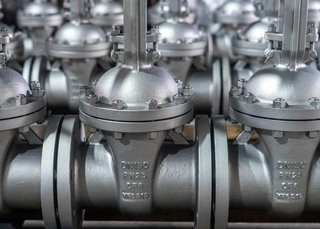
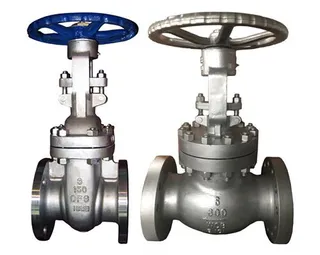
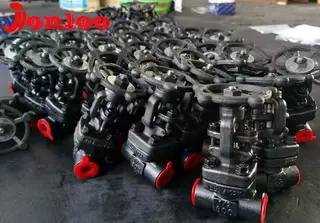
Visual Identification: In practice, experienced technicians can often distinguish between the two valve types by appearance. Cast steel valves usually present a silver-white color with a relatively rough surface, whereas forged steel valves tend to appear dark gray with a smoother, more refined finish. These differences stem from variations in surface treatment and material density.
Sealing Performance Comparison: Leak prevention is a vital performance indicator for any valve. Casting processes can produce defects such as sand holes and porosity, which may become potential leakage paths. As a result, cast steel valves generally offer weaker leak resistance compared to forged alternatives. Integral forged valves perform particularly well in this regard. Because the valve body and flanges are forged as a single piece, there are no parting lines or pouring gates typical of casting. The continuity of the material significantly enhances leak prevention, surpassing even standard forged valves, let alone cast steel ones. For this reason, forged steel valves are widely used in industries with extremely stringent leakage requirements, such as natural gas transmission, petroleum extraction, and chemical production.
Application Scenarios and Industry Selection
The true comparison between forged and cast steel valves becomes evident in real engineering environments. One faces the extreme conditions of high-pressure oil and gas wells, while the other operates within routine municipal pipeline systems. One handles highly toxic media where zero leakage is mandatory; the other supports cost-sensitive, high-flow water distribution networks. These diverging application scenarios allow each valve type to excel in its own domain.
1. Primary Applications of Forged Steel Valves
Thanks to their superior mechanical properties and pressure resistance, forged steel valves are commonly used in demanding environments:
- Oil and gas industry: High-pressure wells, long-distance pipelines, and refineries where high pressure, temperature, and corrosive media are common.
- Power generation: Especially steam systems in thermal and nuclear power plants, which require exceptional strength and heat resistance.
- Chemical industry: High-pressure reactors, ammonia synthesis units, and high-pressure polyethylene plants.
- Aerospace and defense: Critical control systems that demand extremely high material reliability and consistency.
2. Suitable Applications for Cast Steel Valves
Although cast steel valves may not match forged valves in performance metrics, they offer irreplaceable advantages in certain scenarios:
- Water treatment systems: Including municipal water supply and wastewater plants, where pressures are moderate but valve diameters are large.
- General industrial pipelines: Systems carrying water, air, or steam at normal temperatures and pressures. PN16–PN25 cast valves typically meet operational needs at a lower cost.
- Complex-structure valves: Such as three-way valves, four-way valves, and butterfly valves, where casting simplifies the production of complicated geometries.
- HVAC systems: Heating and cooling infrastructure in buildings, where lower pressures and strict cost control make cast steel valves a practical choice.
Selection Principles
In practical engineering applications, it is incorrect to assume that forged steel valves are always superior to cast steel valves. Instead, selection should be based on a comprehensive evaluation of working conditions:
- Pressure rating first: If system pressure exceeds PN40 or Class 600, forged steel valves should be prioritized; cast steel valves are suitable for medium- and low-pressure systems (PN16–PN40).
- Valve diameter: Choose forged steel for high-pressure applications below DN50; select cast steel for medium- to low-pressure systems above DN50.
- Medium characteristics: When transporting flammable, explosive, toxic, or hazardous media, forged valves are recommended for better sealing, even if pressure is not high.
- Temperature conditions: For high-temperature environments (above 400°C), forged steel valves are preferable due to superior structural stability.
- Cost considerations: When performance requirements are satisfied, economic efficiency should be carefully evaluated to avoid overdesign.
- Maintenance convenience: Cast steel valves are less expensive to replace after failure and suit non-critical locations, whereas forged steel valves should be installed in key positions requiring higher reliability.
Conclusion
Forged steel valves and cast steel valves each possess distinct advantages and application ranges. Forged steel valves achieve higher density, improved mechanical performance, and superior sealing through the forging process, making them ideal for high-pressure, high-temperature, and high-reliability environments. However, they are typically limited to smaller sizes and come at a higher cost due to manufacturing complexity. Cast steel valves, by contrast, excel at producing complex shapes and large diameters at a lower cost, making them well suited for medium- to low-pressure industrial applications. In real-world engineering practice, technical professionals should select valve types based on factors such as pressure rating, medium characteristics, temperature conditions, diameter requirements, and budget constraints. Only through context-sensitive and well-informed selection can system safety and reliability be ensured while maximizing economic benefits. Whether forged or cast, the correct choice and proper application of valves remain fundamental to the long-term stable operation of industrial piping systems.
Send your message to this supplier
Related Articles from the Supplier
Differences Between Plug Valves and Butterfly Valves
- May 14, 2026
Use and Difference of R and G Pipe Threads
- Dec 14, 2024
Related Articles from China Manufacturers



Related Products Mentioned in the Article

Zhejiang Kosen Valve Co., Ltd.
- https://www.kosenvalve.com/
- Business Type: Industry & Trading, Manufacturer,
Supplier Website
Source: https://www.kosenvalve.com/media-hub/differences-between-forged-steel-valve-and-cast-steel-valve.html