
Forging vs. CNC Machining: A Selection Guide
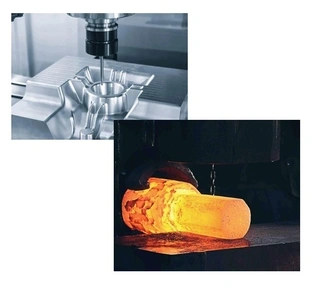
In manufacturing, the processing method of components directly determines product performance, service life, and production cost. Forging and CNC machining are two of the most widely used processes today, representing two different technical routes: “material reshaping” and “subtractive manufacturing.” This article provides a systematic comparison from the perspectives of process principles, performance characteristics, cost structure, and application scenarios, helping you make a reasonable process selection of metal forging and CNC machining based on actual requirements.
Basic Concepts of the Two Manufacturing Processes
Before comparing the advantages and disadvantages of forging and CNC machining, it is necessary to clearly understand their definitions, working methods, and fundamental differences. This is the foundation for any process selection decision.
1. What is Forging?
Forging is a metal forming process in which a metal billet is heated until it reaches a plastic state and then shaped under pressure or impact force. The metal is compressed and formed at high temperatures using methods such as open-die forging, closed-die forging, and impression die forging. With technological development, power hammers and hydraulic presses have replaced manual forging, leading to more advanced precision forging techniques.
During the forging process, the internal grain structure of the metal is rearranged and optimized under deformation. This results in a denser and more continuous microstructure, significantly improving overall strength, toughness, and fatigue resistance.

2. What is CNC Machining?
CNC (Computer Numerical Control) machining is a subtractive manufacturing process based on computer control. A metal workpiece is fixed on a machine tool, and a pre-programmed system controls the movement of cutting tools to remove excess material layer by layer until the final part shape is achieved. Because it is fully computer-controlled, CNC machining enables complex geometries, high precision, and highly consistent repeatability.

3. Fundamental Difference Between the Two Processes
Forging belongs to “material reshaping,” where external force changes the shape of the metal while optimizing its internal grain structure. CNC machining belongs to “subtractive manufacturing,” where material is removed to achieve the desired shape.
Advantages and Limitations of Forging
As a metal forming technology with thousands of years of history, forging still plays an important role in modern manufacturing. Its suitability must be evaluated from three perspectives: material performance, cost input, and geometric limitations.
1. Main Advantages of Forging
The core advantage of forging lies in material performance. Forged parts have higher strength, toughness, and fatigue resistance because the forging process improves the grain flow direction and makes the internal structure more uniform and dense. Therefore, forged components are suitable for high-stress, high-impact, and heavy-load conditions, such as bolts, shafts, and heavy machinery parts.
From the perspective of material utilization, forging reshapes material through plastic deformation and produces minimal cutting waste, resulting in relatively high material efficiency. Forged parts are widely used in aerospace, automotive manufacturing, and heavy equipment industries where reliability is critical.
2. Limitations of Forging
Forging also has several limitations. First, tooling cost is relatively high because dedicated dies are required at the initial production stage, leading to significant upfront investment. Second, forged parts typically have rougher surface finishes and cannot easily achieve high precision or smooth surfaces, often requiring secondary machining. In addition, forging has limitations in terms of part complexity and size; extremely intricate geometries are difficult to form directly.
Advantages and Limitations of CNC Machining
Unlike the “reshaping” concept of forging, CNC machining represents the direction of modern digital manufacturing. Its high precision and flexibility make it indispensable for precision engineering and small-batch production, although it also comes with material waste and higher equipment costs.
1. Main Advantages of CNC Machining
CNC machining offers extremely high precision and flexibility, especially suitable for manufacturing complex-shaped components. Since it is fully computer-controlled, it provides stable and highly repeatable production, making it advantageous for single-piece production, small batches, and multi-variety manufacturing.
CNC machining can produce parts with complex internal structures, threaded holes, and sharp features that are difficult to achieve through forging. In addition, CNC-machined parts generally have high surface finish quality and excellent dimensional consistency, making them widely used in precision engineering. CNC equipment is also commonly used to manufacture forging dies themselves.
2. Limitations of CNC Machining
The main disadvantage of CNC machining is low material utilization. As a subtractive process, it generates a significant amount of metal waste, increasing overall cost. In addition, machining time is generally longer than forging, making it less efficient for large-scale production. CNC equipment is also complex and requires higher maintenance and operating costs, including tool wear, lubrication system maintenance, and general machine upkeep.
Comprehensive Comparison of the Two Processes
After understanding their respective strengths and weaknesses, the two processes can be compared directly under the same evaluation criteria, including material performance, precision capability, production efficiency, and material applicability.
1. Material Performance and Strength
From a material performance perspective, forging significantly improves mechanical properties. During forging, metal grains flow and align along stress directions, enhancing strength, toughness, and fatigue resistance. This makes forged components especially suitable for aerospace, automotive, and heavy-load structural applications.
CNC machining, while excellent in dimensional accuracy, does not alter the internal structure of the material. Therefore, the strength of machined parts depends entirely on the base material itself and does not benefit from structural reinforcement.
2. Precision and Geometric Complexity
In terms of precision and complexity, CNC machining has a clear advantage. It can achieve extremely high dimensional accuracy and produce complex geometries, including micro-features, curved surfaces, and precise hole positions, which are difficult to form directly through forging.
Forging is more suitable for parts with relatively simple shapes but high strength requirements. Complex geometries usually require additional machining after forging for finishing and correction.
3. Production Efficiency and Cost
In terms of cost and efficiency, forging is more suitable for mass production. It offers high material utilization and low waste, resulting in lower unit cost in large-scale manufacturing. However, forging requires die design and manufacturing, which leads to higher initial investment and longer preparation cycles.
CNC machining does not require complex tooling, making it more cost-effective for small batches or prototype production. However, due to its subtractive nature, it generates more waste and has longer processing times, making it less economical for large-scale production.
4. Material Compatibility
Forging is mainly suitable for metals such as steel, aluminum, and titanium, where mechanical properties can be significantly improved through deformation processes.
CNC machining has a much broader range of applicability. It can process not only metals but also plastics, composites, and other engineering materials, making it more versatile across industries.
How to Choose the Right Manufacturing Process?
Theoretical comparisons ultimately serve practical applications. For a specific component requirement, how should one balance strength, precision, production volume, and budget?
1. Selection Based on Performance Requirements
When a component requires high tensile strength, durability, and toughness, forging is generally the better choice. It enhances internal structure density and improves mechanical strength, making it suitable for high-load and high-impact environments.
CNC machining is more suitable for high-precision manufacturing, especially for parts requiring tight tolerances. It is also ideal for small-batch or customized production. In addition, CNC machining enables lightweight structural designs.
If a part must withstand heavy loads, impacts, or extreme conditions, forging is usually preferred. If it requires high precision, complex geometry, or customization, CNC machining is more suitable.
2. Selection Based on Production Scale
For large-scale production, forging is usually more economical due to high material efficiency and low unit cost. For small batches or development stages, CNC machining offers greater flexibility and lower initial cost since no tooling is required.
3. Comprehensive Consideration
In real-world applications, selection should consider multiple factors such as application requirements, structural complexity, precision needs, production volume, and budget. Both forging and CNC machining are widely used in automotive, aerospace, oil and gas, and heavy machinery industries, where proper selection significantly impacts final product quality.
Hybrid Process: Forging Plus CNC Machining
In modern manufacturing, forging and CNC machining are not mutually exclusive. Increasingly, high-end components adopt a “forging first, machining later” hybrid approach that combines the strengths of both processes.
1. Advantages of the Hybrid Process
In many industrial applications, a combination process is used: forging is first applied to produce a high-strength blank, followed by CNC machining for precision dimensions and surface quality. This approach meets both strength and accuracy requirements and has become a common solution in advanced manufacturing.
2. Application Scenarios
This hybrid process is especially suitable for components requiring both high strength and high precision. Examples include aerospace engine parts, automotive transmission components, and valves and connectors in the oil and gas industry. Forging provides a strong mechanical foundation, while CNC machining ensures dimensional accuracy and surface finish, enabling reliable performance under demanding operating conditions.
Conclusion
Forging and CNC machining each have distinct advantages and are suitable for different engineering requirements. Forging is more appropriate for large-scale structural components that require high strength, toughness, and durability, as it significantly improves internal material structure. CNC machining is better suited for high-precision, complex-shaped, and small-batch customized parts, offering excellent dimensional control and design flexibility.
In practical engineering projects, the choice between these two processes should be based on multiple factors, including performance requirements, structural complexity, production scale, and cost constraints. At the same time, the hybrid “forging + CNC finishing” process provides an effective solution that balances strength and precision for high-end manufacturing.
Understanding the fundamental differences in principles, advantages, and application scenarios helps make more accurate manufacturing decisions, ultimately ensuring product quality while optimizing economic efficiency.
Send your message to this supplier
Related Articles from the Supplier
Forging vs. CNC Machining: A Selection Guide
- May 27, 2026
Aluminum Forging vs. Steel Forging
- Apr 10, 2024
Free Forging vs. Die Forging Processing Methods
- Dec 18, 2024

Related Articles from China Manufacturers
Hot Forging vs. Cold Forging
- May 02, 2024
Method of Cooling Forgings in Forging Factory
- Jul 16, 2024
Features of Aluminum Alloy Forgings
- Apr 01, 2015
Manufacturing Process of Cylindrical Forgings
- Jan 21, 2026
Quality Inspection of Shaft Forgings
- Feb 05, 2026
Related Products Mentioned in the Article

Supplier Website
Source: http://www.creatorcomponents.com/news/forging-vs-cnc-machining-a-selection-guide.html