Aluminum Alloy Forging vs. Casting: Process Selection
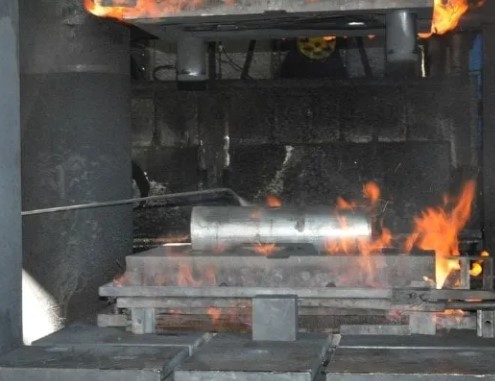
Aluminum alloys are widely used in industries such as aerospace, automotive manufacturing, and construction due to their excellent properties, including low weight, high strength, and strong corrosion resistance. As an important representative of non-ferrous metal materials, the processing technology used for aluminum alloys directly affects the final performance of the product. At present, aluminum alloy forming mainly relies on two process routes: forging and casting. These two methods differ significantly in principles, techniques, and application scenarios.
Forging changes the shape and internal structure of materials through solid-state plastic deformation, whereas casting involves the melting and solidification of the material. Understanding the characteristics and differences between these two processes is crucial for selecting appropriate manufacturing methods, controlling production costs, and ensuring product quality.
- Open-Die Forging: Open-die forging is one of the fundamental methods used in aluminum alloy forging. This process mainly relies on manual or mechanical force to produce local or overall plastic deformation of aluminum alloy ingots or billets. During operation, technicians select suitable forging tools and equipment according to the required shape and dimensions of the forging, applying hammering or compressive forces to shape the material. The main advantages of open-die forging include operational flexibility and strong adaptability, making it particularly suitable for single-piece production, small batches, or large forgings. However, it also has limitations: production efficiency is relatively low, it requires highly skilled operators, and the dimensional accuracy and surface quality of the forgings are generally inferior to those produced by die forging.
- Die Forging: Die forging is one of the most widely used methods in aluminum alloy forging. In this process, precisely manufactured dies shape heated aluminum alloy materials. Through accurate die design, complex parts with precise dimensions can be produced. The key factor in die forging is the design and manufacturing of the dies. Designers must consider material flow behavior, deformation resistance, and die wear resistance. Compared with open-die forging, die forging offers higher production efficiency, better product quality, and superior dimensional accuracy, making it particularly suitable for mass production. In the aerospace industry, high-performance components such as aircraft structural parts and engine components are commonly manufactured using die forging.
- Extrusion Forging: Extrusion forging is a specialized method that uses extrusion presses to plastically deform aluminum alloy materials. During the process, aluminum billets are heated to an appropriate temperature and then forced through die openings under high pressure, causing plastic flow and forming specific cross-sectional shapes. Extrusion forging can produce profiles and tubes with complex cross-sections, such as architectural aluminum profiles and industrial tubing. Its major advantages include high production efficiency, excellent material utilization, dense internal structure, and superior mechanical properties. However, the process requires large specialized equipment and involves significant initial investment, as well as skilled operators.
- Continuous Forging: Continuous forging is an efficient automated forging method that enables uninterrupted processing of aluminum alloys through continuous feeding and forming operations. In a continuous forging production line, heated aluminum materials are automatically fed into forging machines for forming. The greatest advantage of continuous forging is its high production efficiency and stable product quality, making it highly suitable for large-scale standardized manufacturing. Many aluminum alloy components used in modern automobile manufacturing are produced through continuous forging processes to meet strict requirements for consistency and production efficiency.
Although aluminum alloy forging includes multiple methods, it also presents various technical challenges in practical production. Due to the physical and chemical characteristics of aluminum alloys, their forging processes differ significantly from those used for ferrous metals. Understanding these characteristics is essential for optimizing process parameters, improving product quality, and reducing production costs.
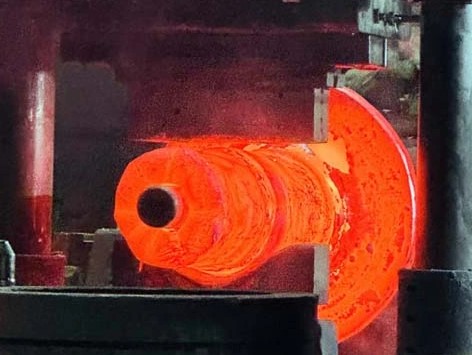
Temperature control is extremely critical in aluminum alloy forging. Most aluminum alloys have a forging temperature range between 350°C and 450°C, with a deformation temperature window often limited to about 100°C, and in some alloys even 50–70°C. Such a narrow temperature window makes forging operations more challenging.
To extend the workable forging time, manufacturers typically heat billets to the upper temperature limit, increase the number of forging heats, and preheat dies and tools to higher temperatures—usually above 300°C. High-precision furnaces and temperature control instruments are essential to avoid overheating, which could deteriorate the material structure.
Aluminum alloys are sensitive to strain rate, which restricts the types of forging equipment that can be used. Equipment with relatively low and stable working speeds is generally preferred. During billet breakdown processes, low-speed compression—often through extrusion or rolling—is required to prevent cracking.
For die forging, aluminum components are usually formed on hydraulic presses or mechanical presses, while impact equipment such as forging hammers is generally avoided. Impact loading may cause internal stress concentration and increase the risk of cracking.
The thermal conductivity of aluminum alloys is approximately three to four times that of steel, which has both advantages and disadvantages. On one hand, billets can be directly placed into high-temperature furnaces without preheating, simplifying the heating process. On the other hand, rapid heat loss from the surface during forging can create significant temperature differences between the surface and the interior, resulting in uneven deformation.
Uneven temperature distribution may cause localized areas to enter critical deformation zones, leading to abnormal grain growth and coarse grain structures. To minimize heat loss, dies and tools that contact the workpiece must be preheated to 300°C or higher.
The friction coefficient between aluminum alloys and steel dies is relatively high, and the material’s flowability during deformation is comparatively poor. This can make metal filling in die forging more difficult. Solutions typically include adding preforming steps, optimizing die design, and increasing die fillet radii.
Aluminum alloys also exhibit strong adhesion to dies during severe deformation, which can cause surface defects such as peeling and warping while accelerating die wear.
Aluminum alloys are relatively sensitive to cracking. Small cracks generated during forging can rapidly propagate during subsequent deformation if not removed in time, ultimately leading to scrap. Therefore, strict monitoring and prompt removal of surface defects are required throughout the forging process.
Forging and casting are both used to manufacture aluminum alloy components, but they differ fundamentally in microstructure, mechanical properties, and application scope.
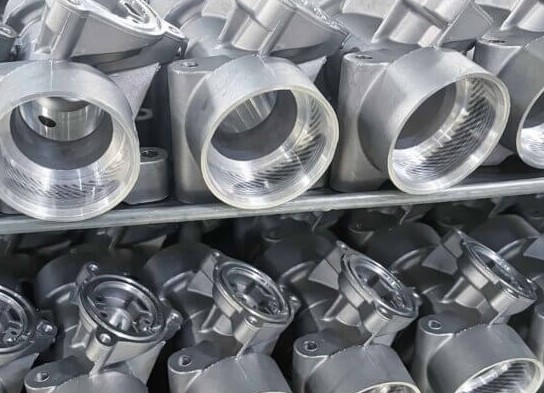
Forging is a solid-state transformation process without liquid-phase transitions. Compared with cast aluminum alloys, forged aluminum alloys offer several advantages:
- Superior mechanical properties: Forged aluminum alloys exhibit higher strength, toughness, and fatigue resistance due to favorable metal flow lines and grain orientation along principal stress directions.
- Better surface quality: Forgings do not contain typical casting defects such as porosity or shrinkage cavities, providing an excellent base for surface treatments such as anodizing or electroplating.
- Higher dimensional accuracy: Precision die forging can produce near-net-shape parts, reducing machining allowance and improving material utilization.
- Higher ductility: Forged aluminum alloys typically achieve elongation values around 14%, demonstrating good plastic deformation capability.
Despite its advantages, forging also has limitations. The process involves multiple stages and requires higher equipment and tooling investments. Extremely complex shapes may be difficult to forge directly and may require additional machining. Forging also requires specialized aluminum alloy billets designed specifically for forging.
Unlike forging, casting forms components through the filling and solidification of molten metal. This principle allows casting to produce parts with more complex geometries while introducing unique process requirements and performance characteristics.
Investment casting is an important method for producing high-precision aluminum alloy castings. The process typically includes the following steps:
- Shell making: Multiple layers of refractory coating are applied to the wax pattern to form a rigid shell after drying.
- Dewaxing: Steam or hot water melts the wax pattern, creating a hollow cavity inside the shell.
- Shell firing: The shell is heated in a furnace to remove residual wax and moisture while improving strength.
- Pouring: Molten aluminum alloy is poured into the shell, and the casting is obtained after cooling and solidification.
- High surface finish: Surface roughness can typically reach Ra 1.6–3.2 μm, better than ordinary sand casting.
- High dimensional accuracy: Investment casting typically achieves CT4–6 accuracy, compared with CT10–13 for sand casting.
Adding alloying elements significantly improves aluminum properties. Small additions (less than 5%) enhance strength or hardenability, while larger additions provide special characteristics such as improved corrosion resistance or high-temperature stability.
Through alloying and heat treatment, cast aluminum alloys can achieve improved strength, hardness, toughness, wear resistance, and corrosion resistance, enabling them to meet demanding application requirements.
- Aerospace: Forged and cast aluminum alloys are widely used in aircraft fuselage structures, engine components, and landing gear systems. High-performance aerospace components with strict material requirements are often manufactured through advanced forging processes.
- Automotive Industry: The trend toward vehicle lightweighting has accelerated the development of aluminum alloy forging and casting technologies. Engine blocks, wheels, suspension components, and body structures frequently use aluminum alloys. Continuous forging is particularly suitable for mass production of automotive components.
- Other Industrial Fields: Aluminum alloys are also widely used in nuclear reactors, electric motors, transformers, architectural curtain walls, and rail transportation systems. Certain specialized aluminum alloys are valued for their electromagnetic properties in applications that require specific magnetic characteristics.
When choosing between forging and casting processes, the following factors should be considered:
- Performance requirements: Critical parts subjected to cyclic or impact loads should prioritize forging; parts with moderate performance requirements and complex shapes can use casting.
- Production volume: Mass production favors die forging or die casting; small batch production may use open-die forging or sand casting.
- Cost considerations: Forgings offer superior performance but higher cost; castings are more economical but generally have lower mechanical performance.
- Shape complexity: Components with complex internal cavities are better suited for casting, while parts requiring high strength and simple cross-sections are better suited for forging.
Aluminum alloy forging and casting are two fundamental forming processes, each with its own advantages and application scope. Forging achieves superior microstructure and mechanical properties through solid-state plastic deformation, making it suitable for critical load-bearing components. Casting, on the other hand, excels at producing complex shapes with relatively lower production costs.
With continuous advancements in materials science and manufacturing technology, both processes are evolving and improving, providing strong technical support for the widespread use of aluminum alloys. In practical manufacturing, selecting the appropriate process based on product requirements is essential for achieving optimal technical and economic performance.
