
In the field of mechanical manufacturing, shaft forgings are core components of numerous machines and products. The quality of a shaft forging directly affects the performance and service life of the final product. If defects exist in a shaft forging, the consequences can be severe. Some defects may negatively impact subsequent heat treatment, surface finishing, or cold working processes; others may significantly weaken the forging's mechanical properties. In extreme cases, defects can drastically shorten the service life of the finished product and even pose serious safety risks during operation.
Because of the potentially serious harm caused by defects, quality inspection of shaft forgings is particularly critical. From a production perspective, quality inspection fulfills a dual mission. The first is control, ensuring that nonconforming shaft forgings do not proceed to the next manufacturing stage, thereby preventing defective products from entering further processing or service. The second is guidance, using the problems identified during inspection to provide direction for improving forging processes. In other words, quality inspection is not only an evaluation of finished products but also a feedback mechanism for optimizing the entire production process.
Through quality inspection, technicians can determine appropriate remedial measures based on the nature of defects and their impact on service performance, enabling completed shaft forgings to ultimately meet technical standards or application requirements. This closed-loop management approach of “inspection–analysis–remediation” is a vital guarantee for maintaining stable and reliable forging quality.
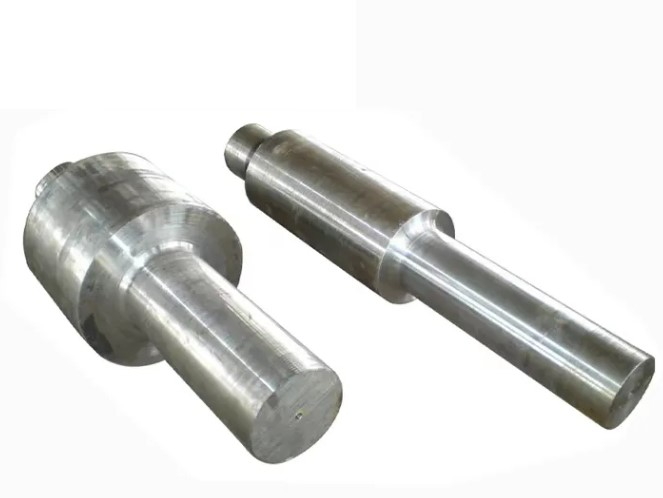
Quality inspection of shaft forgings mainly consists of two aspects: external quality inspection and internal quality inspection. Both dimensions are indispensable and together form a comprehensive quality evaluation system.
External quality inspection focuses on the geometric dimensions, shape, and surface condition of shaft forgings. Inspectors must verify that the forging's geometry and dimensions comply with design drawings while carefully examining the surface for various defects.
Common surface defects include surface cracks, folds, wrinkles, indentations, orange peel, blistering, scabs, corrosion pits, impact damage, foreign material adhesion, underfilling, depressions, material loss, and scratches. Although these defects appear on the surface, failure to detect and address them promptly may allow them to propagate inward during subsequent processing or become sources of cracking under stress.
Inspection methods for external quality are relatively straightforward. Dimensional measurements are typically performed using tools such as calipers and micrometers, while surface conditions are evaluated through visual inspection or with the aid of magnifying devices. For detecting certain fine surface defects, specialized methods such as penetrant testing may also be employed.
Internal quality inspection is an essential step that cannot be replaced by external examination, as it focuses on the intrinsic condition of the forging. It primarily includes three areas: chemical composition analysis, microstructural evaluation, and mechanical property testing.
Chemical composition analysis is mainly conducted for critical components, key parts, or large forgings to ensure that the material meets design specifications.
Microstructural evaluation employs methods such as macro-examination, fracture inspection, and microscopic analysis to detect defects including internal cracks, shrinkage cavities, porosity, coarse grains, white spots, dendritic structures, flow lines inconsistent with the forging shape, disordered flow lines, cross flow, coarse grain rings, oxide films, delamination, overheating, and overburned structures. These defects directly affect the material's uniformity and continuity.
Mechanical property testing involves measuring parameters such as tensile strength at room temperature, plasticity, toughness, hardness, fatigue strength, high-temperature instantaneous fracture strength, creep rupture strength, creep plasticity, and high-temperature creep strength. These indicators determine the forging's load-bearing capacity and service life under actual operating conditions.
To effectively detect internal and surface defects in shaft forgings, the industry has developed various non-destructive testing (NDT) methods. Each method has specific application scopes and technical characteristics, making it essential to select the appropriate technique based on actual requirements.
Magnetic particle testing is one of the most commonly used methods for forging inspection and is specifically designed to detect surface and near-surface defects in ferromagnetic materials. Its working principle is based on magnetic field behavior: when a forging is magnetized, cracks or other discontinuities distort the magnetic flux and create leakage fields. When magnetic particles are applied, they accumulate at these leakage points, forming visible indications that reveal the location and shape of defects.
MT offers advantages such as simple operation, rapid inspection speed, and high sensitivity. In practice, both circumferential and longitudinal magnetization are typically applied to ensure detection of defects in different orientations. Depending on the forging's shape and size, inspectors may choose various magnetization techniques—such as direct current methods, coil methods, or prods—as well as fluorescent or non-fluorescent magnetic particles to enhance accuracy and efficiency.
It is important to note that magnetic particle testing is only suitable for ferromagnetic materials such as steel and iron, and cannot be used for non-ferrous metals like aluminum, copper, or titanium alloys.
Ultrasonic testing is currently the most widely used method for detecting internal defects. It utilizes the propagation characteristics of ultrasonic waves within materials. When ultrasonic waves encounter discontinuities, they reflect, refract, and scatter. By receiving and analyzing these signals, inspectors can determine the location, size, and nature of defects.
The primary advantages of UT include a large inspection range, high sensitivity, and accurate defect localization. It is particularly effective for identifying internal cracks, inclusions, and voids within forgings. In practical applications, appropriate probes (such as straight-beam or angle-beam), frequencies—typically ranging from 0.5 MHz to 10 MHz—and testing parameters must be selected based on the material, geometry, and expected defect types.
However, ultrasonic testing requires a high level of technical expertise. Accurate interpretation of signals depends heavily on inspector experience. Additionally, inspections become more challenging for forgings with complex shapes or rough surfaces.
Liquid penetrant testing is a non-destructive method based on capillary action and is specifically used to detect surface-breaking defects. The process involves several steps: thoroughly cleaning the forging surface to remove oil and contaminants, applying penetrant to allow it to seep into open defects, removing excess penetrant after sufficient dwell time, and finally applying a developer. Under appropriate lighting—white light for dye penetrants or ultraviolet light for fluorescent penetrants—defect indications become clearly visible.
PT is valued for its simplicity, fast inspection speed, and high sensitivity to fine surface cracks that may be invisible to the naked eye. However, it has clear limitations: it can only detect surface-opening defects and is ineffective for closed or internal discontinuities. Strict surface cleaning is required before testing, and residual penetrant and developer must be thoroughly removed afterward.
Radiographic testing uses the penetrating power of X-rays or gamma rays to examine forgings. As radiation passes through the material, variations in absorption and scattering occur at defect locations. These differences are captured on film or digital detectors, producing images of the internal structure that allow inspectors to evaluate defect position, size, and characteristics.
RT provides intuitive results, permanent inspection records, and accurate defect localization. However, it also presents notable disadvantages: radiation hazards require strict protective measures and qualified operators; equipment costs are relatively high; inspection capability is limited for very thick forgings; depth positioning is less precise; and detection rates for crack-type defects are generally lower than those of ultrasonic testing.
In practice, RT is often used to detect volumetric defects such as porosity, slag inclusions, and shrinkage cavities, especially for critical components requiring archived inspection records.
In addition to the four primary methods above, several specialized techniques are applied in specific situations:
Eddy Current Testing (ECT): Based on electromagnetic induction, suitable for detecting surface and near-surface defects in conductive materials, particularly effective for automated inspection of pipes, bars, and wires.
Acoustic Emission Testing (AE): Detects defects by monitoring stress waves released when materials are subjected to load, commonly used for online monitoring of pressure vessels.
Infrared Thermography: Identifies defects through differences in heat conduction, applicable to certain specialized materials and conditions.
Each method has unique strengths and limitations. In practice, factors such as material type, geometry, inspection requirements, and cost must be considered to select the most appropriate technique—or combination of techniques.
After understanding the principles and characteristics of magnetic particle testing, ultrasonic testing, penetrant testing, and radiographic testing, an important question arises: how are these methods applied in real production environments, and what specific problems do they solve?
Forgings may develop defects due to multiple factors during manufacturing. Raw materials might contain inclusions or porosity, while improper process parameters—such as poor temperature control or insufficient deformation—equipment failures, or die wear can lead to cracks, folds, or coarse grains.
The primary role of NDT is to identify these defects promptly and prevent them from advancing to subsequent processes. For example, conducting ultrasonic testing immediately after forging can reveal internal cracks, allowing for timely repair welding or rejection. This prevents cracked forgings from being machined into expensive finished components before defects are discovered, thereby avoiding greater economic losses.
Systematic NDT enables a comprehensive understanding of defect types, quantities, sizes, and distributions within forgings. These data serve as objective criteria for quality grading and are critical references for determining whether a forging can be used and under what conditions.
Different industries impose varying classification requirements. Aerospace forgings typically demand the highest standards and often permit no detectable defects, whereas general mechanical forgings may allow limited imperfections within specified thresholds. NDT results provide the scientific basis for these decisions.
NDT is not merely a product inspection tool; it is also a source of process feedback. Frequent detection of a particular defect type often signals systemic issues in the forging process. For instance, repeated occurrences of coarse grains may indicate improper temperature control, while disordered flow lines may suggest inadequate deformation procedures.
By analyzing statistical inspection data, engineers can optimize forging parameters in a targeted manner, fundamentally reducing defect formation and achieving continuous quality improvement.
For critical shaft forgings already in service—such as turbine rotors in power plants or crankshafts in large compressors—periodic NDT plays an essential preventive role. Regular inspections help detect fatigue cracks and other service-induced defects early, allowing corrective action before they become hazardous and preventing sudden failure incidents.
This preventive strategy is vital for ensuring safe equipment operation, extending service life, and reducing maintenance costs.
After long-term service, NDT can evaluate the extent of damage and estimate remaining life. Information on defect quantity, size, and growth trends provides a scientific basis for determining whether a forging can continue operating or requires repair or replacement. This helps avoid both premature replacement and the safety risks associated with excessive service life.
Ensuring the reliability of NDT itself requires comprehensive quality control measures.
- Personnel Qualifications: NDT is highly specialized work, and inspectors must possess the necessary theoretical knowledge and practical experience. Methods such as radiographic and ultrasonic testing typically require professional training and certification before personnel can conduct inspections independently.
- Equipment Management: Inspection equipment must be regularly calibrated and maintained to ensure compliance with performance standards. For example, ultrasonic flaw detectors require periodic verification of parameters such as vertical linearity, horizontal linearity, and sensitivity margin, while radiation doses from radiographic equipment must be strictly monitored.
- Standards and Specifications: NDT must be carried out in strict accordance with relevant standards and codes. Numerous domestic and international standards exist for different industries and testing methods, such as GB/T 6402 and ASTM A388 for ultrasonic testing, and GB/T 9444 and ASTM E709 for magnetic particle testing. Adhering to these standards ensures the comparability and credibility of inspection results.
- Comprehensive Inspection Strategies: In practical applications, a single testing method is rarely sufficient to detect all defect types. Therefore, critical shaft forgings often require a combination of techniques. For example, ultrasonic testing may first be used to examine internal defects, followed by magnetic particle or penetrant testing for surface flaws, with radiographic testing employed when additional verification is necessary.
The complementary use of multiple methods provides a more complete understanding of forging quality, improves detection reliability, and reduces the risk of missed defects.
Quality inspection and non-destructive testing of shaft forgings are essential for ensuring product quality and operational safety. From geometric dimensions and surface defects to microstructural conditions and mechanical properties, a comprehensive inspection system provides systematic assurance of forging reliability. Magnetic particle testing, ultrasonic testing, penetrant testing, and radiographic testing each offer distinct advantages and collectively form a complete defect detection framework.
In actual production, only by placing strong emphasis on quality inspection, selecting appropriate testing methods, strictly adhering to standards, and cultivating professional inspection teams can manufacturers fully leverage NDT as both a quality gatekeeper and a guide for process improvement. This approach ultimately enables the production of high-quality shaft forgings that meet design specifications and operational demands, laying a solid foundation for enhancing the overall quality level of the mechanical manufacturing industry.
