
Forging vs. Machining: How to Optimize Cost and Performance
In modern manufacturing, the choice of processing method directly influences product quality, production cost, and delivery timelines. Among the many available metal forming techniques, forging and machining are two of the most widely used processes, playing critical roles across industries such as automotive, aerospace, oil and gas, and heavy machinery. This article provides a comprehensive comparison of these two processes from multiple perspectives—including process principles, performance characteristics, cost efficiency, and application scenarios—to help you make informed and strategic manufacturing decisions between steel forging and machining process.
Detailed Overview of the Forging Process
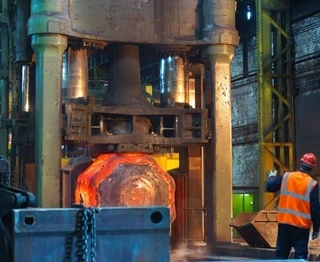
Forging is a manufacturing process that uses compressive forces to plastically deform metal into a desired shape. Typically, the metal is heated to an appropriate temperature and then shaped using hammers, presses, or dies. The defining feature of forging is its ability to enhance material properties by altering the internal structure of the metal.
During forging, the metal's grain structure undergoes significant transformation. Initially irregular grains are reoriented and elongated along the contours of the part, forming continuous grain flow lines. This structural refinement is the fundamental reason why forged components exhibit superior mechanical performance.
1. Core Advantages of Forging
- High Strength and Durability: Forged components are well known for their exceptional mechanical properties. The continuous grain flow aligned with the part geometry results in a dense internal structure capable of withstanding high loads and impact forces. Testing consistently shows that forged parts outperform those produced by other methods in terms of fatigue resistance and impact strength.
- Optimized Material Structure: The forging process eliminates internal defects such as voids and porosity by compressing the material. At the same time, grain refinement improves structural uniformity. This dense microstructure enhances the component's stability under cyclic loading conditions and significantly extends service life.
- High Material Utilization: Forging is a near-net-shape process. By precisely controlling deformation, the initial billet can closely resemble the final part geometry. As a result, minimal material needs to be removed in subsequent processes, achieving material utilization rates of up to approximately 90%. This significantly reduces raw material waste.
- Suitability for Mass Production: Once tooling and dies are prepared, forging enables rapid and continuous production. The cycle time per part is relatively short, and as production volume increases, the cost per unit decreases. This makes forging highly economical for large-scale manufacturing.
2. Precision Forging Technology
Precision forging represents an advanced form of forging technology that produces parts with dimensions very close to the final requirements. In many cases, it reduces or even eliminates the need for subsequent machining.
This technique is widely used in automotive and aerospace applications, particularly for components such as gears and turbine blades that demand both high strength and high precision. Its cost advantages are most evident in large production runs: near-net shaping reduces material waste and machining requirements, while the superior durability of forged parts leads to longer service life and reduced maintenance frequency.
Detailed Overview of the Machining Process
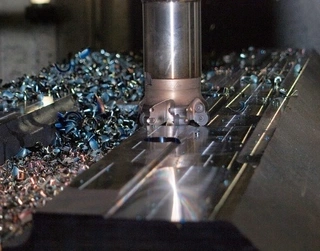
Machining is a subtractive manufacturing process in which material is removed from a workpiece using cutting tools to achieve the desired shape and dimensions. Common machining operations include turning, milling, drilling, and grinding. Modern machining primarily relies on CNC (Computer Numerical Control) systems to achieve high precision and repeatability.
1. Core Advantages of Machining
- High Precision and Accuracy: Machining is capable of achieving extremely tight dimensional and geometric tolerances. By controlling cutting parameters such as speed, feed rate, tool geometry, and coolant flow, manufacturers can maintain consistent accuracy even in mass production environments.
- High Design Flexibility: Unlike forging, which requires dedicated dies, machining can adapt to different part geometries simply by modifying the CNC program. This flexibility makes it ideal for producing complex shapes and customized components without significant upfront investment.
- Excellent Surface Finish: Machining can directly produce smooth and refined surface finishes, often eliminating the need for additional finishing processes. This is particularly important for applications requiring precise fits or low friction.
- Ideal for Small-Batch Production: For prototyping or low-volume manufacturing, machining offers significant advantages. Without the need for tooling or die preparation, production can begin quickly, reducing lead times and initial costs.
2. Modern CNC Machining Technology
In modern manufacturing, the integration of CNC systems with advanced cutting tools has greatly enhanced machining capabilities. By optimizing cutting parameters and tool paths, manufacturers can improve productivity while maintaining high precision.
Machining is often used as a secondary process for forged blanks, refining them to achieve final dimensions, tight tolerances, and functional surfaces.
Key Comparisons Between Forging and Machining
After understanding the fundamental principles and advantages of each process, it is essential to compare them across several critical dimensions. The differences between forging and machining are primarily reflected in material performance, precision, cost efficiency, and production characteristics.
1. Strength and Performance
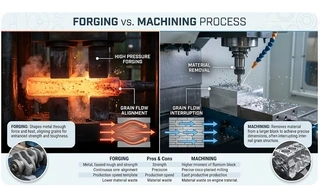
Forged components have a clear advantage in terms of strength. The continuous grain flow aligned with the part geometry creates a dense internal structure, significantly improving fatigue resistance and load-bearing capacity. Forging is especially suitable for components subjected to heavy loads or impact conditions.
In contrast, parts machined directly from bar stock lack this directional grain structure. While machining ensures dimensional accuracy, it does not enhance the inherent mechanical properties of the material. As a result, machined parts typically exhibit lower durability under cyclic loading conditions compared to forged components.
2. Precision and Complexity
Machining excels in precision and complexity. It can produce intricate geometries and maintain tight tolerances required for high-precision applications.
Although forged parts can achieve relatively high accuracy, they often require secondary machining to meet final dimensional requirements. Additionally, forging may face limitations when producing highly complex internal features.
3. Cost Efficiency
High-Volume Production: Forging offers significant cost advantages in large-scale production. Although initial tooling costs and setup time are required, the unit cost decreases as production volume increases. High material utilization further reduces overall costs.
Low-Volume Production: Machining is more suitable for small-batch or custom production. It eliminates the need for expensive tooling and allows quick adjustments. However, for large-scale production, longer processing times and higher material waste can increase unit costs.
4. Material Utilization
Forging achieves high material efficiency by redistributing material through plastic deformation, resulting in near-net shapes with minimal waste. Material utilization can reach approximately 90%.
Machining, on the other hand, removes material from a solid workpiece, generating chips and scrap. Consequently, material utilization is relatively lower.
5. Surface Quality
Machining provides superior surface finish directly, making it suitable for applications requiring precision fits and low friction.
Forged parts typically have surface imperfections such as scale or die marks, requiring additional finishing processes to meet surface quality requirements.
6. Lead Time
Machining is ideal for rapid prototyping and small-batch production, as it does not require tooling preparation and can respond quickly to demand.
Forging involves longer initial lead times due to die design and manufacturing. However, once production begins, it enables faster throughput for large quantities.
Hybrid Manufacturing: Combining Forging and Machining
In modern manufacturing, forging and machining are often complementary rather than competing processes. A typical workflow follows the sequence: raw material → forging → heat treatment → CNC machining → inspection.
1. Advantages of Hybrid Processes
This integrated approach ensures both superior mechanical properties and high precision:
- Forging provides high strength and optimized internal structure
- Machining ensures precise dimensions and excellent surface quality
- Heat treatment further enhances mechanical performance
- Rigorous inspection guarantees consistency and traceability
2. Typical Applications
- Automotive Industry: Components such as drive shafts, connecting rods, differential gears, and wheel hub flanges require reliable performance under continuous torque. Forged blanks combined with CNC machining ensure both strength and assembly precision.
- Wind Power and Energy Sector: Parts like turbine shafts, forged flanges, and bearing housings operate under rotational and thermal stresses. Hybrid processes ensure structural integrity and reliability for large components.
- Heavy Machinery: Gear hubs, rollers, couplings, and drive shafts operate under high loads. Forging provides the necessary strength, while machining ensures precise fit and alignment.
- Marine and Mining Industries: Components such as anchor chains, propeller shafts, and forged bolts operate in corrosive or high-impact environments. Hybrid manufacturing ensures durability and safety under harsh conditions.
Decision Framework for Process Selection
Choosing between forging, machining, or a hybrid approach requires a comprehensive evaluation of several factors.
1. Application Requirements
Identify the working conditions of the part, including load type (static, dynamic, or impact), operating environment (temperature, corrosion), and safety requirements. High-stress components are better suited for forging, while less demanding applications may allow alternative methods.
2. Performance Requirements
- High strength and durability → Forging
- High precision and tight tolerances → Machining
- Both required → Hybrid process
3. Production Volume
- Large-scale production → Forging is more economical
- Small-batch or custom production → Machining is more flexible
- Medium volume with high performance requirements → Hybrid approach
4. Cost Analysis
Evaluate total cost, including:
- Raw material costs (considering material utilization)
- Tooling and setup investment
- Processing time and labor costs
- Post-processing and quality control
- Service life and maintenance costs
When material cost is critical, forging is advantageous. When surface finish requirements are high, machining costs must be evaluated alongside finishing processes.
5. Lead Time Considerations
For urgent projects or prototyping, machining provides faster turnaround. For mass production, forging's initial investment is offset by long-term efficiency.
6. Industry Standards and Compliance
Different industries impose specific requirements:
- Aerospace and defense favor forging for strength and reliability
- Medical and precision industries rely on machining for accuracy and surface quality
- Automotive industry commonly uses a combination of both processes
Conclusion and Recommendations
Forging and machining each have distinct advantages and are suited to different manufacturing needs. Forging enhances material properties through plastic deformation, delivering high strength, durability, and material efficiency, making it ideal for high-load applications and mass production. Machining, on the other hand, excels in precision, flexibility, and surface quality, making it suitable for complex geometries and low-volume production.
In practice, many manufacturers adopt a hybrid approach, using forged blanks followed by CNC machining to achieve optimal performance and precision. This combination leverages the strengths of both processes to produce high-quality, reliable components.
Selection Guidelines:
- Choose forging when high strength, durability, large production volume, and material efficiency are required
- Choose machining when high precision, complex geometry, small batch production, and superior surface finish are needed
- Choose a hybrid approach when both strength and precision are critical
Ultimately, the optimal choice depends on a balanced evaluation of cost, design requirements, and performance expectations. By systematically analyzing application needs, production conditions, and economic factors, manufacturers can achieve better performance, improved cost efficiency, and long-term reliability.
Send your message to this supplier
Related Articles from the Supplier
Aluminum Forging vs. Steel Forging
- Apr 10, 2024
Free Forging vs. Die Forging Processing Methods
- Dec 18, 2024
Hot forgings
- Oct 14, 2024
Alloy Steel Drop Forgings,Hot forging
- Mar 20, 2024
Carbon Steel Drop Forgings
- Apr 23, 2024
Related Articles from China Manufacturers
Hot Forging vs. Cold Forging
- May 02, 2024
Method of Cooling Forgings in Forging Factory
- Jul 16, 2024
Features of Aluminum Alloy Forgings
- Apr 01, 2015
Manufacturing Process of Cylindrical Forgings
- Jan 21, 2026
Related Products Mentioned in the Article

Supplier Website
Source: http://www.creatorcomponents.com/news/forging-vs-machining-how-to-optimize-cost-and-performance.html