
An Introduction to Die-Moulded Graphite Packing Rings
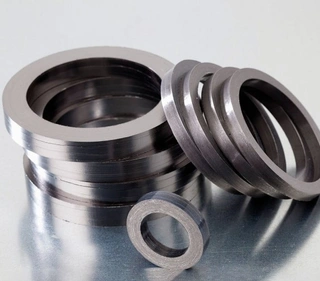
Die-moulded graphite packing rings are extensively used sealing components in various industrial equipment and processes. They are manufactured through a high-pressure die-moulding process that compresses high-purity flexible graphite materials into precise, ring-shaped seals. Unlike ordinary pressed or cut graphite rings, die-moulded rings are produced using custom steel dies that apply enormous pressure to the graphite material, resulting in finished products with exceptional dimensional accuracy, uniform density, and highly stable mechanical properties.
The primary raw material for die-moulded graphite packing rings is high-purity expanded flexible graphite tape. After precise and uniform winding, the graphite tape is subjected to extreme pressure under high-precision steel dies, forming rings of varying profiles, densities, and sizes to meet specific operational requirements. Additionally, according to application needs, these rings can be supplied with brass end caps, anti-corrosion grades, oxidation-resistant grades, or PTFE-impregnated options. Metal end caps or reinforcements can also be customized according to specifications, enabling the rings to perform reliably in high-pressure and harsh operational conditions.
Core Features of Die-Moulded Graphite Packing Rings
- Precision Manufacturing and Uniform Structure: Die-moulded graphite rings are produced by pressing graphite material in precision molds, ensuring exact dimensions and tight tolerances. The entire manufacturing process guarantees uniform structural density and integrity, which is critical for consistent sealing performance. Compared to other forming methods, die-moulding eliminates weak points in the graphite material, allowing the rings to withstand repeated thermal cycling, high-pressure loads, and mechanical stresses without extrusion, cracking, or breakage.
- High Purity and Chemical Inertia: These rings are made from high-purity graphite, minimizing impurity content and ensuring compatibility with a wide variety of process media and operating environments. Graphite itself is chemically inert, offering excellent resistance against acids, alkalis, solvents, and other aggressive chemical media. This property makes die-moulded graphite packing rings highly suitable for corrosive industrial applications, particularly in chemical, petrochemical, and oil & gas industries.
- Exceptional Sealing Performance: Die-moulded graphite rings exhibit high compliance and elasticity, allowing them to maintain effective sealing even under extreme temperatures, pressures, and corrosive conditions. Their high sealing efficiency minimizes leakage, fugitive emissions, and product loss, thereby improving operational safety, process efficiency, and environmental compliance.
- Wide Temperature Range: Graphite is known for its outstanding thermal stability. Die-moulded graphite packing rings are capable of operating effectively within a broad temperature range from -240°C to 430°C. In steam applications, these rings can tolerate temperatures as high as 650°C. This wide operational range allows them to function reliably in both cryogenic and high-temperature industrial processes, from low-temperature freezing systems to high-temperature chemical reactions and steam service.
Major Advantages of Die-Moulded Graphite Packing Rings
- Broad Applicability: Die-moulded graphite packing rings are suitable for a wide range of industries, including petrochemical, aerospace, automotive, pharmaceutical, and food processing. They provide reliable sealing for gases, liquids, and mixed-phase media. In situations where standard graphite seals produce excessive friction, causing vibration, sticking, or wear in valve stems, die-moulded rings can significantly improve operational stability and reduce maintenance issues.
- Long Service Life and Low Maintenance: Die-moulded graphite rings are designed to withstand high temperatures, high pressures, and corrosive media for extended periods without significant degradation. They maintain extremely low friction characteristics over up to 20,000 valve cycles and can extend performance to 60,000 cycles with subsequent manual adjustments. This long service life reduces the frequency of system maintenance and enhances equipment operational efficiency, ultimately lowering overall downtime and associated labor costs.
- Cost-Effectiveness: Although the initial procurement cost of die-moulded graphite rings may be higher than that of some conventional sealing components, their extended service life, low maintenance requirements, and high system reliability lead to a lower total cost of ownership. Reduced unplanned shutdowns, minimized maintenance interventions, and longer operational intervals provide tangible economic benefits, making die-moulded graphite rings a cost-effective sealing solution for industrial operations.
- Customizability: Die-moulded graphite packing rings can be tailored to specific operational needs in terms of size, shape, and performance characteristics. They can be manufactured in square or rectangular cross-sections, chamfered, split, matched halves, and complete sets with integrated wipers. For high-pressure applications, metal reinforcement wires or end caps can be incorporated, ensuring the rings can meet stringent operational requirements. This flexibility makes die-moulded rings suitable for a wide variety of specialized sealing conditions, from extreme high-pressure systems to highly corrosive chemical processes.
- Environmentally Friendly: Graphite is a sustainable and non-toxic material, producing minimal environmental impact. Die-moulded graphite packing rings are fully recyclable and compliant with modern environmental standards. By using these rings, companies can contribute to green manufacturing practices and reduce emissions associated with maintenance and replacement of conventional sealing materials.
- Energy Saving and Fire Resistance: Die-moulded graphite rings reduce the torque required for valve operation, lowering energy consumption and enabling the use of smaller actuators. Reduced startup friction results in smoother valve operation, while the fire-resistant properties of graphite ensure safe application in equipment that must comply with fire safety and certification standards.
Key Applications of Die-Moulded Graphite Packing Rings
- Valve Stem Sealing: Die-moulded graphite packing rings are commonly used as stem seals in globe, gate, and ball valves, ensuring reliable leakage control and stem lubrication. In these applications, the sealing rings must endure frequent actuation while maintaining stable sealing performance under thermal, pressure, and chemical stress conditions.
- Pump Shaft Sealing: These rings are also widely applied as shaft seals in centrifugal, rotary, and other types of pumps. They prevent fluid leakage between the pump shaft and casing, maintaining system efficiency and safety. Pump seals often experience high thermal cycling and pressure fluctuations, making the structural uniformity and compressive strength of die-moulded graphite rings highly advantageous in these critical applications.
- Static Sealing: Die-moulded graphite packing rings are used in static sealing applications, such as gaskets in cylinder heads, compressors, and hydraulic systems. In these scenarios, the seals must maintain stable compressive load and low creep over extended periods. The low creep and high structural stability of die-moulded rings ensure reliable sealing performance in long-term static applications.
- High-Pressure Sealing: In high-pressure systems, including hydraulic machinery, industrial process equipment, and high-pressure cylinders, die-moulded graphite rings can withstand severe operational conditions. Additional reinforcement with metal wires or end caps can improve extrusion resistance and compressive strength, enabling the rings to maintain sealing integrity under extreme pressure loads.
Usage Considerations for Die-Moulded Graphite Packing Rings
- Anisotropic Properties: During the die-moulding process, graphite sheets may align along the pressing direction, resulting in weaker mechanical properties perpendicular to the forming direction. Applications that require isotropic strength may consider isotropic cast graphite rings as an alternative to ensure uniform performance in all directions.
- Oxidizing Environments: Graphite can oxidize in high-temperature oxygen-rich environments, potentially compromising performance. For such conditions, oxidation-resistant grades or anti-corrosion additives should be selected to extend operational life. Proper selection of graphite grades based on environmental and operational conditions can effectively mitigate oxidation risks.
- Joint Integrity: Seams in split or assembled rings can serve as potential leakage paths or structural weak points. For seam-sensitive applications, spiral-wound or seamless die-moulded designs may be preferred to ensure high sealing reliability.
- Customization Limitations: While die-moulded rings are highly adaptable, there are limitations when producing non-standard sizes, complex cross-sections, or small-batch orders. High mould costs make low-volume production less economical, and complex shapes (e.g., U-grooves or intricate profiles) are difficult to produce. Alternatives include cutting flexible graphite tape or sheets, or CNC machining graphite blocks to achieve the desired form.
- Thermal Cycling and Creep: In high-temperature cycling applications, microcracks or mechanical joints in moulded rings may become sources of leakage. Creep relaxation of die-moulded rings is higher than in homogeneous cast graphite rings, potentially leading to loss of bolt load and requiring periodic retightening. Reinforced designs, such as stainless steel inserts or tangentially reinforced gaskets, can mitigate these issues and enhance durability under cyclic thermal stress.
Installation & Maintenance of Die-Moulded Graphite Packing Ring
- Handling and Storage: Die-moulded graphite rings are relatively fragile during transport. Rings should always be handled by their edges or outer diameters to avoid directly compressing sealing surfaces. Rings must be stored in their original protective packaging in a clean, dry, and temperature-stable environment. Stacking rings or placing heavy objects on top should be avoided.
- Pre-Installation Inspection: Before installation, confirm that the graphite grade is suitable for the process media, temperature, and pressure. Ensure the sealing surfaces in the packing box or grooves are smooth, clean, and free from scratches, pits, or residual sealant. For static sealing applications, surface roughness should generally be below 1.6 μm. Lightly lubricating the ring and mating surfaces can help prevent twisting or folding during installation.
- Installation Procedure: Careful installation is critical to avoid ring deformation. Use appropriate tools such as installation sleeves or guide cores, and apply uniform axial pressure. Avoid rolling, twisting, or hammering the ring. When multiple rings are installed, stagger joints by at least 90° to prevent aligned seams from creating potential leakage paths.
- Bolting and Adjustment: After installation, use a calibrated torque wrench to apply torque in a cross-pattern to ensure even flange loading. After initial operation, retorque bolts as recommended to compensate for slight relaxation of the graphite ring. Monitor the seal during the first few thermal cycles to ensure proper performance.
- Usage Recommendations: Die-moulded graphite rings generally should not be reused after removal, as disassembly may damage the structure and compromise sealing performance. For high-temperature applications above 500°C, use high-purity, oxidation-resistant graphite and gradually increase operational temperature during initial startup to allow the ring to adapt to thermal stress safely.
Conclusion
Die-moulded graphite packing rings, with their precision manufacturing, high purity, excellent sealing performance, and wide applicability, have become indispensable components in modern industrial sealing systems. From valves and pumps to flanges and static sealing applications, these rings provide reliable leakage control and maintain operational integrity.
Understanding the features, advantages, limitations, and proper selection of grades and specifications allows industrial operators to fully leverage the performance benefits of die-moulded graphite rings. By integrating these rings into their systems and collaborating closely with experienced suppliers, companies can achieve safe, efficient, and cost-effective production operations. Die-moulded graphite packing rings ensure reliability, durability, and consistent performance across a wide range of demanding industrial applications.
Send your message to this supplier
Related Articles from the Supplier
An Introduction to Metal Jacketed Gaskets
- Jun 16, 2025
An Introduction to Metal Lens Gaskets
- Jun 18, 2025
An Introduction to Corrugated Graphite Gaskets
- Dec 16, 2025
Related Articles from China Manufacturers
An Introduction to Countergravity Casting Technology
- Sep 02, 2025
An Introduction to Solution Treatment for Forgings
- Feb 27, 2026

An Introduction to the Digital Two Way Radios
- May 16, 2017
An Introduction to Vacuum Packaging for Food
- Mar 03, 2021
An Introduction to Sous Vide Cooking
- Oct 22, 2020

An Introduction to Food Preservation Techniques
- Mar 26, 2022

An Introduction to 23mn Steel Pipe
- Aug 29, 2020
An Introduction to Coated Steel Pipes
- Jan 06, 2021
Related Products Mentioned in the Article

Supplier Website
Source: https://www.magpievalves.com/media-hub/an-introduction-to-die-moulded-graphite-packing-rings.html