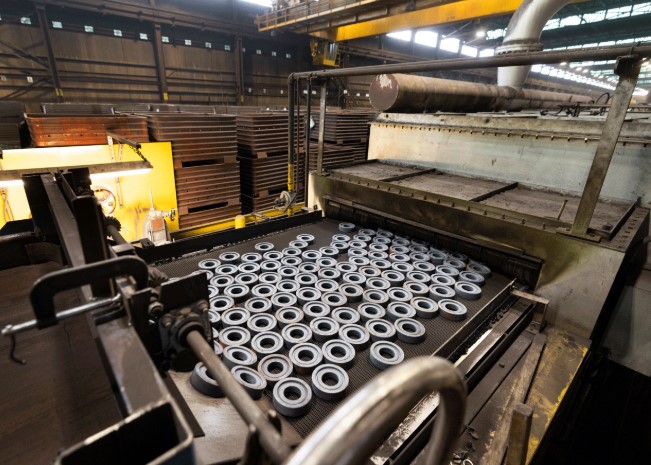
Solution Treatment, often referred to in industry as solution quenching, is one of the most fundamental and indispensable heat treatment processes used in modern metallurgy. For forged components in particular, solution treatment plays a decisive role in determining final mechanical properties, corrosion resistance, structural stability, and service life.
At its core, solution treatment is a process in which an alloy is heated to a sufficiently high temperature so that secondary phases dissolve into the matrix, forming a homogeneous single-phase solid solution. This state is then “frozen” through rapid cooling, typically by quenching. The resulting supersaturated solid solution becomes the foundation for either direct application or subsequent aging treatment, which further enhances strength and hardness through controlled precipitation.
For manufacturers and engineers involved in forging production, understanding when and how to apply solution treatment is critical. Not all materials benefit from this process, and improper parameter selection can lead to grain coarsening, incipient melting, distortion, or insufficient performance improvement. This comprehensive guide systematically explores the principles, suitable material categories, process parameter control, differences from other heat treatment routes, and practical selection recommendations.
Understanding the fundamental principles of solution treatment is essential before exploring its material applications and process parameters. This section explains the metallurgical basis of the process, clarifying how heating, dissolution, and rapid cooling work together to create a supersaturated solid solution that forms the foundation for subsequent strengthening and performance enhancement.
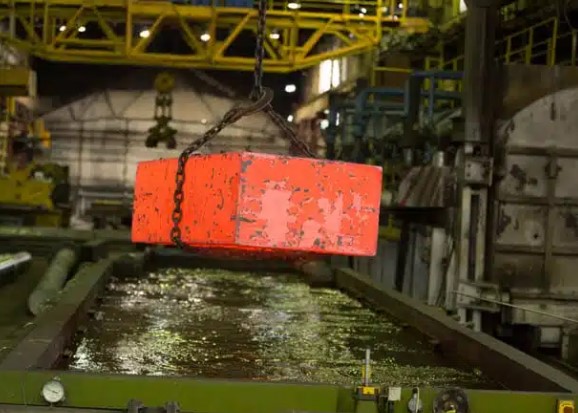
Solution treatment is rooted in the temperature-dependent solubility behavior of alloy systems. In many alloys, the solubility of alloying elements in the matrix increases significantly at elevated temperatures. When heated into the single-phase region of the phase diagram—typically between 980°C and 1250°C for many high-performance alloys—secondary phases such as carbides, intermetallic compounds, or γ′ precipitates dissolve into the matrix.
The process involves three essential stages:
- Heating to the single-phase region
- Holding (soaking) at temperature for sufficient diffusion and dissolution
- Rapid cooling to suppress re-precipitation
After quenching, the alloy retains a supersaturated solid solution at room temperature. This state is thermodynamically metastable. Much like a supersaturated sugar solution, it appears stable but contains excess solute atoms trapped within the matrix.
The supersaturated state is critical for precipitation hardening. During subsequent natural or artificial aging, fine and uniformly distributed strengthening phases precipitate from the matrix. These precipitates impede dislocation motion, dramatically increasing strength and hardness.
In addition to preparing the alloy for aging, solution treatment:
- Relieves internal stresses induced by forging, rolling, or machining
- Promotes recrystallization
- Homogenizes chemical composition
- Improves corrosion resistance by reducing segregation
Thus, solution treatment is not merely a preparatory step; it is a structural reset that optimizes the alloy for enhanced performance.
Solution treatment is applicable primarily to alloy systems whose solubility changes significantly with temperature. Pure metals or alloys without precipitation strengthening potential typically do not benefit.
Below are five major material categories where solution treatment is essential.
Special steels represent one of the earliest and most established applications of solution treatment. Among them, high-manganese steels are particularly notable.
A representative example is M13 high-manganese steel, containing approximately 1.2% carbon and 13% manganese. After solution treatment at 1050–1100°C followed by water quenching, the steel obtains a fully austenitic microstructure.
Key Benefits
Work Hardening Ability: Under heavy impact or compressive stress, the surface rapidly hardens while the core remains tough.
Wear Resistance: Ideal for mining machinery, crusher liners, excavator teeth, and railway switches.
Toughness Preservation: The internal structure retains high impact resistance.
Additionally, certain alloy steels containing S-phase or CuAl₂ precipitates respond well to solution treatment combined with aging. These steels are often used in demanding conditions such as high-temperature environments or strong magnetic fields.
Superalloys are indispensable materials for aerospace engines, gas turbines, and high-temperature industrial equipment. Typically based on nickel, cobalt, or iron matrices, they contain significant amounts of chromium, molybdenum, titanium, aluminum, and other strengthening elements.
Role of Solution Treatment in Superalloys
Dissolution of Strengthening Phases: Produces a uniform matrix before controlled aging.
Grain Size Control: Higher solution temperatures can promote grain growth, beneficial for creep resistance in turbine blades.
Improved Corrosion Resistance: Homogeneous structure reduces galvanic microcells.
Superalloys must operate at temperatures exceeding 700°C for prolonged periods. Solution treatment ensures structural stability and maximizes service life under extreme stress.
Aluminum alloys are among the most widely solution-treated materials in modern manufacturing. Particularly in aerospace, automotive, and structural industries, 2xxx, 6xxx, and 7xxx series alloys depend heavily on solution treatment.
Mechanical Improvements
Dissolution of strengthening phases into a uniform matrix
Formation of supersaturated solid solution
Subsequent precipitation hardening during aging
This combination significantly increases tensile strength and yield strength.
Stress Relief and Dimensional Stability
Forged aluminum components often contain residual stresses. Solution treatment relieves these stresses, improving machinability and minimizing distortion.
Corrosion Resistance
Homogenized composition reduces localized corrosion susceptibility.
However, aluminum alloys require extremely precise temperature control. Many have narrow solution temperature windows—sometimes within ±5°C—making furnace uniformity and monitoring critical.
Magnesium alloys are valued for their ultra-low density and increasing application in automotive lightweighting, aerospace structures, and electronics housings.
Solution treatment of magnesium alloys:
Dissolves strengthening intermetallic phases
Homogenizes microstructure
Improves strength and corrosion resistance
Magnesium alloys typically have lower solution temperatures compared to aluminum. They are sensitive to cooling rates, and improper quenching may cause cracking or distortion.
Titanium alloys combine high specific strength, corrosion resistance, and excellent high-temperature performance. They are widely used in aerospace structures, medical implants, and chemical processing equipment.
Effects of Solution Treatment
Dissolves excess α or β phases
Adjusts α/β phase balance
Prepares ideal microstructure for aging
Titanium solution treatment must carefully control heating atmosphere to prevent oxygen or hydrogen absorption, which can degrade mechanical properties.
The success of solution treatment depends on precise control of temperature, holding time, and cooling rate.
Temperature selection is the most critical parameter.
Upper Limit
Usually close to the solidus temperature. Excessive heating risks:
- Incipient melting at grain boundaries
- Overburning
- Reduced toughness
- Quench cracking
- Lower Limit
Must exceed the solvus temperature to ensure complete dissolution of strengthening phases.
Grain Size Consideration
High-temperature service components benefit from coarse grains for improved creep resistance.
Medium-temperature applications require finer grains for better strength and toughness balance.
Holding ensures sufficient diffusion and homogenization.
Factors influencing holding time:
- Alloy composition
- Initial microstructure
- Heating temperature
- Workpiece thickness
- Furnace loading capacity
Thicker forgings require longer soaking times to ensure core temperature uniformity.
Rapid cooling prevents premature precipitation.
Common Quenching Media
Water: Fast cooling; widely used; may cause distortion.
Oil: Slower cooling; reduces thermal stress.
Air: Suitable for thin-walled components or low-supersaturation alloys.
Polymer Solutions or Salt Baths: Adjustable cooling rates.
Advanced techniques such as isothermal quenching or step quenching may reduce distortion while maintaining performance.
These two processes differ significantly:
|
Aspect |
Solution Treatment |
Quench-and-Temper |
|
Applicable Materials |
Alloy systems (special steels, superalloys, non-ferrous alloys) |
Medium-carbon and alloy structural steels |
|
Core Purpose |
Dissolve excess phases; prepare for aging |
Achieve high strength and toughness |
|
Process Steps |
Heat → Hold → Rapid Cool |
Heat → Quench → High-Temp Temper |
|
Temperature Range |
High-temp single-phase region (980–1250°C) |
Above critical point (quench), below critical point (temper) |
|
Microstructure |
Supersaturated solid solution |
Tempered sorbite or equilibrium structure |
|
Follow-Up |
Usually requires aging |
Typically final treatment |
In simple terms:
Solution treatment = “Dissolve and freeze” (prepare for strengthening)
Quench-and-temper = “Harden and soften” (directly obtain usable properties)
Solution treatment is not a universal solution; its value lies in matching material characteristics with service requirements.
Consider the following:
- Is the material precipitation-strengthenable?
- Are high strength and corrosion resistance required?
- Will aging treatment follow?
- Does the forging contain significant residual stress?
- Is the component used in high-temperature or corrosive environments?
If the answer to multiple questions is yes, solution treatment is likely necessary.
Wear-resistant parts: High-manganese steels
High-temperature components: Nickel-based superalloys
Lightweight structural parts: 2xxx, 6xxx, 7xxx aluminum alloys
Corrosion-resistant applications: Titanium alloys or high Cr-Ni stainless steels
Maintain temperature accuracy within ±5°C
Use staged heating to minimize thermal stress
Regularly monitor quenching media
Design fixtures to reduce distortion
Consider press quenching for complex shapes
Solution treatment is not a universal remedy, but when correctly applied, it provides:
- Structural homogenization
- Enhanced strength potential
- Improved corrosion resistance
- Stress relief
- Optimized microstructure for aging
For high-end equipment manufacturing—such as aerospace turbines, automotive lightweight structures, mining machinery, and chemical processing systems—solution treatment is often indispensable.
Solution treatment remains one of the most critical heat treatment processes in forging metallurgy. By precisely heating alloys into their single-phase region, dissolving excess phases, and rapidly quenching to preserve supersaturation, engineers establish the microstructural foundation for enhanced performance.
Applicable to special steels, superalloys, aluminum alloys, magnesium alloys, and titanium alloys, solution treatment requires meticulous parameter control. Proper temperature selection, adequate holding time, and optimized cooling rates are essential to achieving desired mechanical properties and corrosion resistance.
For engineers and manufacturers, mastering solution treatment principles and selection strategies is key to ensuring forging quality and meeting the demanding requirements of modern high-performance equipment. Only through scientific process design and strict execution can the full benefits of this classical yet technologically vital heat treatment method be realized.
