
Complete Guide to Triple Eccentric Butterfly Valves
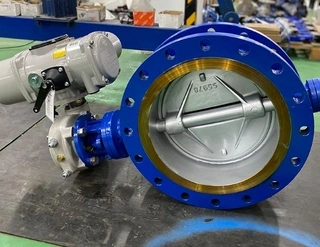
The triple eccentric butterfly valve is a high-performance industrial valve mainly used in pipeline systems to control fluid on-off and flow regulation. Its core feature lies in the “triple eccentric” structure, meaning that three key parts of the valve are offset relative to the central axis. These three offsets are arranged relative to the pipeline axis, the valve seat, and the valve stem centerline. Compared with traditional butterfly valves, the triple eccentric butterfly valve has undergone a fundamental change in its sealing method. Traditional butterfly valves rely on the elastic deformation of the valve seat to achieve sealing, while the triple eccentric butterfly valve adopts a torque sealing principle, achieving the sealing effect through the contact pressure between sealing surfaces. This change enables it to simultaneously meet the requirements of both on-off control and precise regulation, and it is widely used in industries such as petrochemical, electric power, metallurgy, and water treatment.
Evolution of Butterfly Valve Structure
- Concentric Butterfly Valve: The earliest butterfly valve uses a concentric design where the stem axis, disc center, and valve body center align. It is simple and easy to manufacture, but during operation the disc continuously scrapes against the seat, causing heavy wear, poor sealing, and short service life.
- Single Eccentric Butterfly Valve: Developed to reduce wear, this design offsets the stem axis from the disc center, reducing compression at the seat. However, friction and scraping still occur throughout operation, so improvements in sealing and durability remain limited.
- Double Eccentric Butterfly Valve: This design offsets the stem axis from both the disc center and valve body center. It allows the disc to quickly disengage from the seat during opening, reducing friction, lowering operating torque, and improving service life. Metal seats can also be used for high-temperature applications. However, it still relies on positional sealing through seat deformation, requiring precise closing conditions and offering limited pressure resistance. It also faces the trade-off between hard sealing (high temperature resistance but more leakage) and soft sealing (better sealing but poor heat resistance).
- Triple Eccentric Butterfly Valve: Based on the double eccentric design, a third offset is introduced. The disc adopts an oblique conical shape, and the sealing cone axis is offset from the valve body axis, changing the sealing surface from circular to elliptical. Most importantly, it shifts from positional sealing to torque sealing, relying entirely on contact pressure between sealing surfaces. This fundamentally resolves the sealing limitations of traditional butterfly valves.

Structural Features of the Triple Eccentric Butterfly Valve
After the gradual improvement from a concentric structure to a triple eccentric structure, the sealing principle and operation mode of the butterfly valve have undergone fundamental changes. The reason why the triple eccentric butterfly valve can achieve zero leakage and precise regulation under high temperature, high pressure, and harsh working conditions lies in its unique geometric structure design and material selection. The core structural features are described as follows.
1. Triple Eccentric Design
- First eccentricity: the valve stem axis deviates from the centerline of the disc sealing surface.
- Second eccentricity: the valve stem axis deviates from the pipeline centerline.
- Third eccentricity: the cone axis of the disc sealing surface deviates from the cylindrical axis of the valve body.
The superposition of these three eccentricities forms a unique motion trajectory of the disc during rotation.
2. Elliptical Conical Disc
The sealing cross-section of the disc is no longer circular but elliptical. The disc is in an elliptical conical shape, and the sealing surface is usually overlaid with hard alloy materials. This structure has excellent wear resistance and can operate stably for a long time in media containing solid particles.
3. Floating U-shaped Stainless Steel Valve Seat
The valve seat adopts a floating U-shaped stainless steel structure with self-aligning capability. When the valve is closed, the disc rotates and automatically adjusts its central position under the action of the eccentric shaft, causing the valve seat to undergo elastic deformation under pressure and closely fit with the sealing surface of the disc.
4. Double Safety Protection Structure
To prevent deformation of the disc, displacement of the valve stem, and jamming of the sealing surface under fluid pressure and temperature, independent limiting devices are installed on both the upper and lower sides of the disc in the triple eccentric butterfly valve. At the same time, a thrust ring ensures stable operation under various working conditions.
An independent anti-blowout structure is also designed at the lower end of the valve stem both inside and outside the valve. This design effectively avoids safety accidents caused by valve stem damage or detachment and improves operational safety.
Performance Advantages of the Triple Eccentric Butterfly Valve
From the above structural description, it is clear that the triple eccentric butterfly valve incorporates several key design improvements. The triple eccentric geometry alters the disc motion path, the combination of an elliptical conical disc and floating seat changes the sealing mechanism, and the dual safety protection structure enhances operational reliability. Together, these structural features define the valve’s overall performance. Based on this design, the triple eccentric butterfly valve delivers the following advantages in industrial applications.
1. Integration of Regulation and Shut-off Functions
The triple eccentric butterfly valve integrates regulation and shut-off functions, with strong control capability. Its regulation ratio can reach 100:1 or even higher, about twice that of ordinary butterfly valves. It has good controllability from nearly 0° to 90° opening, meeting the requirements of precise flow control.
2. No Dead Zone Design
Traditional butterfly valves have a “dead zone” or “insensitive zone” at the initial opening stage, where the disc has almost no effect on flow regulation. The triple eccentric butterfly valve adopts a no dead zone design, where the torque borne by the valve stem is directly transmitted to the sealing surface, eliminating the jumping phenomenon commonly seen in ordinary butterfly valves during opening and making flow control more stable and precise.
3. Frictionless Opening and Closing Process
During the opening and closing process, there is basically no frictional contact between the disc and the valve seat. Specifically, when the valve is opened, the elliptical conical sealing surface first separates from the valve seat and then rotates; when the valve is closed, the disc rotates and automatically adjusts its central position under the action of the eccentric shaft. This design avoids the scraping problem of traditional butterfly valves during opening and closing and significantly reduces operating torque.
4. Excellent Sealing Performance
The greatest feature of the triple eccentric butterfly valve is the fundamental change in its sealing structure. It no longer relies on the elastic deformation of the valve seat to achieve sealing but adopts a torque sealing principle, achieving sealing through the contact pressure of the sealing surfaces. This structure enables it to achieve high-grade metal hard sealing, reaching Class VI sealing standards and achieving true zero leakage.
5. High Temperature and High Pressure Resistance
Due to the use of a metal valve seat and surface sealing structure, the triple eccentric butterfly valve still has good adaptability under high temperature and high pressure conditions. In high-temperature flue gas pipeline applications, the maximum working temperature can reach 750°C. The metal sealing structure avoids the problem of aging and failure of soft sealing materials at high temperatures.
6. Compact Structure and Long Service Life
The triple eccentric butterfly valve usually adopts an integrated valve body and valve seat structure, making the overall structure more compact. This design reduces direct contact between the valve seat and the medium, lowers the erosion effect of the medium on the valve seat, alleviates the impact of solid particles and the biting problem of sealing surfaces caused by thermal expansion, and effectively extends the service life of the valve seat.
7. Low Maintenance Cost
The new triple eccentric butterfly valve has good maintainability. It not only supports the replacement of the valve body seat, but also the sealing surface of the disc and the disc body are usually designed separately, allowing the sealing surface to be replaced independently. This feature significantly reduces maintenance costs and improves usage efficiency.
Applications of the Triple Eccentric Butterfly Valve
- Petrochemical Industry: Widely used in petrochemical plants, the triple eccentric butterfly valve provides both shut-off and regulation at lower cost in large-diameter pipelines, gradually replacing gate valves above DN300 mm. In polyethylene reactor cooling systems, it ensures stable control and reliable shut-off under interlock conditions, improving operational efficiency. In severe services such as ethylene cracking decoking systems, it performs well in media containing carbon particles, preventing sealing jamming.
- High-Temperature Flue Gas Systems: Used for shut-off and regulation in high-temperature gas pipelines up to DN1800 mm. With hydraulic actuators, fast closing within 0.5 seconds is possible. It is also widely applied in fans, vents, compressors, flare systems, slurry pumps, and steam pipelines.
- Liquefied Petroleum Gas Systems: In LPG storage and transport pipelines, it provides safe operation with zero-leakage sealing, reducing risks of flammable and explosive gas leakage.
- Special Applications: In sulfur recovery units, steam-jacketed designs are used for molten sulfur handling. In hydrogen systems, it operates smoothly without seat dragging, making it suitable for hydrogen service with high safety requirements.
- Other Industries: Used in hydrocarbon processing, air separation, refrigeration, heat transfer, and vacuum systems. It offers low wear, stable sealing, and adaptability to high pressure, temperature cycling, and corrosive or hygienic conditions.
Comparative Advantages over Traditional Valves
- Comparison with Gate Valves: Taking DN1000 mm as an example, the weight of a butterfly valve is about 2 tons, while that of a gate valve is about 3.5 tons. The triple eccentric butterfly valve has shorter opening and closing time, lower operating torque, smaller installation space, lighter weight, and is easy to match with various driving devices, with good durability and reliability.
- Comparison with Ball Valves: In large-diameter applications, the manufacturing cost of triple eccentric butterfly valves is significantly lower than that of ball valves. At the same time, butterfly valves have a simple structure, small size, light weight, and consist of only a few components, making them easy to operate. Their structural principle is suitable for manufacturing large-diameter valves and provides good flow control characteristics.
- Comparison with Ordinary Butterfly Valves: Ordinary butterfly valves have problems such as poor sealing performance, inability to withstand high temperature and high pressure, and short service life. The triple eccentric butterfly valve solves these problems through structural optimization, achieving high-grade sealing and wide working condition adaptability while maintaining the advantages of simple structure and low cost.
Selection and Usage Considerations
When selecting a triple eccentric butterfly valve, factors such as medium characteristics, working pressure, working temperature, and pipeline diameter need to be comprehensively considered. For media containing solid particles, models with hard alloy overlay sealing surfaces should be selected. For high-temperature conditions, the temperature resistance of valve body and seat materials must be confirmed. For corrosive media, corresponding corrosion-resistant materials should be selected.
During installation, attention should be paid to the flow direction marking of the valve to ensure correct installation direction. Regular inspection of the sealing performance and operational flexibility of the valve, and timely replacement of worn sealing surfaces, can significantly extend the service life of the valve.
Summary
Through the triple eccentric structural design and torque sealing principle, the triple eccentric butterfly valve achieves performance levels that traditional butterfly valves cannot reach. It integrates regulation and shut-off functions, featuring zero leakage sealing, high temperature and high pressure resistance, frictionless opening and closing, and a high regulation ratio.
In industries such as petrochemical, power generation, metallurgy, and water treatment, the triple eccentric butterfly valve has become the preferred valve type for large-diameter and high-demand working conditions.
With the development of industrial technology, triple eccentric butterfly valves will continue to improve in materials, manufacturing processes, and intelligent control, and their application scope will further expand. For industrial fluid control systems requiring precise control and tight sealing, the triple eccentric butterfly valve provides an economical and reliable technical solution.
Send your message to this supplier
Related Articles from the Supplier
Complete Guide to Triple Eccentric Butterfly Valves
- Apr 23, 2026
Complete Guide to Flange Insulation Gasket Kits
- Mar 03, 2026
Complete Guide to Selecting Chemical Valves
- Mar 11, 2026
Complete Guide to Double-Ended Studs
- Mar 17, 2026
Complete Guide to Olet Branch Connections
- May 06, 2026

Related Articles from China Manufacturers

Complete Guide to Forging Die Design
- Apr 03, 2026

Complete Guide to Infrared Sensors
- Aug 21, 2024


Complete Guide to Die-Formed Graphite Packing Rings
- May 14, 2026
Complete Guide to Heat Exchanger Installation
- Oct 28, 2025
Related Products Mentioned in the Article

Supplier Website
Source: https://www.landee.cn/news/industry-news/complete-guide-to-triple-eccentric-butterfly-valves.html