
Complete Guide to Olet Branch Connections
In industrial piping systems, safely and reliably branching a smaller-diameter pipe from a larger mainline is a common yet critical engineering challenge. Traditional solutions often involve using standard tees or cutting a hole in the main pipe followed by welding a reinforcement pad. While these methods are functional, they have limitations in certain scenarios, such as occupying excessive space, causing stress concentration, and requiring significant on-site welding effort.
Olet branch connections offer a superior alternative. The term Olet refers to a category of fittings specifically designed for branch connections, featuring self-reinforcing structural designs, multiple forms, and a wide range of sizes. In many high-pressure, high-temperature, or space-constrained piping systems, Olets have become the preferred solution, replacing traditional tees and reinforcement pads.
This article systematically introduces Olet branch connections from four perspectives, principle, types, selection, and installation and maintenance, to help engineers quickly grasp their core knowledge and application essentials.
Three Common Methods for Pipe Branching
There are generally three methods for achieving branch connections in industrial piping:
- Standard Tee Fittings: A T-shaped fitting is used to form a branch. Its advantage is structural completeness, while the disadvantages include heavy weight and high cost, especially when the main and branch pipe diameters differ significantly.
- Saddle Branch with Reinforcement Pad: After cutting a hole in the main pipe, the branch is welded in place, and an external reinforcement pad is installed to distribute stress. This method requires extensive on-site welding, occupies additional space, and does not always provide ideal stress distribution.
- Olet Branch Connection: This design employs local reinforcement in the fitting itself, creating the branch directly on the main pipe. No additional reinforcement plates are needed, and both welding and fabrication are significantly reduced.
The Structural Principle of Olets
The core principle of an Olet is its self-reinforcing structure. Key areas of the fitting—such as the base and shoulder—are forged or machined to provide sufficient wall thickness and smooth transitional curves. This design enables the fitting to withstand internal pressure from both the main and branch pipes, as well as external loads, without relying on external reinforcement.
In essence, an Olet concentrates reinforcement material where it is most needed, rather than uniformly thickening a large area as with traditional reinforcement pads. This approach conserves material and optimizes stress distribution.
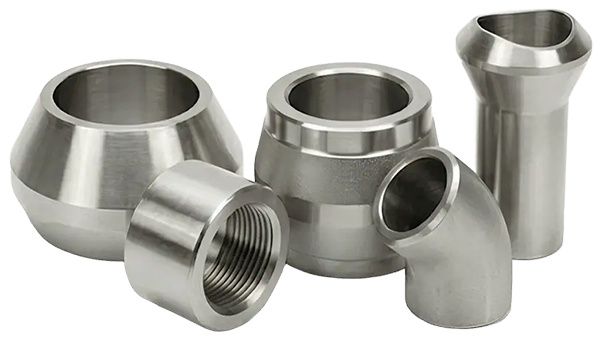
Main Advantages of Olets
Compact Structure: Welded directly to the outside of the main pipe, Olets do not occupy additional space, making them ideal for dense piping layouts.
Optimized Stress Distribution: The self-reinforcing design ensures smooth stress transitions at the connection, reducing the risk of fatigue cracking.
Reduced On-Site Workload: No need for making or welding reinforcement pads; after cutting the hole, the Olet can be installed directly.
Wide Applicability: Suitable for demanding conditions including high pressures (up to 9000#), high temperatures, and corrosive media.
Most Olets are used for 90° perpendicular branch connections, though 45° angled and elbow-mounted types are also available. End connections are flexible, including butt weld, socket weld, or threaded options.
Common Olet Types and Their Characteristics
Olets form a family of products, with different names corresponding to specific structures and purposes. Below are the eight most common types:
1. Weldolet (Butt-Weld Branch Connection)
Weldolet is the most typical Olet. It is directly welded onto the main pipe and features a bevel of approximately 37° for butt-welding the branch. This design allows a smooth flow transition, reducing localized resistance and stress concentration.
Applications: High-temperature, high-pressure systems where weld quality is critical.
Variants:
Forged Weldolet: Single-piece forging with dense metal structure, high strength, and good toughness; ideal for severe environments.
ASME Standard Weldolet: Manufactured to ASME standards with precise dimensions and material performance, ensuring international compliance and interchangeability.
2. Sockolet (Socket-Weld Branch Connection)
Sockolets feature a socket structure matching the branch pipe's outer diameter. During installation, the branch is inserted into the socket and welded with a fillet weld, eliminating the need for butt welding on the main pipe.
Pressure Ratings: Commonly 3000#, 6000#, and 9000#.
Applications: Medium- to low-pressure systems; simpler installation and cost-effective.
3. Thredolet (Threaded Branch Connection)
Thredolets use threaded connections, allowing installation without welding.
Pressure Ratings: Typically 3000# or 6000#.
Applications: Systems requiring frequent disassembly or maintenance, small-diameter pipelines, low-pressure fluid transport, or locations where hot work is prohibited.
4. Latrolet (45° Angled Branch Connection)
Latrolets provide a 45° branch, offering greater flexibility than standard 90° connections in space-limited areas or for controlling medium flow direction.
Connection Options: Available in butt-weld, socket-weld, or threaded types.
5. Elbolet (Elbow-Mounted Branch Connection)
Elbolets are designed for installation on elbows or curved sections, enabling 90° branches without adding extra fittings.
Typical Uses: Thermowell mounting, instrumentation connections.
6. Nipolet (Extended Neck Branch Connection)
Nipolets feature an extended pipe body, combining a short pipe and branch fitting in one piece.
End Connections: Butt-weld, socket-weld, or external thread; lengths can be customized.
Applications: Valve tapping, venting, drainage, and pressure vessel nozzle connections.
7. Sweepolet (Large-Diameter Streamlined Branch Connection)
Sweepolets are engineered for large-diameter branches. Their streamlined design ensures smooth flow transition and reduces stress concentration.
Advantages:
Extended fatigue life
Facilitates radiographic or ultrasonic inspection
8. Insert Weldolet (Insert-Style Reinforced Branch Connection)
Insert Weldolets add reinforcement to standard Weldolets, facilitating weld inspection and installation alignment. Suitable for systems with stringent weld quality requirements.
Sizing and Selection Considerations
Once the Olet type is determined, selecting the correct size and model is critical. Improper sizing can compromise system performance and safety.
1. Size Notation
Olet specifications are typically marked as “Main Pipe Range × Branch Pipe Size.”
Example: A “2”×36”×½” Olet fits main pipes from 2 to 36 inches in diameter and connects to a ½-inch branch.
Note: When installed on the largest main pipe, a radial gap of roughly 1/16 inch may exist. This gap is filled during welding and is usually negligible, provided installation is performed correctly.
2. Protecting Critical Stress Areas
Two strict rules apply in engineering design:
Do Not Modify: The crotch (inner transition zone) and shoulder are critical stress regions. Any alteration can cause failure.
Adjustable Areas: The skirt (outer non-critical edge) may be lightly trimmed to fit the main pipe curvature.
Simply put: critical stress zones remain untouched, non-critical zones can be fine-tuned.
3. Factors to Consider During Selection
Selection should evaluate:
Operating Conditions: Maximum system pressure, temperature extremes. Forged Weldolets are preferred for high-pressure, high-temperature systems.
Pipe Sizes: Ensure the main and branch sizes fall within the Olet’s specification range.
Media Characteristics: Corrosive media require stainless steel or corrosion-resistant alloys; non-corrosive media can use carbon steel.
Connection Method: Butt welds provide maximum strength but require skilled installation; socket welds are easier but slightly less robust; threaded connections are convenient but unsuitable for high pressure.
Maintenance Needs: Systems requiring frequent disassembly should use threaded types; stationary systems may favor welded types.
Industry Standards: Petroleum, chemical, and power sectors typically require compliance with ASME B16.11, among others.
4. Common Mistakes
Using low-grade materials under high-temperature, high-pressure conditions, leading to early creep or cracking.
Selecting non-corrosion-resistant alloys for aggressive media, causing rapid thinning.
Improper sizing resulting in excessive stress concentration or increased flow resistance.
Ignoring flow distribution, leading to insufficient branch flow or excessive mainline pressure drop.
Material Selection and Maintenance
Correct selection and installation are only the first steps. Long-term reliability depends on choosing materials suited to the conditions and performing routine maintenance.
1. Common Materials
Stainless Steel: Excellent corrosion resistance; ideal for chemical, marine, or high-humidity environments.
Carbon Steel: High strength and cost-effective; suitable for conventional systems like steam, compressed air, or general process fluids.
Engineering Plastics: For low-pressure, highly corrosive, and low-temperature media where metal Olets cannot endure.
Material choice must align with media type, temperature, and corrosive environment to ensure system longevity.
2. Compatibility with Standard Forged Fittings
High-performance Olets in high-pressure, corrosive, or high-reliability systems are often used with ANSI B16.11 standard stainless steel forged fittings. These fittings provide consistent strength, corrosion resistance, and connection integrity, widely applied in critical piping systems in oil, chemical, pharmaceutical, and energy industries.
3. Routine Maintenance Guidelines
To ensure reliable operation:
Regular Inspections: Check for corrosion, cracks, or leaks, especially at welds and transition zones.
Verify Installation Accuracy: Misalignment causes stress concentration, accelerating fatigue damage.
Adhere to Operating Limits: Avoid exceeding pressure or temperature limits. Short-term overexposure may not show immediate effects but causes cumulative damage.
Clean Deposits and Debris: Internal build-up impedes flow and can accelerate localized corrosion.
Maintain Maintenance Records: Document inspection dates, issues found, and corrective measures for trend analysis.
Conclusion
Olet branch connections are a highly practical and essential component of industrial piping systems. They constitute a complete solution family, including Weldolet, Sockolet, Thredolet, Latrolet, Elbolet, Nipolet, Sweepolet, and Insert Weldolet.
The core advantage lies in self-reinforcing structures, which provide compact, reliable connections with optimized stress distribution. This makes them especially suitable for high-pressure, high-temperature, complex, or space-constrained piping systems.
When selecting an Olet, engineers must consider operating conditions, pipe sizes, media characteristics, connection method, maintenance requirements, and industry standards. Common mistakes include ignoring operating conditions, improper sizing, and incorrect material selection. Regular maintenance should include checking for corrosion, cracks, leaks, and ensuring proper alignment, while strictly observing pressure and temperature limits.
Correctly selecting and applying Olets can significantly improve the safety, reliability, and cost-effectiveness of piping systems. When designing branch connections, start by defining operating conditions, then select the most suitable type, material, and size from the Olet family, and finally, install and maintain according to established standards.
Send your message to this supplier
Related Articles from the Supplier
Complete Guide to Olet Branch Connections
- May 06, 2026
Complete Guide to Flange Insulation Gasket Kits
- Mar 03, 2026
Complete Guide to Selecting Chemical Valves
- Mar 11, 2026
Complete Guide to Double-Ended Studs
- Mar 17, 2026
Complete Guide to Triple Eccentric Butterfly Valves
- Apr 23, 2026
Related Articles from China Manufacturers
Complete Guide to Forging Die Design
- Apr 03, 2026

Complete Guide to Low Fugitive Emission Valves
- Oct 16, 2025
Complete Guide to PTFE Packing Selection
- Mar 10, 2026
Complete Guide to Expanded Graphite Packing
- Mar 19, 2026
Complete Guide to Lubricated Plug Valves
- Jul 31, 2024
Complete Guide to Cryogenic Ball Valve Maintenance
- Aug 14, 2024
Related Products Mentioned in the Article

Supplier Website
Source: https://www.landee.cn/news/industry-news/complete-guide-to-olet-branch-connections.html