
An Introduction to PTFE Lined Ball Valves
In modern industrial sectors such as chemical processing, pharmaceuticals, food processing, and water treatment, companies often need to transport highly corrosive liquid media such as sulfuric acid, hydrochloric acid, caustic soda, or various organic solvents. If ordinary metal valves are used in such environments, these corrosive media can easily erode the internal metal components of the valve, leading to leakage, damage, and failure. This not only increases maintenance costs but may also cause production interruptions and even serious safety accidents.
To address this challenge, the PTFE lined ball valve was developed. This type of valve incorporates a layer of polytetrafluoroethylene (PTFE) lining inside a standard metal ball valve. PTFE is a chemically highly stable material, often referred to as the “king of plastics.” It is almost completely non-reactive with most acids, alkalis, and chemical solvents. This lining effectively isolates the flowing corrosive media from the metal valve body, thereby protecting the structural integrity of the valve.
In this blog, we provide a detailed introduction to the advantages, working principles, structural characteristics, main application areas, and key selection considerations of PTFE lined ball valves.
What Is a PTFE Lined Ball Valve?
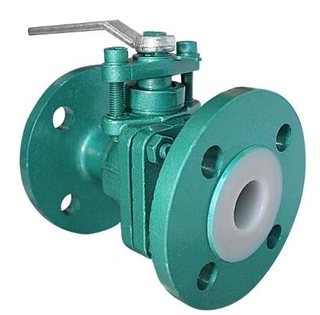
A PTFE lined ball valve is an industrial valve specifically designed for controlling corrosive media. It operates using a quarter-turn mechanism, and its internal metal body is fully coated with polytetrafluoroethylene (PTFE).
This PTFE lining forms a reliable barrier between the process medium and the metal components, effectively preventing corrosion, scaling, and contamination issues. PTFE is a high-performance fluoropolymer with excellent chemical stability and non-stick properties. Thanks to these characteristics, PTFE lined ball valves can operate stably in highly aggressive chemical environments while maintaining excellent sealing performance and smooth operation.
At present, this type of valve is widely used in chemical, pharmaceutical, food and beverage, water treatment, and petrochemical industries, making it an important device for handling and controlling corrosive fluids.
Main Advantages of PTFE Lined Ball Valves
The PTFE lined ball valve occupies an important position in corrosive media applications because it integrates multiple superior performance characteristics. Compared with conventional metal valves, it demonstrates significant advantages in corrosion resistance, thermal stability, operational smoothness, safety, and service life. The key advantages are outlined below.
1. Excellent Corrosion Resistance
PTFE is considered one of the most chemically inert engineering materials. It can resist most acids, alkalis, salts, organic solvents, and other corrosive media.
Once the valve is lined with PTFE, the corrosive medium cannot come into contact with the metal body, effectively protecting the valve structure and significantly extending its service life. In addition, PTFE does not react with most process fluids, ensuring product purity and preventing contamination. This makes it particularly suitable for industries such as pharmaceuticals, biotechnology, and food processing where high cleanliness standards are required.
2. Outstanding Thermal Stability
PTFE has excellent thermal stability and can maintain its performance over a relatively wide temperature range. Even under elevated temperature conditions, PTFE does not easily degrade or fail. This ensures reliable valve performance in high-temperature corrosive environments.
3. Self-Lubricating Properties Reduce Operating Resistance
PTFE has natural self-lubricating properties, which significantly reduce friction during valve opening and closing operations. This allows smoother and more stable operation. The self-lubrication also reduces wear on internal components and lowers the required operating torque, improving equipment reliability while reducing maintenance frequency and operational costs.
4. Excellent Safety Performance
Modern industrial production places increasingly high demands on equipment safety and personnel protection. PTFE has excellent electrical insulation properties, reducing safety risks related to conductivity or high temperatures.
The PTFE lining forms a continuous anti-corrosion barrier, preventing direct contact between corrosive media and the metal body, thereby reducing leakage risks and equipment failure. For systems handling highly corrosive fluids, PTFE lined ball valves not only enhance operational reliability but also help reduce safety hazards and maintenance costs.
5. Low Friction and Non-Stick Properties
PTFE lined ball valves have extremely low friction coefficients and strong non-stick properties. This prevents media from adhering to the internal surfaces of the valve, reducing the risk of buildup and clogging.
Even when handling high-viscosity or highly corrosive fluids, the valve maintains smooth operation and stable flow control performance.
6. Wear Resistance and Long Service Life
PTFE materials have good wear resistance and anti-aging properties, making them suitable for long-term operation without significant performance degradation. This extends the service life of the valve and reduces downtime and maintenance frequency. In industrial production, continuous and reliable operation is critical to efficiency and product quality, and PTFE lined ball valves provide clear advantages in this regard.
Working Principle and Structural Characteristics
To understand why PTFE lined ball valves can achieve reliable sealing and flexible control under corrosive conditions, it is necessary to examine their working principle and internal structure. Compared with standard ball valves, PTFE lined versions have special design features in the ball coating, valve lining, and sealing system.
1. Working Principle of PTFE Lined Ball Valve
PTFE lined ball valves operate using a quarter-turn mechanism. Inside the valve body is a spherical ball with a through hole. The surface of the ball is coated or fully lined with PTFE and connected to a stem that is operated by a handle or actuator.
When the bore of the ball aligns with the pipeline direction, the medium flows freely through the valve. When the stem rotates the ball by 90 degrees, the solid portion of the ball blocks the flow path completely. In the closed position, the PTFE-coated ball tightly contacts the PTFE seat, forming a reliable seal that achieves zero or near-zero leakage.
The operation process is simple, fast, and requires low torque, making it suitable for systems that require frequent switching and rapid shutoff.
2. PTFE Lined Ball Valve Structural Design
In terms of structure, PTFE lined ball valves typically use high-strength carbon steel, stainless steel, or cast steel as the external pressure-bearing shell to ensure mechanical strength and pressure resistance. The internal wetted surfaces are fully lined with fluoroplastic materials such as PTFE, PFA, or FEP.
The ball, as the core flow control element, is precisely machined and fully encapsulated to ensure corrosion resistance equivalent to the valve body. Some high-performance designs integrate the ball and stem into a single structure to reduce potential leakage points and improve reliability.
Valve seats and sealing components are also made of PTFE. In the closed position, they form a tight seal with the ball, ensuring excellent sealing performance and long-term stability.
3. Key Role of the PTFE Lining
The PTFE lining plays a critical role in valve performance. By covering all wetted surfaces, including the internal cavity, ball surface, and sealing areas, the valve forms a continuous protective barrier.
This barrier prevents corrosive media from contacting the metal substrate, fundamentally solving the corrosion issues common in traditional metal valves. It also prevents metal ion contamination, which is especially important for high-purity applications.
Main Applications for PTFE Lined Ball Valves
Due to their excellent corrosion resistance and purity characteristics, PTFE lined ball valves are widely used across various industrial sectors. Different industries emphasize different performance requirements, such as chemical resistance, purity, or non-contamination.
- Chemical Industry: In the chemical industry, PTFE lined ball valves are commonly used for handling sulfuric acid, hydrochloric acid, nitric acid, caustic soda, and various organic solvents. Chemical production environments involve highly corrosive substances, making corrosion resistance essential. These valves significantly extend equipment life and reduce maintenance costs.
- Pharmaceutical and Biotechnology: In pharmaceutical and biotechnology applications, PTFE lined ball valves are used for high-purity fluids and sensitive media. These industries require compliance with strict FDA and GMP standards. PTFE does not react with process media or release metal ions, making it suitable for highly regulated environments.
- Food and Beverage Industry: In food and beverage applications, PTFE lining prevents contamination and ensures compliance with hygiene and safety standards. The non-stick nature of PTFE also facilitates cleaning and reduces microbial growth risks.
- Water and Wastewater Treatment: In water treatment systems, valves must withstand various chemical agents used in purification and conditioning processes. PTFE lined ball valves provide long-term resistance to these chemicals, ensuring reliable flow control.
- Petrochemical and Refining Industry: In petrochemical and refining environments, PTFE lined ball valves offer dependable performance under highly corrosive and complex operating conditions, compensating for the limitations of traditional metal valves.
- Semiconductor Industry: Semiconductor manufacturing requires ultra-high purity chemicals and gases. PTFE lined ball valves ensure non-contamination and maintain process cleanliness, meeting strict industry requirements.
How to Select a PTFE Lined Ball Valve?
Proper selection is essential to ensure long-term reliable operation. PTFE lined ball valves come in various specifications, lining materials, and structural designs. Incorrect selection may result in lining deformation, wear, or leakage.
- Chemical Compatibility: First, confirm that the PTFE lining is compatible with the process medium. Although PTFE is highly inert, compatibility verification is still necessary for long-term performance assurance.
- Operating Temperature and Pressure: Select a valve that meets actual temperature and pressure conditions. PTFE has lower temperature and pressure limits compared to all-metal valves. Excessive temperature may cause softening or deformation, while excessive pressure may affect sealing performance and service life.
- Connection Type: Common connection types include flanged, threaded, and special configurations. The selected type should match the existing pipeline system to ensure proper installation and sealing.
- Valve Size: Valve size should be determined based on flow requirements and pipe diameter. Undersized valves may cause pressure loss, while oversized valves may reduce control accuracy and economic efficiency.
- Certification Standards: For pharmaceutical, food, or export applications, compliance with standards such as FDA, ANSI, and ISO is essential to ensure regulatory conformity and project acceptance.
- Media Characteristics: Consider whether the medium contains abrasive particles. PTFE is relatively soft and may wear under high solid content or slurry conditions. In such cases, alternative solutions such as ceramic-lined valves or metal-seated valves may be more suitable.
Conclusion
PTFE lined ball valves combine advanced fluoropolymer corrosion resistance technology with a mature ball valve structure, providing reliable flow control and excellent chemical resistance. They offer advantages such as corrosion resistance, wear resistance, electrical insulation, and low friction, making them ideal for handling corrosive media in various industries.
Whether in strong acid and alkali systems or in highly demanding pharmaceutical and food processing environments, PTFE lined ball valves deliver stable sealing performance and long-term reliability. By selecting appropriate specifications and designs, companies can improve efficiency, product quality, and operational safety while reducing maintenance costs.
For industrial systems requiring corrosive media handling, fluid purity maintenance, or reduced maintenance costs, PTFE lined ball valves represent a highly economical, reliable, and long-term solution. With proper selection and adherence to operating conditions, they provide safe, efficient, and stable performance even in the most demanding industrial environments.
Send your message to this supplier
Related Articles from the Supplier
An Introduction to PTFE Lined Ball Valves
- Jun 01, 2026
An Introduction to Through-Conduit Knife Gate Valve
- Sep 04, 2025
An Introduction to Full-Lift Safety Valve
- Sep 19, 2025
An Introduction to Orbit Ball Valve
- Nov 26, 2025
An Introduction to Metal-Seated Butterfly Valves
- Jan 07, 2026
Related Articles from China Manufacturers

An Introduction to the Digital Two Way Radios
- May 16, 2017
An Introduction to Heated Welding Ball Valves
- Aug 10, 2020
An Introduction to Stainless Steel Ball Valves
- Aug 20, 2020

An Introduction to 23mn Steel Pipe
- Aug 29, 2020
An Introduction to Coated Steel Pipes
- Jan 06, 2021
An Introduction to Flange Joints
- Aug 19, 2020

An Introduction to Vacuum Packaging for Food
- Mar 03, 2021
Related Products Mentioned in the Article




Zhejiang Kosen Valve Co., Ltd.
- https://www.kosenvalve.com/
- Business Type: Industry & Trading, Manufacturer,
Supplier Website
Source: https://www.kosenvalve.com/media-hub/an-introduction-to-ptfe-lined-ball-valves.html