
An Complete Guide to Monoflange Valve
A monoflange valve is a compact valve device specifically used in industrial instrumentation systems. Simply put, it integrates the functions of multiple valves into a single flanged valve body, and is used to replace the traditional multi-valve installation method.
Traditional instrumentation installation requires multiple independent valves to be installed on pipelines and connected through tubing. This method not only occupies a large amount of space, has many connection points, but also is heavy in weight and complex to install. The emergence of the monoflange valve solves these problems. It integrates one, two, or three needle valves into a compact flanged valve body, greatly reducing volume, size, weight, and potential leakage points.
The main function of the monoflange valve is to isolate and vent pressure measurement instruments. Although its working principle is similar to that of traditional valves, its structure is more compact, and it is especially suitable for process environments containing corrosive or harsh media.
Internal Structure of the Monoflange Valve
The core design of the monoflange valve lies in its precise internal channels and valve chamber network. Channels are formed inside the valve body through drilling, and these channels connect the various annular valve chambers.
When the first isolation valve is opened, the fluid flows toward the second isolation valve; when the second valve is opened, the instrument port is connected to the process pipeline. When the first isolation valve is closed, the bleed valve becomes the only channel to release the trapped medium between the valve and the instrument. In order to ensure smooth flow, the isolation valves are usually arranged at a certain angle.
This internal structural design enables the monoflange valve to achieve complex functions within a very small space while maintaining reliable performance.
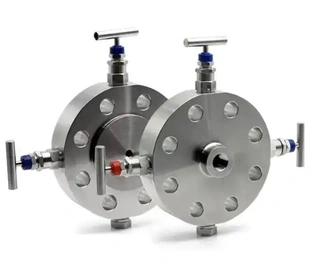
Main Types of Monoflange Valves
According to different configurations, monoflange valves are mainly divided into the following types:
1. Single Block Valve
This is the most basic configuration, with only one isolation valve, used for simple isolation functions. It is suitable for some basic instrumentation installation scenarios.
2. Block and Bleed Valve (Block & Bleed)
This configuration includes two valves: one valve (usually with a blue cap) is used to isolate the process medium, and the other valve (usually with a red cap) is used to regulate the discharge of the trapped medium inside the instrument.
This dual-valve configuration is usually used in relatively non-critical working conditions, such as low-pressure environments, or in situations where a primary isolation valve has already been installed upstream of the monoflange valve.
3. Double Block and Bleed Valve (Double Block & Bleed, DBB)
This is the safest configuration and is also the solution we recommend for handling corrosive media or critical working conditions. It includes two isolation valves arranged in series and one bleed valve.
The two isolation valves provide more reliable process isolation: if the first isolation valve cannot completely seal the medium, the second valve will serve as a safety guarantee to prevent accidental leakage.
In some cases, customer specifications do not allow the medium to contact the instrument when the instrument is not measuring, so it is necessary to discharge the medium through a bleed line. In other applications, with the help of a bleed line, calibration can be easily performed without removing the instrument.
From the perspective of series classification, monoflange valves mainly include instrumentation monoflange valves and process monoflange valves. Users can choose the appropriate type according to actual needs.
Core Advantages of Monoflange Valves
- Compact Structure, Space Saving: The monoflange valve integrates the functions of multiple valves into a compact valve body, greatly reducing the space required for installation. Even in areas with limited space in factories or assembly units, it can be easily installed and used.
- Reduced Leakage Points, Improved Safety: Compared with traditional multi-valve installation methods, monoflange valves significantly reduce potential leakage points by reducing connection paths. The fewer the connections, the lower the risk of leakage, making the system more compact
- Lightweight, Easy to Install: Monoflange valves are lightweight, making them easy to transport and install, while also effectively reducing overall weight and related component costs.
- Reduced Impact of Vibration: Vibration is a key issue in industrial instrumentation systems. When impulse lines are connected to vessels, the longer the connection, the greater the vibration amplitude, which may lead to damage of the nozzle. The compact design of the monoflange valve significantly reduces the stress caused by vibration and load.
- Fast Response Speed: In chemical processes, most control applications require fast response speed. One of the factors affecting response time is the volume and distance between the process and the instrument. The monoflange valve installs the instrument close to the process, significantly improving response speed. If the measured medium is gas, and the process fluctuates greatly at certain times or has high control requirements, this compact design is the best solution.
- Strong and Durable, Long Service Life: The monoflange valve adopts an integral structure design, which can withstand high pressure without cracking, damage, or leakage. Compared with traditional systems that used large block valves in the early stage, monoflange valves are not only lighter in structure but also easier to operate and maintain, avoiding the problems of old-style valves being bulky, prone to leakage, and requiring frequent maintenance and replacement.
- Excellent Sealing Performance: To further improve performance, manufacturers usually adopt a combination of graphite sealing and metal sealing, enabling it to maintain excellent sealing performance and prevent leakage even under high-temperature conditions. The monoflange valve also adopts a bubble-tight metal valve seat that has undergone leakage testing. This structure provides excellent sealing performance under high pressure and extreme working conditions.
Application Scenarios of Monoflange Valves
Monoflange valves are widely used in multiple industrial fields:
1. Oil and Gas Industry
In the process of oil and gas extraction, transportation, and processing, monoflange valves are used in pressure measurement and control systems. It is especially suitable for harsh application environments such as sour gas or natural gas treatment.
2. Chemical and Petrochemical Industry
Chemical processes often involve corrosive media and harsh working conditions. The DBB configuration of the monoflange valve provides double safety protection to ensure safe operation in hazardous media environments.
3. Power Industry
In critical working conditions such as steam turbine systems with high requirements for pressure resistance and temperature resistance, monoflange valves play an important role.
4. Refining Units
In the refining process, accurate pressure measurement and reliable isolation are required, and monoflange valves can meet these requirements.
5. Nitrogen Generation Units
Monoflange valves are also suitable for systems such as nitrogen generation units, providing reliable sealing and isolation functions.
6. General Industrial Units
In general industrial fields such as machinery manufacturing and mining, monoflange valves have become key components in industrial process control and instrumentation installation due to their compact structure, reliable sealing, and high safety.
How Monoflange Valves Solve Fugitive Emission Problems
In industrial applications, fugitive emissions (such as hazardous gas leakage) are an important issue, especially in chemical processes or in situations involving toxic and harmful gases.
To ensure that monoflange valves can still maintain reliable performance in extreme temperatures and corrosive media environments, they are usually manufactured with high-quality materials and undergo multiple quality inspections to ensure stable operation under various working conditions.
The bubble-tight metal valve seat design of the monoflange valve provides excellent sealing performance under high pressure and extreme working conditions, effectively reducing the risk of harmful gas leakage. This design makes it particularly suitable for handling toxic and harmful gases.
Monoflange Valves vs. Traditional Multi-Valve Systems
Compared with traditional multi-valve systems, monoflange valves have obvious advantages in many aspects.
- From the perspective of volume, monoflange valves have a compact structure and occupy less space, while traditional multi-valve systems require multiple independent valves and connecting pipelines, resulting in a large volume.
- From the perspective of weight, monoflange valves are lightweight, while traditional multi-valve systems are heavier.
- From the number of leakage points, monoflange valves have fewer connection points and correspondingly fewer leakage points, while traditional multi-valve systems have more connection points and higher leakage risks.
- From the installation complexity, monoflange valves are easy to install and can be directly installed with flanges, while traditional multi-valve systems require multiple connection points and have a complex installation process.
- From the impact of vibration, monoflange valves are less affected by vibration due to their compact structure, while traditional multi-valve systems have long pipelines and large vibration amplitudes, which can easily lead to nozzle damage.
- From the maintenance cost, monoflange valves are simple to maintain and low in cost, while traditional multi-valve systems are complex to maintain and costly.
- From the response speed, monoflange valves have fast response speed, while traditional multi-valve systems respond relatively slowly.
- From the service life, monoflange valves are strong and durable with a long service life, while traditional multi-valve systems have a relatively shorter lifespan.
- From the comprehensive comparison above, it can be seen that monoflange valves are superior to traditional multi-valve installation methods in terms of efficiency, cost, and safety.
How to Choose the Right Monoflange Valve
When selecting a monoflange valve, the following factors need to be considered:
1. Operating Pressure
Select the appropriate pressure rating according to the working pressure of the system. Monoflange valves can withstand high pressure, but the pressure ratings of different models vary.
2. Medium Characteristics
If the measured medium is corrosive or toxic, it is recommended to select a DBB configuration and choose suitable materials and sealing methods.
3. Temperature Range
For high-temperature working conditions, it is necessary to select models that use a combination of graphite sealing and metal sealing to ensure excellent sealing performance at high temperatures.
4. Installation Space
If the installation space is limited, the compact design of the monoflange valve is an ideal choice.
5. Safety Requirements
For critical working conditions, a DBB configuration must be selected to provide double safety protection.
6. Supporting Instruments
Monoflange valves can be used together with pressure measurement devices, diaphragm seals, and level measurement instruments. Compatibility with existing instruments needs to be considered during selection.
Installation and Maintenance of Monoflange Valves
Installation: Monoflange valves can be directly installed on process flanges, providing a stable installation method. The following points should be noted during installation: First, ensure that the flange surface is clean and undamaged. Second, tighten the bolts according to the specified torque. Third, pay attention to the valve direction to ensure correct fluid flow direction. Finally, check whether the sealing components are intact.
Routine Maintenance: Monoflange valves have a simple structure and are easy to maintain. Routine maintenance mainly includes regular inspection of valve sealing performance, checking whether there is leakage at each connection point, operating the valve regularly to prevent sticking, and cleaning the outside of the valve to prevent corrosion. Because the monoflange valve adopts an integral structure, it avoids the maintenance complexity caused by multiple connection points and greatly reduces maintenance costs.
Summary
As an innovative industrial instrumentation valve solution, the monoflange valve integrates multiple valve functions into a compact valve body, solving the problems of large size, heavy weight, many leakage points, and slow response in traditional multi-valve systems.
Its main advantages include compact structure and space saving, reduced leakage points and improved safety, lightweight and easy installation, reduced vibration impact, fast response speed, strong and durable with long service life, and excellent sealing performance.
Monoflange valves are widely used in oil and gas, chemical and petrochemical, power, refining, and other industries, and are especially suitable for working conditions involving corrosive or harsh media.
When selecting a monoflange valve, it is necessary to comprehensively consider factors such as operating pressure, medium characteristics, temperature range, installation space, safety requirements, and supporting instruments.
Whether for simple isolation functions or critical working conditions requiring double safety protection, monoflange valves can provide reliable solutions. It represents technological innovation in industrial instrumentation system management and is an indispensable key component in modern industrial process control.
For industrial applications that require high-precision pressure measurement and reliable process isolation, the monoflange valve is undoubtedly an efficient, safe, and economical choice.
Send your message to this supplier
Related Articles from the Supplier
An Complete Guide to Monoflange Valve
- Apr 16, 2026
An Introduction to Through-Conduit Knife Gate Valve
- Sep 04, 2025
An Introduction to Full-Lift Safety Valve
- Sep 19, 2025
An Introduction to Orbit Ball Valve
- Nov 26, 2025
An Introduction to Metal-Seated Butterfly Valves
- Jan 07, 2026
Related Articles from China Manufacturers


An Introduction to the Digital Two Way Radios
- May 16, 2017

An Exclusive Range of Non Return Valves Announced
- Apr 23, 2014
An Introduction of Swing Check Valves
- Aug 23, 2017

An Unforgettable Trip to Wuyi Mountain
- Dec 28, 2015
Related Products Mentioned in the Article

Zhejiang Kosen Valve Co., Ltd.
- https://www.kosenvalve.com/
- Business Type: Industry & Trading, Manufacturer,
Supplier Website
Source: https://www.kosenvalve.com/media-hub/an-complete-guide-to-monoflange-valve.html