
Guide to Swing Check Valves: Principles, Types & Applications
The swing check valve, also known as a non-return valve or reverse flow valve, is an automatic valve installed in a unidirectional pipeline. Its core function is to prevent backflow of the medium in the pipeline, thereby ensuring the safe operation of the pipeline system. Unlike valves that require manual operation or external power, the swing check valve relies entirely on the pressure of the medium in the pipeline to open or close automatically, requiring no manual intervention and no electrical or pneumatic drive. This type of valve is widely used in industrial piping systems and is one of the more commonly used types of check valves. According to the structure of the disc, swing check valves can be divided into three main types: single-disc, double-disc, and multi-disc, each suitable for different pipe diameters and operating conditions.
Working Principle of Swing Check Valves
Understanding the working principle of a swing check valve helps in correct selection and use. The valve's working mechanism is based on a clever combination of fluid dynamics and mechanical structure.
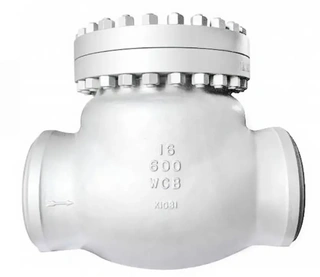
- Opening under normal flow: When fluid flows in the designated direction (usually designed from left to right), the pressure at the disc inlet is higher than at the outlet. Under this pressure difference, the disc is pushed away from the seat and rotates around the hinge pin to a certain angle. At this point, the valve is fully open, and the fluid can flow smoothly. Because the internal passage of the valve is designed to be streamlined, the resistance to fluid flow is relatively small, which is an important advantage of swing check valves.
- Automatic closure under reverse flow: When fluid shows a tendency to flow backward (from right to left), the pressure on the right side of the disc becomes higher than the left side. The force generated by the pressure difference presses the disc tightly against the seat, blocking the fluid passage and achieving a sealing effect. It is noteworthy that the higher the fluid pressure, the tighter the disc is pressed against the seat, and the better the sealing effect. This self-sealing characteristic allows swing check valves to perform well under high-pressure conditions.
- Auxiliary sealing mechanism: To improve sealing reliability, especially under low-pressure conditions, swing check valves are usually equipped with auxiliary springs and counterweights. These auxiliary devices ensure that the disc remains in close contact with the seat even when the medium pressure is low, preventing leakage. In addition, a damping structure is arranged on the disc. This design effectively prevents water hammer caused by sudden disc closure, thereby reducing seat wear and extending the valve's service life.
Main Structural Components of Swing Check Valves
The swing check valve has a relatively simple structure, mainly composed of four core components:
- Valve body: The valve body is the main structure of the valve and forms the fluid passage inside. The body channel is designed in a streamlined manner, which is key to the low flow resistance of swing check valves. The material of the valve body is usually selected based on the characteristics of the medium, commonly including cast iron, cast steel, stainless steel, etc., to adapt to different corrosion environments and temperature conditions.
- Valve cover: The cover is connected to the body to form a sealed chamber, protecting the internal components. Its design must consider sealing and removability to facilitate later maintenance and inspection.
- Valve disc: The disc is disc-shaped and is the key component controlling the on-off of the medium. The disc is connected to the lever and can rotate around the hinge pin to a certain angle. The design of the disc and seat has been continuously optimized, and modern manufacturing uses new materials and precision processing technologies, significantly improving sealing performance and wear resistance.
- Lever and hinge pin: The lever connects the disc and the hinge pin, which is fixed on the body. The axis of the hinge pin must remain in the same plane as the body's sealing surface, which is an important geometric condition to ensure a good seal when the valve closes. Through the spherical connection structure, the disc maintains a certain degree of freedom during operation, allowing it to automatically adjust its position to adapt to changes in fluid conditions, thereby achieving a longer service life.
Three Types of Swing Check Valves
According to the number and structure of discs, swing check valves are divided into three types: single-disc, double-disc, and multi-disc, mainly selected according to the valve diameter.
- Single-disc swing check valve: The single-disc structure is the simplest, with only one disc. This type is generally suitable for medium-diameter pipelines. When used in large-diameter pipelines, it is recommended to select a slow-closing single-disc swing check valve to reduce water hammer. The slow-closing design can extend the closing time and reduce the damage caused by water hammer.
- Double-disc swing check valve: The double-disc structure includes two discs and is suitable for medium to large pipelines. The wafer-type double-disc swing check valve is a compact and lightweight product. The two discs are symmetrically arranged, and the forces during opening and closing are more balanced. This structure, due to its excellent performance and smaller installation space requirement, is considered a promising product, and its application in modern pipeline projects is increasingly widespread.
- Multi-disc swing check valve: The multi-disc structure includes three or more discs and is mainly suitable for low-pressure, large-diameter pipelines. Multiple discs share the force of the medium, reducing the load on a single sealing surface, but the structure is relatively complex, and manufacturing costs are higher.
Core Advantages of Swing Check Valves
Compared with other types of check valves, swing check valves have the following notable advantages:
- Compact and lightweight: The structure is compact, especially the double-disc type, occupying less installation space and being relatively light in the same diameter, convenient for transport and installation.
- Low fluid resistance: Due to the streamlined internal channel design, the flow resistance of swing check valves in the open state is significantly lower than that of lift check valves. This feature makes them particularly suitable for low-velocity, large-diameter applications, reducing pump energy consumption and saving operating costs.
- Lower water hammer pressure: Although swing check valves are more prone to water hammer than spring check valves, their water hammer pressure during closing is lower than that of lift check valves. Combined with damping structure design, water hammer effects can be further alleviated.
- Convenient and flexible operation: As an automatic valve, swing check valves require no external power and rely on the medium's pressure to open and close automatically, making operation extremely simple. Meanwhile, the opening and closing process is smooth, suitable for occasions requiring frequent operation or flow adjustment.
- Long service life: With optimized disc and seat design, new materials, and advanced manufacturing processes, modern swing check valves have excellent corrosion and wear resistance, significantly extending service life. Spherical connection structures reduce mechanical wear, further enhancing reliability.
- Flexible installation position: Swing check valves can be installed at any position on horizontal pipelines, convenient to install, with low maintenance costs. However, to ensure normal operation, horizontal installation is generally required.
- Reliable sealing performance: When the valve closes, reverse medium pressure acts on the disc to form sealing force; the higher the pressure, the better the sealing. Reasonable sealing surface design can achieve reliable sealing under various pressure conditions, ensuring system stability.
Suitable Operating Conditions and Selection Points
- Suitable medium conditions: Swing check valves are best used in relatively clean pipelines. Since the disc needs to rotate around the axis, the medium should not contain excessive solid particles, which may cause disc jamming, insensitivity in opening, or even incomplete sealing. The medium's viscosity should not be too high, as high viscosity increases disc movement resistance and affects valve responsiveness.
- Suitable flow characteristics: Swing check valves are suitable for low-speed, relatively stable flow and are not suitable for pulsating flow. They perform especially well in large-diameter pipelines with stable flow. For systems with frequent reverse or pulsating flow, spring check valves are recommended for faster response and quieter operation.
- Installation direction requirement: Swing check valves are generally installed in horizontal pipelines and must align with the valve's flow direction marking. They are less suitable for vertical flow, in which case spring check valves are preferable due to vertical installation capability.
- Diameter selection principle: Selection mainly depends on pipeline diameter: medium diameter uses single-disc, medium to large uses double-disc, and low-pressure large diameter can consider multi-disc. For large-diameter high-pressure pipelines, slow-closing single-disc valves should be prioritized to control water hammer.
Usage Precautions and Maintenance Recommendations
- Prevent water hammer hazards: Swing check valves close relatively slowly, prone to water hammer. Pipeline design should minimize sudden changes in flow and velocity. Another solution is installing a pressure-reducing valve upstream, releasing pressure before it reaches the check valve to protect the pipeline system.
- Control sealing pressure: Sealing performance is closely related to medium pressure. High-pressure conditions provide strong sealing, but actual sealing pressure must not exceed allowable material limits to avoid damage. Low-pressure conditions provide weaker sealing, which can be ensured by optimizing sealing surface design (e.g., reducing sealing surface width). Design calculations must ensure actual sealing pressure is greater than required sealing pressure and below the material's allowable pressure, balancing sealing and safety.
- Regular inspection and maintenance: Although swing check valves are simple and reliable, periodic inspection of disc and seat wear, cleaning of accumulated debris, and checking the lubrication of hinge pins are necessary. Damaged sealing surfaces should be repaired or replaced promptly to ensure sealing performance.
- Material selection: Select body, disc, and sealing materials based on medium corrosion, temperature, and pressure. Common choices include: cast iron or brass for ordinary water systems; stainless steel or special alloys for corrosive media; heat-resistant alloy steel for high temperature and pressure.
Comparison with Lift Check Valves
In practical selection, swing check valves are often compared with lift check valves, each having characteristics:
- Flow resistance: Swing check valves have streamlined internal channels, lower resistance than lift check valves, better for large-diameter, low-flow applications.
- Sealing performance: Lift check valves usually have better sealing, advantageous for strict sealing requirements.
- Applicable diameter: Swing check valves suit large-diameter pipelines; lift check valves mainly for medium and small.
- Installation direction: Swing check valves generally require horizontal installation; lift check valves also mainly horizontal.
- Response speed: Lift check valves close faster; swing check valves close slower, slightly higher water hammer risk.
- Flow state suitability: Swing check valves are unsuitable for pulsating flow; lift check valves adapt slightly better.
Conclusion
As a simple and reliable automatic valve, the swing check valve plays an important role in industrial pipeline systems. Its automatic operation driven by medium pressure makes it an ideal choice to prevent backflow and ensure system safety. Through reasonable selection (single, double, or multi-disc), correct installation (horizontal, correct flow direction), and regular maintenance, its advantages, low flow resistance, long service life, and reliable sealing, can be fully realized.
When selecting a valve, factors such as medium characteristics (cleanliness, viscosity), flow state (stable or pulsating), and pipeline parameters (diameter, pressure, installation direction) must be considered. It may also be compared with lift or spring check valves to choose the most suitable type for specific conditions. With advances in material science and manufacturing technology, the performance of swing check valves continues to improve, especially new structures such as double-disc wafer types, representing the development trend of this product and expanding its applications.
Send your message to this supplier
Related Articles from the Supplier
Guide to the Selection of PTFE Packing
- Aug 02, 2025
Guide to Valve Sealing Surface Repair and Grinding
- Aug 08, 2025
Related Articles from China Manufacturers

Guide to Liquid Die Forging Technology
- May 20, 2025
Guide to Nickel-Based Alloy Open Die Forging
- Dec 09, 2025
Guide to Multi-Directional Die Forging Technology
- Feb 04, 2026
Guide to Metal Forging with Presses
- Mar 17, 2026
Related Products Mentioned in the Article
![A Guide to Computer User Support for Help Desk [Book]](https://img.jeawincdn.com/resource/upfiles/153/images/products/custom-full-color-printing/custom-catalogs/resize/3f25b1a83689330016a4063627d10c04/CC002-A-Guide-to-Computer-User-Support-for-Help-Desk-Book-320x320.webp)


Supplier Website
Source: https://www.valvepackingsealkits.com/news/guide-to-swing-check-valves-principles-types-applications.html