
Swing Check Valve: Structure, Principle & Application
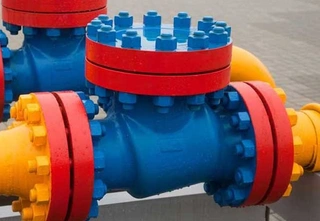
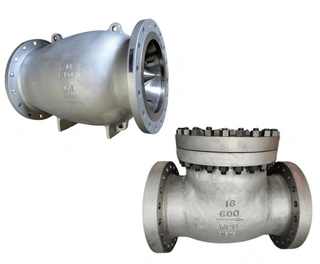
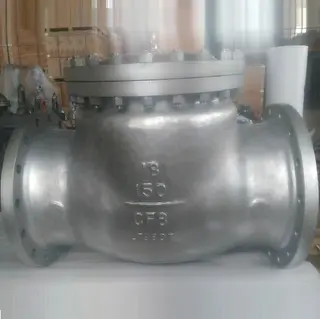
A swing check valve is an automatic valve used in pipelines to ensure unidirectional flow, with its primary function being to prevent backflow of the medium. It is also commonly referred to as a non-return valve, reflux valve, or one-way valve. This type of valve operates automatically by relying on the pressure of the flowing medium to open or close, without the need for manual intervention, making it one of the most widely used valves in industrial piping systems. The defining feature of a swing check valve is its disc, which is connected to a hinge arm and can rotate around a pivot pin through a certain angle. When fluid flows in the designated direction, the disc is pushed open, allowing the valve to open. When the flow reverses, the disc is pressed against the valve seat by differential pressure, preventing backflow. This automatic opening and closing mechanism makes the swing check valve essential in various industrial piping systems.
Structure of a Swing Check Valve
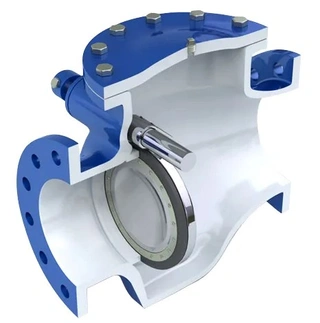
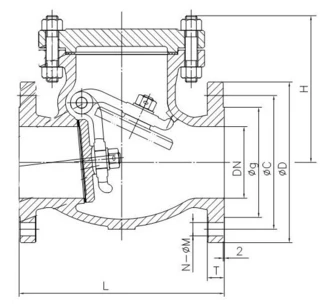
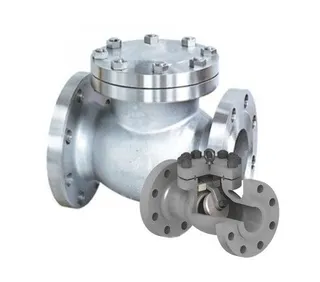
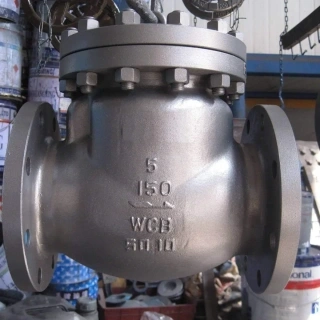
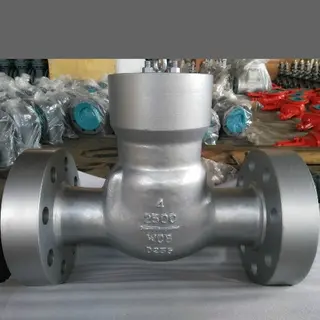
A swing check valve mainly consists of four core components: the valve body, bonnet, disc, and hinge arm. These parts work together to ensure proper valve operation.
1. Valve Body and Bonnet
The valve body forms the main structure and provides the flow passage for the medium. Swing check valves typically adopt an internal hinge design, where all moving parts are installed inside the valve body without penetrating it. Except for the mid-flange sealing area, which uses gaskets and sealing rings, the valve is free from external leakage points, fundamentally eliminating the risk of external leakage. This design significantly enhances safety and reliability.
2. Disc and Hinge Arm
The disc serves as the opening and closing element, while the hinge arm connects the disc to the valve body and provides rotational support. The connection between the disc and hinge arm often adopts a spherical joint structure, allowing the disc a certain degree of freedom within a 360-degree range. This enables slight positional compensation, extending service life and improving sealing performance through automatic alignment.
3. Auxiliary Structures
To enhance sealing performance, swing check valves are often equipped with auxiliary springs and counterweights. These devices ensure effective sealing even under low-pressure conditions. In addition, damping mechanisms may be installed on the disc to slow down the closing speed, preventing water hammer caused by sudden closure. This reduces seat wear and extends valve life.
Working Principle of a Swing Check Valve
The operation of a swing check valve is based on fluid pressure and gravity, as described below:
1. Opening Process
When fluid flows in the specified direction (e.g., from left to right), the inlet pressure exceeds the outlet pressure. Under this differential pressure, the disc is pushed away from the seat and rotates around the hinge pin to an open position. The medium flows freely with minimal resistance. The pressure required to initiate opening is known as the cracking pressure. When the fluid velocity and pressure exceed this value, the valve opens automatically.
2. Closing Process
When the pressure differential decreases or flow stops, the disc returns to the closed position under its own weight. If reverse flow occurs (e.g., from right to left), the pressure on the downstream side becomes greater than that on the upstream side, forcing the disc tightly against the seat and preventing backflow. Notably, higher reverse pressure results in tighter sealing.
3. Sealing Mechanism
After closure, the sealing force is generated by the reverse medium pressure acting on the disc. This force determines the sealing specific pressure. Higher pipeline pressure leads to greater sealing force and improved sealing performance. Conversely, at low pressure, sealing becomes more difficult. In such cases, narrower sealing surfaces are typically designed to maintain sufficient sealing pressure.
It is important to note that under high-pressure conditions, the sealing force can become very large. The design must ensure that the actual sealing pressure is greater than the required sealing pressure but does not exceed the allowable stress of the material, ensuring both sealing performance and safety.
Classification of Swing Check Valves
Based on the number of discs, swing check valves can be classified into three types:
- Single-Disc Swing Check Valve: This type has a single disc and a relatively simple structure, typically used for medium-sized pipelines. For large-diameter applications, slow-closing designs are recommended to reduce water hammer.
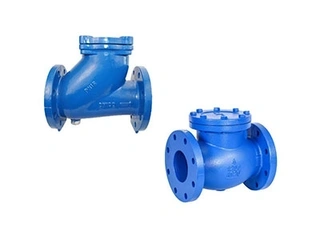
- Double-Disc Swing Check Valve: Featuring two discs, this type is suitable for medium to large pipelines. Wafer-type double-disc designs are compact and lightweight, offering improved resistance to hydraulic shock and better operational stability.
- Multi-Disc Swing Check Valve: This type includes multiple discs and is suitable for low-pressure, large-diameter pipelines. The design helps distribute fluid impact forces but is not suitable for high-pressure conditions.
Installation Requirements for Swing Check Valves
- Installation Position: Swing check valves can be installed horizontally, vertically, or on inclined pipelines. However, for vertical installation, the flow direction must be from bottom to top to ensure proper closure under gravity. Horizontal installation is more common, as it provides a straighter flow path and lower resistance compared to lift check valves. The hinge is preferably positioned at the top to prevent the disc from remaining open due to gravity and to reduce water hammer effects.
- Straight Pipe Requirements: A straight pipe section upstream is required, typically with a length of at least 10 times the pipe diameter, to ensure stable flow. Installing the valve near elbows or other flow-disturbing components can lead to disc wear, leakage, and reduced sealing performance.
- Maintenance Space: Sufficient space must be reserved around the valve for inspection, maintenance, and part replacement.
Advantages of Swing Check Valves
- Excellent Flow Performance: The streamlined flow path results in low flow resistance. Compared to lift check valves, swing check valves offer lower pressure drop and are ideal for large-diameter, high-flow systems.
- Simple and Reliable Structure: With only a few moving parts, such as the disc and hinge, the valve has a simple design that reduces mechanical failure risks. Maintenance is convenient, and overall costs are low.
- Wide Range of Applications: Swing check valves can be installed in various pipeline positions and are suitable for media such as water, steam, oil, nitric acid, acetic acid, oxidizing media, and urea. They are widely used in industries including petroleum, chemical processing, pharmaceuticals, fertilizers, and power generation.
- Strong Anti-Clogging Capability: The open internal structure makes the valve less prone to clogging, making it suitable for media containing particles, such as wastewater and slurry systems.
- Cost-Effective: Swing check valves are relatively inexpensive, especially those made of cast iron, and offer long service life and high reliability, resulting in excellent overall economic performance.
Limitations of Swing Check Valves
- Medium Cleanliness Requirement: They are best suited for clean fluids and may not perform well with highly viscous or heavily contaminated media, which can impair operation and sealing.
- Water Hammer Effect: Due to relatively slow closing, sudden flow reversal can cause water hammer, potentially damaging pipelines or valves. This can be mitigated by proper installation or using damped slow-closing designs.
- Vertical Installation Limitations: Improper installation in vertical pipelines may cause disc suspension or vibration, affecting performance. Alternative check valve types may be recommended in such cases.
- Sealing Limitations at Low Pressure: Low-pressure conditions may result in insufficient sealing force. Although auxiliary devices can help, sealing performance may still be compromised under very low pressure.
- Vibration and Noise: Turbulent flow can cause internal vibration and noise, reducing service life. Proper installation and vibration control measures are recommended.
Selection Considerations of Swing Check Valves
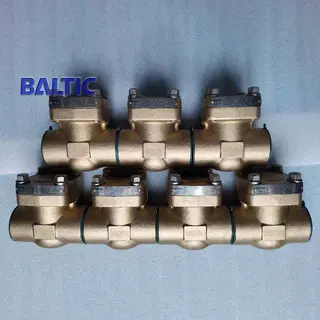
- Material Selection: Choose materials based on the medium: stainless steel for corrosive environments, brass or bronze for clean water, carbon steel for oil and gas, and cast iron for general applications.
- Size Selection: Proper sizing is critical. Undersized valves restrict flow and increase pressure drop, while oversized valves may lead to slow closure and water hammer. Selection should be based on flow rate, velocity, and manufacturer specifications.
- Pressure and Temperature Rating: Ensure the valve operates within its design limits. Exceeding these limits can lead to leakage or damage.
- Structural Design: Different designs, such as inclined-disc types, offer faster closure and reduced water hammer, making them suitable for systems with fluctuating flow conditions.
Applications of Swing Check Valves
Swing check valves are widely used in industries such as municipal water supply, wastewater treatment, petrochemical processing, power generation, HVAC systems, and fire protection systems.
In municipal water systems, they protect water quality by preventing backflow contamination. In wastewater treatment, their anti-clogging design makes them suitable for handling fluids with solid particles. In the petrochemical industry, they prevent backflow of hazardous media in processing units. In power plants, they are used in cooling water and steam systems.
From water treatment facilities in California to refineries along the Texas Gulf Coast, swing check valves have demonstrated reliable performance across diverse environments, proving their adaptability and durability.
Conclusion
The swing check valve is a simple yet highly reliable automatic valve that prevents backflow through the rotational movement of its disc. Its key advantages include low flow resistance, ease of maintenance, broad applicability, and cost-effectiveness, making it widely used across multiple industries.
Proper selection, correct installation, and regular maintenance are essential to ensure optimal performance. Attention should be given to factors such as medium cleanliness, installation orientation, and water hammer. For engineers and procurement professionals, a thorough understanding of the valve’s structure, working principle, and selection criteria is crucial for making informed decisions and ensuring safe and stable pipeline operation.
Send your message to this supplier
Related Articles from the Supplier
Swing Check Valves vs. Tilting Disc Check Valves
- Apr 03, 2026
How to Install Swing Check Valves
- Mar 23, 2026
Related Articles from China Manufacturers
Related Products Mentioned in the Article

Zhejiang Kosen Valve Co., Ltd.
- https://www.kosenvalve.com/
- Business Type: Industry & Trading, Manufacturer,
Supplier Website
Source: https://www.kosenvalve.com/media-hub/swing-check-valve-structure-principle-application.html