
Swing vs. Axial Flow Check Valves: Comparison and Selection
Water hammer is one of the most destructive transient phenomena in piping systems. It is primarily caused by rapid deceleration or sudden reversal of fluid flow. Water hammer most frequently occurs when pumps stop, power fails, or valves close abruptly. The resulting pressure surge can damage pipelines, valves, pumps, and other equipment, and in severe cases, it can lead to catastrophic system failure.
Among all pipeline components, check valves have the greatest impact on the severity of water hammer. This is because the closing dynamics of a check valve directly determine the velocity of backflow. If a check valve closes too slowly, the reverse flow velocity can become very high. When such high-speed reverse flow suddenly stops, it generates a strong pressure shock. Therefore, valve selection plays a critical role in protecting pipeline systems from water hammer damage.
This article compares the transient behaviors of swing check valves and axial flow check valves, with a particular focus on their water hammer characteristics. By understanding the differences between these two types of valves, engineers can select the most suitable option for their systems.
What is Swing Check Valve?
To understand why swing check valves are prone to generating water hammer, it is necessary first to examine their basic structure and operating mechanism. Following this, the chain reactions that occur during sudden events such as pump shutdowns can be analyzed, along with the specific risks they pose.
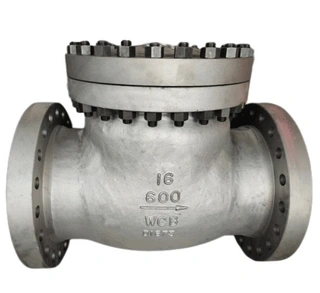
1. Basic Structure and Operation
Swing check valves operate via a disc attached to a hinge. Under forward flow conditions, fluid pressure pushes the disc open. When flow stops or reverses, the disc closes under the combined effects of gravity and reverse flow force. The disc rotates around the hinge pin, moving through a relatively large angular range between the open and closed positions. This simple design makes swing check valves cost-effective to manufacture and widely used in many industrial applications.
2. Water Hammer Generation
Water hammer typically follows this sequence during pump shutdown or sudden loss of driving force:
- Forward flow begins to decelerate.
- Flow reverses direction.
- The valve disc gains angular momentum and strikes the seat violently.
Because the disc remains open until significant backflow develops, swing check valves inherently allow high reverse flow before closure. This delayed closure results in the disc suddenly shutting when reverse flow is already substantial.
3. Specific Issues Arising
This delayed closure and high reverse flow can cause multiple problems:
- Peak pressures in the piping system rise sharply, potentially damaging joints and supports.
- Valve discs and seats experience impact loading, leading to sealing failures.
- Hinge pins are subject to wear and fatigue, potentially breaking over long-term use.
- Audible knocking and system vibrations occur, adversely affecting the working environment.
These effects are particularly severe in high-head pumps, vertical installations, and fast-transient systems. Since swing check valve closure relies on gravity and reverse flow force, installation orientation significantly affects performance. Improper installation can exacerbate water hammer problems.
About Axial Flow Check Valves
In contrast to swing check valves, axial flow check valves adopt a fundamentally different design approach. The following sections detail their structural features, operating mechanism, and how they achieve anti-shock performance.
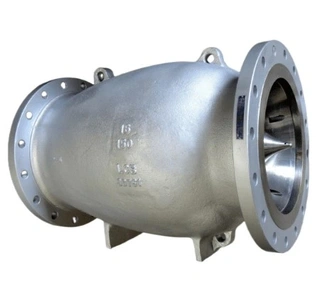
1. Basic Structure and Design Characteristics
Axial flow check valves feature a spring-assisted, centrally guided disc that moves linearly along the flow axis, responding continuously to changes in flow velocity rather than relying on gravity. Key design characteristics include:
- Short travel distance: The disc moves only a minimal distance.
- Low moving mass: The disc is lightweight.
- Preloaded spring force: Ensures rapid response.
- Streamlined axial flow path: Minimizes flow resistance.
These features allow the disc to begin closing as flow decelerates, well before significant backflow occurs. The disc closes at a very low reverse flow velocity, minimizing peak pressure. The disc does not collide with the seat, providing smooth and controlled transient response. This behavior classifies axial flow valves as anti-collision check valves.
2. Detailed Operating Principle
When the pressure difference between the upstream and downstream sides exceeds the spring’s opening pressure, the disc moves to allow fluid to pass. The valve’s flow area gradually reduces to the seat diameter, following a Venturi design. The Venturi effect reduces static pressure while increasing dynamic pressure, enabling rapid and complete opening.
Spring selection ensures that under normal flow conditions, the disc fully opens and seats securely. As flow decreases, the spring counters the reduced fluid force, closing the valve in time. This ensures the valve begins closing as flow decelerates, rather than waiting until backflow develops.
3. Anti-Shock Performance
Axial flow check valves exhibit excellent response characteristics. As flow in the pipeline slows, forces acting on the disc decrease, and the spring overcomes these smaller forces to close the valve. The short travel distance combined with spring assistance dramatically reduces response time, achieving rapid, impact-free closure while minimizing reverse flow.
Axial flow check valves are suitable for a wide range of conditions, from minimal to maximum system flow deceleration. Their rapid response and anti-shock behavior effectively mitigate pressure fluctuations and water hammer.
Quantitative Performance Comparison
To illustrate the differences between the two types of valves, we compare them in five key areas: peak pressure, response time, applicable diameter range, pressure loss, and noise level.
1. Peak Pressure Difference
Comparative analysis shows a significant difference between the two valves. In swing check valves, the disc accelerates due to inertia during rapid backflow formation, closing violently and imposing a high-pressure shock on the system. Axial flow check valves, in contrast, follow the decelerating flow and close gradually, without sudden momentum change, resulting in controlled and mitigated pressure rise.
Field data and transient simulations indicate that, under identical conditions, axial flow check valves can reduce peak pressure by 30% to 70% compared to swing check valves—a critical factor in safe pipeline design.
2. Response Time Comparison
Swing check valves respond slowly under dynamic conditions, leading to high reverse flow velocity, impacts, and undesirable pressure fluctuations. Dual-disc spring-assisted check valves improve on this by using lighter discs with spring preload to apply closing force across all angles, reducing response time.
Axial flow check valves can close rapidly, typically within 0.2 seconds. Delayed closure in swing check valves can cause significant water hammer, potentially damaging pipelines and equipment.
3. Applicable Diameter Range
Axial flow check valves are suitable for larger pipelines, up to DN2000, making them appropriate for high-capacity system design. Swing check valves are typically limited to DN600 or less, restricting their applicability in large-scale industrial systems.
4. Pressure Loss and Energy Efficiency
The streamlined design of axial flow valves ensures low flow resistance, minimal pressure drop, and high energy efficiency. Swing check valves, with their larger disc structure, may obstruct flow, causing turbulence and higher pressure drop, thereby reducing efficiency.
5. Noise Level
Axial flow check valves operate quietly, typically below 50 decibels, suitable for noise-sensitive environments. Swing check valves generate higher noise during rapid flow reversal as the disc closes, potentially disturbing quiet surroundings.
Application Scenarios and Selection Recommendations
Understanding the performance differences between the two valve types helps determine their appropriate applications and critical factors for selection.
1. Swing Check Valve Applications
Swing check valves are suitable for:
- Low-flow systems
- Non-critical systems without expected rapid transients
- Budget-limited projects
- Water and wastewater systems
- HVAC systems
- General pump protection
The simple structure and low cost of swing check valves make them suitable for budget-conscious systems. However, their potential for higher pressure loss and water hammer must be considered. At high flow rates or during rapid flow reversal, swing check valves are prone to impacts and pressure fluctuations.
2. Recommended Applications for Axial Flow Check Valves
Axial flow check valves are recommended for:
- Pump discharge lines
- High-head pump systems
- Vertical pipelines
- Boiler feedwater systems
- Offshore facilities
- Power plants
- Petrochemical installations
- High-pressure systems
- Water treatment plants
- Noise-sensitive environments
Axial flow check valves are specifically designed to mitigate water hammer. Features include optimized spring selection, CFD-validated disc and body geometry, compact end-to-end dimensions, and, where applicable, API 594 and API 6D verified anti-collision performance. These valves are widely used in critical systems with high transient control requirements.
3. Key Selection Considerations
Choosing the appropriate check valve is decisive for system safety and efficiency. Understanding design features, operating principles, and performance differences enables selecting the most suitable valve based on specific needs. Considerations include:
- Potential for rapid transient conditions
- Pump head height
- Pipeline orientation: horizontal or vertical
- Pressure loss and cost constraints
- Noise requirements
- Maintenance and reliability requirements
Axial flow check valves can often replace swing check valves in existing systems, offering lower water hammer, impact-free closure, and suitability for both horizontal and vertical installations. Compatibility with the specific system must be confirmed.
Frequently Asked Questions
In practical engineering, questions often arise about anti-shock check valves, spring function, and whether swing check valves are obsolete.
1. What is an Anti-Shock Check Valve?
The primary function of a check valve is to allow fluid flow in one direction while preventing reverse flow. The valve’s normal static state is closed. Reverse flow in the pipeline can generate hydraulic shock waves that may severely damage equipment.
Selecting an appropriate check valve for reverse flow and ensuring complete closure effectively prevents this. Valves that prevent water hammer and close rapidly without collision are termed anti-shock check valves. Axial flow check valves fall into this category, as they close without impact, avoiding additional pressure peaks.
2. Role of the Spring-Assisted Mechanism
The spring-assisted mechanism ensures rapid, controlled closure, reducing reverse flow and water hammer, improving system reliability, and lowering maintenance demands. Most axial flow check valves use spring-loaded designs with single low-mass discs that respond quickly to decreasing flow. The single-disc and spring structure ensures balanced forces when open, providing smooth and uniform flow.
3. Are Swing Check Valves Obsolete?
Swing check valves are not obsolete, but their suitability is limited in applications requiring rapid closure and high water hammer protection. Modern industrial systems increasingly favor axial flow check valves for improved performance and reliability. In corrosive environments, durability depends on material selection; both types can be manufactured from stainless steel or specialized alloys to withstand harsh conditions.
Summary
Swing check valves and axial flow check valves differ significantly in structure, operating principle, and water hammer resistance.
Swing check valves are simple and cost-effective but have large disc travel and slow closure. They close after reverse flow has developed, producing high reverse flow velocities and strong water hammer, suitable only for low-flow, non-critical systems.
Axial flow check valves use spring assistance and short travel designs, providing fast response. They begin closing as flow decelerates, completing impact-free closure at low reverse flow velocity. Peak pressure can be reduced by 30% to 70% compared to swing check valves. They also offer low pressure loss and quiet operation, making them ideal for high-head pumps, vertical pipelines, power plants, and offshore facilities. Valve selection should consider water hammer protection requirements, budget, pipeline diameter, and installation conditions. For systems requiring high reliability and long service life, axial flow check valves are the superior choice.
Send your message to this supplier
Related Articles from the Supplier
Swing Check Valves vs. Tilting Disc Check Valves
- Apr 03, 2026
How to Install Swing Check Valves
- Mar 23, 2026
Related Articles from China Manufacturers
Swing vs. Lift Check Valves: What is the Difference?
- Sep 04, 2024
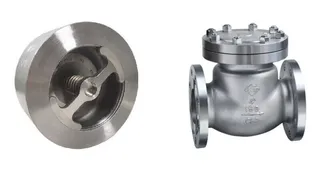

Swing Check Valves vs. Wafer Check Valves
- Jun 12, 2026

Dual Plate vs. Swing Check Valve
- Jun 17, 2019

Swing Robot Arms
- Aug 02, 2019
Related Products Mentioned in the Article

Zhejiang Kosen Valve Co., Ltd.
- https://www.kosenvalve.com/
- Business Type: Industry & Trading, Manufacturer,
Supplier Website
Source: https://www.kosenvalve.com/media-hub/swing-vs-axial-flow-check-valves-comparison-and-selection.html