
Aluminum Bronze Ball Valves: Corrosion-Resistant Solutions
In industrial pipeline systems, valves serve as critical devices for controlling the flow of process media. Under challenging conditions such as chemical corrosion, seawater exposure, high temperature, and high pressure, conventional metal valves (such as carbon steel or standard brass) often struggle to maintain stable long-term operation. Aluminum bronze ball valves, leveraging the unique properties of aluminum bronze alloys and reliable structural design, have emerged as an ideal solution for addressing corrosion and erosion challenges in harsh environments. This article provides a comprehensive overview of aluminum bronze ball valves, covering basic concepts, structural types, operating principles, material advantages, application fields, manufacturing standards, maintenance practices, and selection recommendations to help engineers and procurement professionals gain a deep understanding of this high-performance industrial valve product.
What Is an Aluminum Bronze Ball Valve?
An aluminum bronze ball valve is a fluid control device that regulates flow by rotating a spherical valve core. The central structure is a precision-engineered ball with a bore through its center, which allows flow when aligned with the pipeline and blocks flow when rotated 90°. Typically, an operator rotates the valve stem via a handle, worm gear, or automated actuator, causing the ball to turn in unison. When the bore aligns with the pipeline, fluid passes freely, and the valve is fully open; when the ball rotates 90° clockwise or counterclockwise, the bore becomes perpendicular to the flow, completely stopping the fluid and placing the valve in the fully closed state.
Ball valves are widely used in industrial pipelines due to their rapid operation, excellent sealing performance, and minimal flow resistance. Aluminum bronze material further enhances the suitability of these valves for highly corrosive or erosive environments, making them ideal for chemical processing, marine engineering, shipbuilding, industrial manufacturing, and water treatment applications.
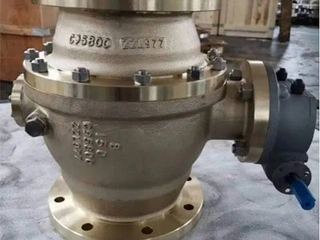
Aluminum Bronze Materials and Their Properties
The valve body and internal components of aluminum bronze ball valves are primarily made of aluminum bronze alloys, such as ASTM B148 C95800, C95400, or domestic equivalents like QAl9-4 and QAl10-4-4. These high-strength copper-based alloys typically contain 5%–11% aluminum, with small additions of iron, nickel, manganese, or silicon depending on application requirements. The aluminum content enables the rapid formation of a dense aluminum oxide (Al₂O₃) protective layer on the alloy surface, significantly enhancing oxidation and corrosion resistance. This allows the material to withstand seawater, chloride ions, and various complex chemical media.
As an industrial-grade valve material, aluminum bronze offers exceptional mechanical performance:
High mechanical strength: Its tensile and yield strength approaches that of medium carbon steel, maintaining structural stability under high-pressure conditions and resisting deformation.
Excellent wear and erosion resistance: It effectively resists cavitation and fluid erosion in high-velocity flows or particulate-laden media, ensuring the valve maintains its integrity under demanding operating conditions.
Types and Classifications of Aluminum Bronze Ball Valves
Beyond the basic definition and material characteristics, aluminum bronze ball valves are available in diverse structural designs to accommodate various operating conditions, from conventional water systems to high-pressure chemical pipelines.
1. Classification by Bore: Full Bore vs. Reduced Bore
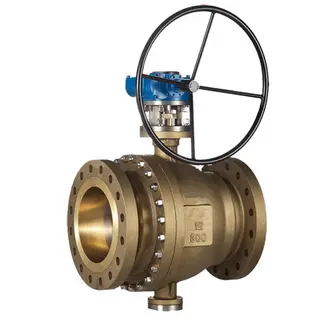
- Full Bore (Full Port) Aluminum Bronze Ball Valve: Features a flow passage equal to the pipeline diameter, maximizing fluid throughput. Its advantage is minimal pressure drop, making it suitable for pigging operations or systems with strict flow resistance requirements.
- Reduced Bore Aluminum Bronze Ball Valve: Features a flow passage slightly smaller than the pipeline diameter. Reduced bore valves are more compact, lighter, and cost-effective, making them suitable for installations with limited space or less sensitive flow requirements.
2. Classification by Connection and Structural Form
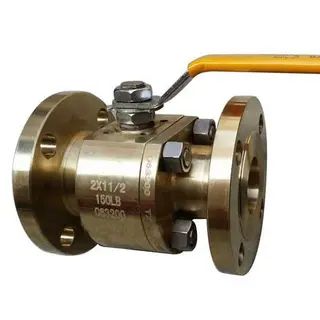
- Three-Piece Ball Valve: Composed of the valve body and two end caps joined by bolts. This design allows inline maintenance without disassembling the pipeline, enabling replacement of seats and seals and reducing downtime costs.
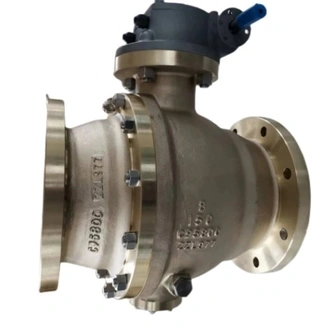
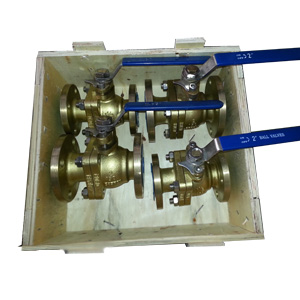
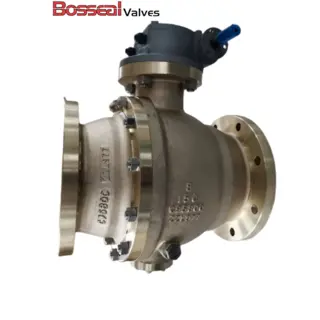
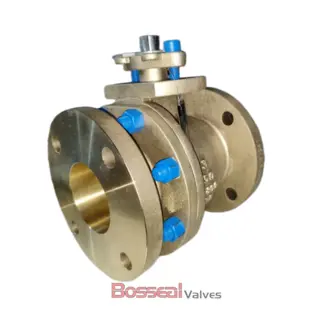
- Flanged Ball Valve: Connected to pipelines using standard flanges (ANSI/ASME B16.5, DIN, etc.), offering robust installation and tensile strength, commonly used for medium- to high-pressure, large-diameter industrial pipelines.
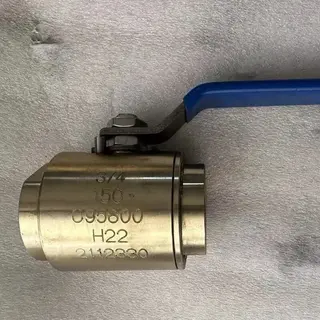
- Threaded Ball Valve (NPT or BSP): Uses internal or external threads for quick installation, typically applied in small-diameter, low- to medium-pressure pipelines or instrumentation systems.
3. Classification by Special Function
- Pressure-Relief Ball Valve: Incorporates a small pressure-relief hole in the ball to balance internal cavity pressure when the valve is closed, preventing rupture from thermal expansion and improving system safety.
- API 607 Fire-Safe Ball Valve: Features a dual soft/hard sealing design. If a fire destroys the soft seal (PTFE/RPTFE), the ball engages with a metallic backup seal to prevent fluid leakage, widely used in flammable media systems.
- Cryogenic/Low-Temperature Ball Valve: Designed with an extended neck to protect packing and operate reliably between -196°C and -40°C, commonly used for liquid nitrogen, liquid oxygen, and other cryogenic media.
- Customized Valves: Aluminum bronze ball valves can also be custom-designed with extended stems, pneumatic or electric actuators, or other adaptations to meet unique operational requirements.
Operating Principle of Aluminum Bronze Ball Valves
Regardless of external form, aluminum bronze ball valves control fluid flow through the 90° rotation of a spherical ball. Understanding this principle and the underlying sealing mechanisms is essential for proper selection, installation, and maintenance.
1. Basic Operation and Actuation Methods
The valve body houses an inlet and outlet, with a rotating ball featuring a central bore. The stem connects to the ball and extends from the top of the valve. Applying torque to the stem rotates the ball:
Open: The bore aligns with the pipeline axis, allowing maximum flow.
Closed: The ball rotates 90°, pressing against the seat to fully block flow.
Actuation options include:
Manual: Handle (small valves) or worm gear (large valves), suitable for infrequent operation.
Pneumatic/Electric: Automated actuators integrate with PLC/DCS systems for remote operation, rapid shutoff, and automated flow management.
2. Sealing Mechanism (Soft and Hard Seals)
Soft Seated: Seats made of PTFE, RPTFE, or PEEK achieve bubble-tight sealing per API 598, suitable for gas and liquid media.
Metal-to-Metal Seated: For particulate-laden, crystallizing, or high-temperature media, the ball and seat are precision-ground or overlaid with hard alloys to maintain long-term sealing performance.
Four Key Material Advantages of Aluminum Bronze Ball Valves
Aluminum bronze ball valves excel due to the unique composition of the alloy, offering unmatched corrosion resistance, mechanical strength, and safety features.
- Superior Corrosion Resistance in Seawater and Chlorides: Resistant to pitting and crevice corrosion from chloride ions, significantly extending service life in marine environments.
- High Mechanical Strength and Erosion/Cavitation Resistance: Iron and nickel additions improve hardness and impact toughness, protecting against cavitation and particulate erosion in turbulent flows.
- Non-Sparking Safety (Explosion-Proof): Aluminum bronze does not produce sparks under impact or friction, making it ideal for flammable gas pipelines (natural gas, hydrogen).
- Non-Magnetic: Non-ferromagnetic, suitable for environments sensitive to magnetic interference, including precision instrumentation and certain naval applications.
Key Applications for Aluminum Bronze Ball Valves
Thanks to these advantages, aluminum bronze ball valves are used across multiple challenging industrial sectors:
- Marine Engineering and Shipbuilding: Seawater cooling, ballast systems, bilge drainage, fire water supply, SWRO desalination, offshore drilling manifolds.
- Chemical, Petrochemical, and Refining Plants: Transport of weak acids, salt-containing solutions, and operation in non-sparking zones.
- Oil and Gas Production: High-pressure shut-off and control valves in offshore platforms and coastal LNG receiving stations.
- Power Industry (Nuclear and Thermal): Large-scale seawater cooling systems, condenser pipelines, auxiliary networks.
- Mining and Industrial Water Treatment: Tailings, acidic wastewater, and high-salinity industrial wastewater treatment systems.
Manufacturing Standards and Quality Control
High-quality aluminum bronze ball valves comply with international design and manufacturing standards. Strict process control and testing ensure reliable performance in the field.
- Design and Manufacturing Standards: API 6D, ASME B16.34, ISO 17292
- Face-to-Face/Length Standards: ASME B16.10, GB/T 12221
- Flange Standards: ASME B16.5, EN 1092
- Inspection and Testing: API 598, EN 12266
Advanced casting and forging processes eliminate internal porosity, while CNC machining achieves micron-level tolerances on ball and seat surfaces, ensuring low operating torque and superior sealing. Non-destructive testing (ultrasound, dye penetrant, radiography) verifies the absence of defects. Pressure testing ensures bubble-tight sealing at 1.1–1.5 times rated pressure.
Maintenance and Lifecycle Cost Efficiency
Although aluminum bronze ball valves are low-maintenance, regular care extends their already impressive service life.
Routine Operation: Exercise valves every 3–6 months to prevent sedimentation or seat adhesion.
Cleaning and Lubrication: Remove external deposits and lubricate stem bearings or worm gears.
Packing Maintenance: If slight leakage occurs at the stem, tighten the gland bolts or replace PTFE/graphite packing as needed.
With proper maintenance, high-quality aluminum bronze ball valves can achieve a service life exceeding 20 years. Although the initial cost is higher than carbon steel or cast iron valves, the significantly reduced downtime, maintenance expenses, and leakage risks result in a much lower total cost of ownership (TCO), making them highly cost-effective across their lifecycle.
Recommendations for Engineers and Procurement Specialists
When selecting aluminum bronze ball valves for industrial projects, it is essential to evaluate operating conditions systematically to ensure proper compatibility.
1. Key Selection Factors
Media Characteristics: Consider chloride concentration, pH level, and presence of abrasive solids to determine whether soft or metal sealing is appropriate.
Pressure and Temperature (P-T Rating): Refer to ASME B16.34 pressure-temperature charts to verify allowable working pressure at operating temperature for materials such as C95800 (e.g., Class 150, Class 300).
Flow and Resistance Requirements: Balance between full bore and reduced bore designs depending on system flow and pressure drop requirements.
2. Typical Application-Based Selection Guidelines
Seawater Circulation / High-Flow Pipelines: Full bore flanged aluminum bronze ball valves (commonly C95800) are preferred for maximum flow capacity and corrosion resistance.
Frequent Maintenance Chemical Systems: Three-piece threaded or welded ball valves are recommended for easy disassembly and maintenance.
Refineries and Gas Hazardous Zones: Fire-safe API 607-certified, anti-static, and blow-out proof stem aluminum bronze ball valves are mandatory for safety compliance.
Space-Limited Marine Applications: Wafer-type or reduced bore designs are ideal for compact installation and weight reduction onboard vessels.
Conclusion
In summary, aluminum bronze ball valves have become indispensable flow control devices in modern industrial systems due to their exceptional resistance to seawater and chloride corrosion, mechanical strength comparable to carbon steel, high sealing reliability, and unique non-sparking safety characteristics.
Manufactured in compliance with strict international standards such as API 6D and ASME B16.34, and supported by advanced casting, forging, machining, and rigorous factory testing, high-quality aluminum bronze ball valves ensure safe, stable, and low-maintenance operation for decades.
In future engineering applications, proper selection based on media type, pressure conditions, and installation environment will further enhance system safety, operational efficiency, and long-term economic performance.
Send your message to this supplier
Related Articles from the Supplier
Related Articles from China Manufacturers


Related Products Mentioned in the Article

Zhejiang Kosen Valve Co., Ltd.
- https://www.kosenvalve.com/
- Business Type: Industry & Trading, Manufacturer,
Supplier Website
Source: https://www.kosenvalve.com/media-hub/aluminum-bronze-ball-valves-corrosion-resistant-solutions.html