
A Guide to Selecting Between Globe Valves and Ball Valves
In modern industrial piping systems and civil facilities, valves are key devices used to control fluid flow, and their selection directly affects system efficiency, safety, and economic performance. As two of the most commonly used valve types, globe valves and ball valves both serve the basic function of flow control, but they differ significantly in working principles, performance characteristics, and application scenarios. This article analyzes the differences between these two industrial valves from multiple perspectives, including structural principles, performance features, and service environments, providing practical guidance for engineering selection.
Fundamental Differences in Working Principles
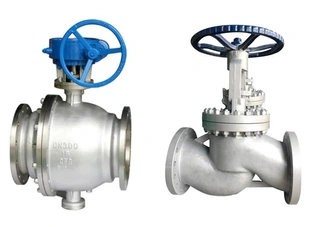
Linear motion mechanism of globe valves: Globe valves belong to the linear motion valve family. Their core working principle is to control fluid flow through vertical reciprocating movement of internal components. The valve disc (or plug) moves linearly in a direction perpendicular to the flow path. When the valve opens, the disc lifts upward, creating a restricted flow passage between the seat surfaces; when closing, the disc gradually moves downward until it tightly contacts the valve seat, completely blocking the flow channel. This linear motion characteristic gives globe valves excellent flow regulation capability. Operators can achieve precise positioning of the disc by controlling the number of handwheel rotations, allowing fine adjustment of flow rate. This control method is similar to the volume knob of audio equipment, enabling stepless flow regulation.
Rotational motion mechanism of ball valves: Unlike globe valves, ball valves operate on a rotary motion principle and belong to the quarter-turn valve category. The core component is a hollow spherical ball with a central through-hole, connected to an external handle via a valve stem. When the ball’s bore aligns with the pipeline axis, fluid flows through freely; when the handle rotates 90 degrees (a quarter turn), the bore becomes perpendicular to the flow direction, and the flow path is completely blocked. Ball valves typically exhibit a two-position operating characteristic, mainly functioning in fully open or fully closed states. Although this design sacrifices throttling precision, it provides extremely fast operation and reliable sealing performance. The operation of a ball valve is similar to a light switch, emphasizing clear state transitions rather than fine intermediate control.
Structural Design Comparison
After understanding the fundamentally different working principles, further analysis of internal structures is necessary. Structural design directly determines flow resistance characteristics, maintenance convenience, and application range, making it a key factor in performance differentiation.
1. Complex flow channel structure of globe valves
The design of globe valves follows a function-oriented principle. The valve body is usually spherical or cylindrical in appearance, with S-shaped or Z-shaped tortuous flow passages inside. Although this arrangement increases flow resistance, it provides stable guidance for disc movement and effective sealing contact surfaces.
Main structural components include:
- Valve body: provides the flow passage and mounting base for internal components
- Bonnet: protects the threaded transmission mechanism and forms the pressure boundary with the body
- Stem: transmits operating torque and drives the disc to move vertically
- Disc: the core component that directly controls opening and closing
- Seat: works with the disc to form the sealing pair
- Handwheel/actuator: provides the operating interface
Variants such as T-type, Y-type, and angle-type globe valves are designed to adapt to different installation spaces and flow direction requirements. In particular, Y-type globe valves improve flow smoothness and reduce pressure loss to a certain extent through inclined stem design.
2. Compact straight-through structure of ball valves
Ball valves pursue simplicity and high efficiency in structural design. The valve body contains the ball, with elastic seats installed on both sides, forming a compact modular structure.
Main structural components include:
- Valve body: houses the ball and seats, commonly available in one-piece, two-piece, and three-piece designs
- Ball: the core control element with a central through-hole
- Seat: usually made of elastic materials such as PTFE, providing sealing function
- Stem: connects the ball to the operating handle and transmits torque
- Sealing ring: prevents external leakage at the stem
- Handle/actuator: provides the operating interface
Ball valve flow passages are generally classified into full-bore, standard-bore, and reduced-bore types. Full-bore ball valves have a bore diameter equal to the pipeline inner diameter, producing almost no pressure loss, making them particularly suitable for pipeline pigging operations.
Performance Comparison of Ball Valve and Globe Valve
Based on the structural differences described above, globe valves and ball valves exhibit markedly different performance characteristics during actual operation. These performance indicators directly determine their suitability under various working conditions and serve as the core basis for engineering selection. This section compares the two valves from four dimensions: flow control capability, sealing performance, pressure loss, and operating characteristics.
1. Differences in flow control capability
Globe valves have obvious advantages in flow regulation. Due to the linear motion of the disc, the relationship between valve opening and flow rate is approximately linear, making it easier for operators to predict and control flow. The disc can be maintained at any intermediate position, enabling arbitrary flow settings between fully closed and fully open states. This capability makes globe valves the preferred choice in situations requiring frequent flow adjustment or maintenance of specific flow rates.
Ball valves exhibit typical quick-opening flow characteristics. During the initial rotation of the ball, flow changes relatively slowly; however, when the angle between the bore and pipeline axis exceeds a certain threshold, flow rate changes sharply. This nonlinear characteristic makes ball valves unsuitable for precise throttling control in most cases. Operating a ball valve in a partially open state may also cause erosion damage to the sealing surface, affecting service life.
2. Sealing performance and reliability
The sealing of globe valves relies on metal-to-metal contact or soft sealing between the disc and seat. When fully closed, the disc presses against the seat to form a seal. This design allows restoration of sealing performance by replacing the disc or seat after long-term use. High-quality globe valves can achieve Class VI leakage standards, making them suitable for most industrial applications.
The sealing mechanism of ball valves is more advanced. Elastic seats made of resilient materials are pressed against the ball surface by medium pressure or spring force, forming a self-tightening seal. This design enables ball valves to maintain excellent sealing performance even after long periods of inactivity, achieving bubble-tight zero leakage. In particular, floating ball valve designs utilize medium pressure to enhance sealing effectiveness—the higher the pressure, the better the sealing performance.
3. Pressure loss and flow efficiency
When fluid passes through a globe valve, it must undergo multiple directional changes: entering horizontally, turning vertically through the disc opening, and exiting horizontally again. This S-shaped flow path causes significant local resistance. Even in the fully open state, pressure loss is typically equivalent to several times the resistance of a straight pipe section of the same diameter. In high-pressure-differential applications, such energy losses must be considered in system energy consumption evaluation.
In contrast, when a ball valve is fully open, fluid passes directly through the central bore of the ball with minimal flow direction change. The pressure loss coefficient of a full-bore ball valve is close to that of a straight pipe of equivalent length, resulting in very low pressure loss. This feature makes ball valves ideal for applications requiring reduced pumping energy consumption and improved flow efficiency.
4. Operating characteristics and response speed
Globe valves are multi-turn operating valves. The transition from fully open to fully closed usually requires several or even dozens of handwheel rotations. Although this design requires longer operation time, it provides the possibility of fine regulation and helps avoid water hammer effects by allowing gradual fluid velocity changes that reduce pipeline impact.
The 90-degree quick-opening feature of ball valves enables instantaneous state switching. This rapid response is crucial for emergency shutoff applications but may also induce water hammer effects. In high-pressure and high-flow systems, slow-closing devices are often required in conjunction.
Typical Application Scenarios
The differences in performance characteristics are ultimately reflected in practical engineering applications. Understanding the applicable boundaries of the two valve types helps achieve accurate selection and avoid system inefficiency or safety risks caused by functional mismatch.
1. Application fields of globe valves
Based on their regulation advantages, globe valves are widely used in the following scenarios:
- Steam systems: In boiler outlet and steam distribution pipelines, globe valves regulate steam flow and control process temperature. Their high-temperature-resistant design can accommodate saturated steam or even superheated steam conditions.
- Chemical process control: In reactor inlet/outlet and heat exchanger pipelines, globe valves are used as control valves to precisely regulate medium flow and maintain stable process parameters.
- HVAC systems: In chilled water and cooling water pipelines of HVAC systems, globe valves balance branch flows and optimize system energy efficiency.
- Fuel systems: In generator sets and industrial burner fuel supply pipelines, globe valves control fuel flow to ensure stable combustion.
- Sampling and drainage: Suitable for applications requiring precise small-flow control, such as laboratory sampling valves and boiler blowdown valves.
2. Application fields of ball valves
Leveraging their switching advantages, ball valves perform outstandingly in the following scenarios:
- Pipeline isolation: Provide reliable shutoff during equipment maintenance or pipeline switching, commonly used in petrochemical and long-distance natural gas pipelines.
- Emergency shutoff: Serve as final actuating elements in safety systems to rapidly isolate hazardous sources when abnormal conditions are detected.
- Multi-way switching: Multi-port ball valves (three-way, four-way, etc.) enable rapid flow direction changes, simplifying pipeline design.
- Slurry and viscous media: Full-bore ball valves are less prone to clogging and are suitable for media containing solid particles or high-viscosity polymers.
- Hygienic applications: Stainless steel ball valves with dead-space-free design are widely used in CIP/SIP systems in food and pharmaceutical industries.
- Subsea and buried pipelines: Fully welded ball valves offer excellent sealing durability and are suitable for hard-to-maintain environments.
Key Considerations for Valve Selection
In practical engineering selection, the following factors should be considered comprehensively:
- Control requirements: If frequent flow regulation or specific opening maintenance is needed, globe valves are preferred; if only full open/close control is required, ball valves are more cost-effective.
- Pressure drop limitation: In low-pressure systems or energy-sensitive applications, the low-pressure-loss characteristics of ball valves are advantageous; however, in high-pressure differential regulation scenarios, the energy dissipation of globe valves may help stabilize control.
- Sealing requirements: For toxic, flammable media or vacuum systems, the zero-leakage capability of ball valves is often decisive.
- Operating frequency: Globe valves are suitable for high-frequency regulation, while ball valves are better suited for applications that remain in a fixed state but require rapid switching.
- Maintenance convenience: Three-piece ball valves and flanged globe valves allow online maintenance, but modular ball valve designs usually simplify repair.
- Cost factors: For the same specification, ball valves generally have lower initial cost, although special materials or high-performance sealing designs may make some ball valves more expensive than ordinary globe valves.
Conclusion and Recommendations
As two major types of industrial valves, globe valves and ball valves have clearly differentiated technical positioning. Globe valves occupy an irreplaceable role in process control due to their excellent regulation performance and throttling capability, while ball valves are preferred for isolation applications because of their simple structure, excellent sealing, and fast operation.
In modern engineering practice, the boundary between the two valve types is gradually becoming blurred. V-port ball valves can achieve approximately equal percentage control characteristics through special opening designs, while high-performance globe valves reduce pressure loss by optimizing flow passages. Therefore, valve selection should go beyond simple type comparison and involve detailed analysis of specific operating conditions. When necessary, professional manufacturers should be consulted for customized design solutions.
Understanding the essential differences between these two valve types helps engineers make informed decisions in piping system design, ensuring safe, efficient, and economical operation. Whether for new projects or system upgrades, proper valve selection is the foundation of system success.
Send your message to this supplier
Related Articles from the Supplier

A Complete Guide to Diaphragm Valve Maintenance
- Jan 06, 2026
A Complete Guide to Mechanical Steam Traps
- Jan 08, 2026
A Complete Guide to Fire-Safe Ball Valves
- Mar 30, 2026
A Complete Guide to Through Conduit Gate Valves
- Apr 23, 2026
A Complete Guide to Magnetic Drive Pumps
- Apr 25, 2026
A Complete Guide to Balanced Bellows Safety Valve
- May 21, 2026
Related Articles from China Manufacturers
A Guide to Selecting Electric V-Type Ball Valves
- Aug 22, 2025
A Guide to Media Selection for Multi-Media Filters
- Jul 25, 2024
A Guide to Steel Selection in Pressure Vessel Design
- Aug 08, 2025

A Guide to the Selection and Use of Valve
- Nov 08, 2024



A Complete Guide to Globe Valve Trim Selection
- Jun 30, 2026
Related Products Mentioned in the Article

Zhejiang Kosen Valve Co., Ltd.
- https://www.kosenvalve.com/
- Business Type: Industry & Trading, Manufacturer,
Supplier Website
Source: https://www.kosenvalve.com/media-hub/a-guide-to-selecting-between-globe-valves-and-ball-valves.html