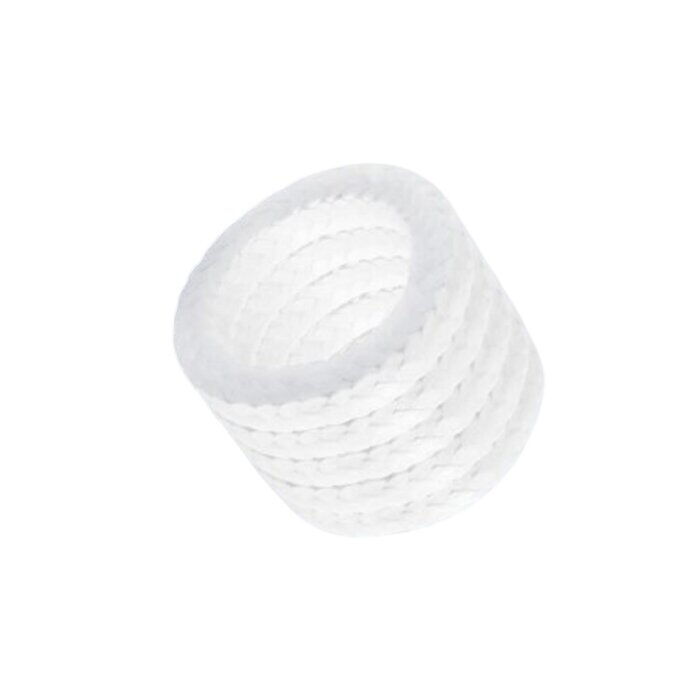
The Low Emission Valve Packing Plant specializes in producing high-performance packing solutions for valves. The plant offers a range of yarn braided packing options, including carbon yarn sleeves and PTFE yarn sleeves, available in customized sizes to meet specific requirements. These packing materials are designed to withstand high pressures up to 30 MPa (300 bar) and comply with stringent emission standards such as TA-Luft and ISO 15848-1. These low-emission packing solutions are ideal for critical applications where minimizing fugitive emissions is essential, ensuring both environmental compliance and operational efficiency.
Product Name: Low Emission Braided Valve Packing
Core Material: Carbon Yarn
Sleeve Material: PTFE Yarn
Size: Customized
Pressure: 30 MPa, 300 bar
pH: 0–14
Temperature Range: –100°C to 280°C
Certificates: TA-Luft, ISO 15848-1
Medium: Water, Oil, Gas, Acids, etc
Key Features
Advanced Construction: Carbon yarn core with a concentrically over-braided dense PTFE yarn sleeve ensures durability and strength.
Enhanced Density: Special impregnation increases cross-sectional density for superior sealing performance.
Fugitive Emissions Control: Engineered for use in both on/off and control valves to effectively limit fugitive emissions.
Thermal Cycle Stability: Maintains consistent gland pressure across multiple temperature cycles without retightening.
Flexible Design: Offers excellent adaptability and compression recovery.

Basic Concept
Low Emission Valves refer to valves that, through special design and manufacturing processes of the stem packing and mid-seat gasket, control the leakage of media (gases, liquids) to extremely low levels. They are primarily used in industrial scenarios with high safety and environmental protection requirements. The core objective is to reduce or prevent the leakage of harmful media (such as volatile organic compounds (VOCs), toxic gases, flammable and explosive substances, etc.) into the external environment. Therefore, low emission valves offer multiple advantages in terms of energy conservation, emission reduction, reduced safety risks, and environmental pollution.
Key Technical Standards and Leakage Grades
The performance of Low Emission Valves is quantified by their leakage rate, and different industries follow different standards. Common standards include:
1. International Standards
ISO 15848-1: This standard classifies valve leakage grades into four levels: A (the highest requirement), B, C, and D. Grade A requires a leakage rate of ≤100 ppm (by volume).
API 624 (American Petroleum Institute): This standard, applicable to the refining and chemical industries, specifies a leakage rate of ≤100 ppm (for gases) under specific pressures.
EPA Standard (U.S. Environmental Protection Agency): This standard, targeting VOC emissions, requires a leakage rate of ≤500 ppm.
2. Chinese Standards
GB/T 42223-2022: This standard, which references international standards, regulates the design, manufacturing, and testing of Low Emission Valves.
Taking the petroleum refining industry as an example, if a conventional valve has a daily average leakage rate of 500 standard cubic meters (calculated based on the volume of gas under standard conditions), for a large refinery with 100,000 valves, the annual media emission loss can be quantified in the following dimensions.
1. Direct Material Loss
Annual leakage volume = 100,000 valves × 500 Nm³/valve•day × 365 days = 1.825 billion standard cubic meters of gas. If the unit price of natural gas is 3 yuan/Nm³, the annual direct economic loss reaches 5.475 billion yuan (without considering the cost of media recovery).
2. Increased Operation and Maintenance Costs
High leakage rates lead to a 3-5 times increase in on-site inspection frequency, with an additional annual maintenance cost of 2,000-3,000 yuan per valve, resulting in an extra 200 million - 300 million yuan in annual O&M costs for the entire plant; emergency shutdowns and repairs caused by sudden leaks can result in average losses of millions of yuan per incident.
3. Compliance Risk Costs
Leakages exceeding environmental emission standards (such as the volatile organic compound leakage limits specified in China's "Pollutant Emission Standards for the Petroleum Chemical Industry") may face:
Single administrative penalty: 100,000 - 1 million yuan
Production suspension and rectification: Daily value loss can reach tens of millions of yuan
Brand reputation loss: Leading to downstream customer loss or restricted financing
4. Release of Hidden Value
Using low emission valves (leakage rate ≤0.1 Nm³/valve•day) can achieve:
Annual emission reduction of over 1.8 billion cubic meters, meeting the carbon trading market quota requirements and creating additional revenue
More than 40% improvement in operation and maintenance efficiency, with a 5%-8% increase in overall equipment utilization rate
Avoidance of the risk of downgraded environmental credit rating, ensuring project approval and expansion qualifications
Conclusion: Low Emission Valves, through a three-dimensional value system of "material conservation control, operation and maintenance efficiency optimization, compliance risk isolation", can not only directly reduce losses of hundreds of millions of yuan but also build a sustainable development capability that meets ESG (environmental, social, and corporate governance) requirements. Especially under the "dual carbon" goals, they have become a core cost control tool for industries with high leakage risks.
At first, manufacturing low emission valves was pretty much the same for us as it was for other regular valve manufacturers in China. If we ran into problems like valves not passing tests or having leak rates that kept changing, we'd just try to get better packing materials from a different supplier. We didn't really stop to think about the bigger picture, like how the whole manufacturing process or the properties of the materials we were using might be causing the issues.
Over time, we figured out that the metal parts of the valves were pretty reliable, but we hadn't been paying enough attention to the non-metal parts that actually do the sealing. And those parts are super important for making sure the valves don't leak. So, back in 2008, we decided to focus on manufacturing low emission valves from start to finish.
First, we created a special team just for figuring out better ways to seal valves. They dug deep into how to make the seals work really well and how to build them. At the same time, we started working closely between the people who design the seals and the people who manufacture the valves. By tweaking the design of the seals and how we put the valves together, we made a system where everything works together perfectly. After that, we tested a bunch of different valves to see how well they sealed in all kinds of situations: different sizes, pressures, and temperatures. All the data we collected from these tests helped us keep improving our valves.
Now, when we manufacture a bunch of valves and check them randomly, they all meet the tough standards of API 624 and ISO 15848-1. We've gone from just following a process to really understanding and controlling the technology ourselves.