
Cryogenic Valve Sealing and Leak Prevention
Cryogenic valve engineering is one of the most technically demanding fields in industrial valve manufacturing. These valves must operate reliably under extremely low-temperature environments, typically reaching below –150°C. Under such conditions, valves are required not only to maintain sealing performance but also to ensure operational precision. Among all performance requirements, leak prevention is the most critical. Once leakage occurs, it not only reduces operational efficiency but may also compromise the safety and structural integrity of the entire system.
Cryogenic systems are widely used in industries such as liquefied natural gas (LNG), aerospace, petrochemical processing, and medical applications. These systems typically store and transport gases in liquid form under ultra-low temperatures. In cryogenic environments, material properties change significantly. Materials that perform normally under ambient conditions may become brittle or lose toughness at low temperatures. In such systems, cryogenic valves play essential roles in regulating flow, isolating equipment, and maintaining pressure balance. Since the medium can expand rapidly once warmed, even minor leakage can lead to severe consequences. Understanding these fundamental characteristics is the basis for further analysis of leak prevention issues.
Importance of Leak Prevention in Cryogenic Valves
Leak prevention is regarded as the core design objective of cryogenic valves because it is directly related to economic, safety, and environmental factors. Its importance can be explained from four perspectives.
1. Economic Loss Risk
Even a very small leakage can lead to medium loss, resulting in direct economic damage. Cryogenic media are often high-value substances, and long-term leakage can accumulate into significant financial losses.
2. Safety Risk
In systems involving media such as liquid oxygen or liquid hydrogen, leakage can create serious safety hazards. For example, leakage may lead to fire or explosion risks. Oxygen-enriched environments significantly increase flammability, making sealing performance directly related to personal and equipment safety.
3. Pressure Differential Issues
Cryogenic systems often involve large internal and external pressure differences. If the valve sealing design is not appropriate, leakage may easily occur under pressure. Pressure differences can further worsen leakage, turning minor issues into major failures.
4. Environmental Impact
From an environmental perspective, certain cryogenic media such as methane or nitrous oxide are greenhouse gases. Leakage can cause environmental pollution and lead to regulatory and compliance risks. Enterprises may face fines or operational restrictions as a result.
Key Sealing Design Technologies of Cryogenic Valves
Reliable sealing in cryogenic valves cannot be achieved through a single measure. It requires comprehensive consideration of materials, structure, and thermal effects during the design stage. The following are four key technical aspects.
1. Material Selection
Material selection is the foundation of anti-leakage design. In extremely low-temperature environments, ordinary materials lose toughness and become brittle. Therefore, stainless steel, Monel alloys, or Inconel alloys are commonly used. These materials retain mechanical strength at low temperatures and can adapt to different chemical properties of cryogenic media.
2. Sealing Structure Design
Traditional sealing methods often fail to accommodate dimensional changes caused by thermal expansion and contraction. Therefore, cryogenic valves commonly use metal-to-metal sealing or specially designed low-temperature elastomer seals. Bellows sealing structures are also widely used to isolate the valve stem from the medium, effectively preventing leakage along the stem direction.
3. Thermal Shrinkage Effect Control
Thermal shrinkage is a critical factor in cryogenic design. Materials contract significantly at low temperatures, and gaps may appear at connection points. Designers must reserve appropriate tolerances and apply thermal compensation design to ensure sealing performance remains stable across the full temperature range.
4. Valve Seat Design
Cryogenic valves typically use specially treated PTFE and other soft sealing materials. These materials maintain sufficient flexibility and sealing capability at low temperatures. In addition, factory pressure testing under cryogenic conditions is required to verify zero-leakage performance.
Influence of Manufacturing Processes on Leak Prevention
Good design must be realized through high-quality manufacturing processes. Even with perfect design, deviations in machining, welding, or cleaning can still lead to leakage. The following are six key manufacturing factors.
1. High-Precision Machining
High-precision machining ensures the fitting accuracy of sealing surfaces. The higher the machining accuracy, the more uniform the contact between sealing surfaces, and the fewer potential leakage paths. Strict surface finishing improves sealing quality.
2. Welding Process
Cryogenic valves typically require full penetration welds with strict defect control. Even minor defects may evolve into leakage points under cryogenic cycling conditions. Welding quality directly determines the structural integrity of the valve body.
3. Post-Weld Heat Treatment
Post-weld heat treatment is used to relieve residual stress and reduce deformation risk. Residual stress may cause structural distortion under temperature changes, which can damage sealing contact conditions.
4. Cleanliness Control
Cryogenic systems are extremely sensitive to impurities. Even trace moisture or particles may freeze at low temperatures, causing blockage or sealing failure. Therefore, valves are usually cleaned and assembled in controlled clean environments.
5. Helium Leak Detection
Helium molecules are small and easy to detect, making them ideal for identifying micro-leaks. Helium leak testing ensures sealing reliability before shipment and is one of the most commonly used detection methods.
6. Real-Time Monitoring Technology
During operation, advanced systems may introduce real-time monitoring technologies. Potential leakage risks can be identified through pressure changes or gas composition variations. Predictive maintenance based on sensors and data analysis is increasingly used to detect potential failures in advance.
External Leakage in Cryogenic Valves
Among all leakage types, external leakage is the most visible and also the most dangerous. This section explains its definition, common locations, identification methods, and hazards.
1. Definition of External Leakage
External leakage refers to the phenomenon in which cryogenic media such as LNG or liquid nitrogen escape from external connection points or valve body structures. It is one of the most direct and dangerous risks in cryogenic systems.
2. Main Locations of External Leakage
External leakage commonly occurs at several key locations:
- Valve stem sealing area: the moving part of valve operation, the most common leakage point
- Valve bonnet and body connection: failure of flange or threaded sealing surfaces
- Valve body defect areas: micro-cracks caused by casting or welding defects
3. Identification Methods
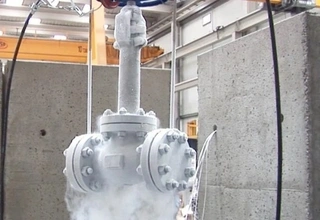
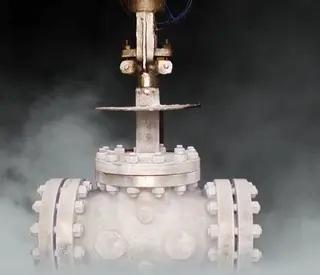
The most obvious sign is frost or ice formation. If abnormal frost or heavy icing appears on non-insulated parts such as the valve stem, bonnet, or flanges, it usually indicates external leakage. This occurs because escaping cryogenic media rapidly absorbs heat from the air, causing moisture to condense and freeze.
Soapy water or leak detection fluids can also be used for bubble testing. Continuous bubble formation indicates leakage. For flammable or hazardous media, gas detectors or ultrasonic leak detection instruments can be used for accurate localization.
4. Hazards of External Leakage
The risks of external leakage are direct and severe:
- Safety risk: flammable gases such as LNG may cause fire or explosion when exposed to ignition sources. Even inert gases may cause oxygen deficiency and suffocation risks.
- Equipment damage: continuous leakage leads to icing, which may cause moving parts to freeze and fail.
- Economic loss: direct loss of valuable cryogenic media increases operating costs.
- Environmental impact: greenhouse gas emissions such as methane create regulatory and environmental pressure.
Internal Leakage in Cryogenic Valves
Compared with external leakage, internal leakage is more hidden and difficult to detect, but its long-term impact on system efficiency is equally significant.
1. Definition of Internal Leakage
Internal leakage refers to the situation where, even when the valve is fully closed, a small amount of medium passes through the valve seat and disc, flowing from the high-pressure side to the low-pressure side. This is commonly described as improper sealing or incomplete shutoff.
2. Detection Methods
Pressure decay testing is the most common method. After the valve is closed, the downstream pressure is monitored. If it continues to drop, internal leakage may exist.
Temperature anomaly monitoring is also effective. Infrared thermometers can detect whether downstream pipelines show abnormally low temperatures or frost formation.
Ultrasonic detection technology captures high-frequency sound waves generated by leakage, allowing precise localization and severity assessment.
3. Hazards of Internal Leakage
Although less direct than external leakage, internal leakage has serious long-term effects:
- Energy waste and increased operating cost: continuous loss of cryogenic media increases expenses
- Reduced system efficiency: additional compensation is required to maintain pressure and flow stability
- Process interruption or equipment damage: abnormal pressure or contamination may affect compressors and other key equipment
Root Causes of Leakage
Whether external or internal, leakage often originates from similar root causes. Understanding these causes helps prevent issues across design, manufacturing, installation, and maintenance stages.
1. Improper Material Selection
At low temperatures, ordinary carbon steel undergoes brittle fracture and loses toughness, leading to cracking or failure. Austenitic stainless steels or low-temperature nickel steels must be used. In addition, mismatched thermal contraction rates between components may cause jamming or sealing failure.
2. Design and Manufacturing Defects
Insufficient machining accuracy between valve seat and disc leads to poor sealing. Rough sealing surfaces cannot achieve effective contact. Cryogenic valves often require extended bonnet designs to prevent freezing of the packing area. Improper design may lead to stem freezing or external leakage. Contaminants or micro-defects during machining and assembly may also become long-term leakage risks.
3. Improper Installation and Operating Conditions
If pipeline stress is not properly released during installation, valve body deformation may occur, damaging sealing surfaces. Improper operation such as rapid opening/closing or water hammer impact can also damage sealing structures. Insulation damage may allow external heat ingress, causing vaporization and pressure fluctuation that affect sealing performance.
4. Insufficient Maintenance
During long-term operation, lack of maintenance such as loosening of bolt preload or aging of sealing components can gradually lead to leakage.
Conclusion
Leak prevention performance in cryogenic valves runs through the entire lifecycle of design, material selection, manufacturing, operation, and maintenance. It is the core indicator ensuring safe and stable operation of cryogenic systems. From material behavior changes under ultra-low temperatures to sealing adaptation under thermal contraction, and from machining precision to strict testing and monitoring, every step directly affects final sealing reliability.
External leakage is usually more visible but concentrated in risk, while internal leakage is hidden but continuously reduces system efficiency. Together, they form the primary risks in cryogenic valve operation. Therefore, engineering practice must establish a systematic leak prevention control system. Through material optimization, structural improvement, precision manufacturing, and comprehensive testing and monitoring, the probability of leakage can be minimized, ensuring long-term safe, efficient, and stable operation of cryogenic systems.
Send your message to this supplier
Related Articles from the Supplier
Cryogenic Valve Sealing and Leak Prevention
- May 13, 2026
Related Articles from China Manufacturers
Sealing Elements of Cryogenic Ball Valves (Part One)
- Feb 17, 2021
Selection of Sealing Materials for Cryogenic Valves
- Jul 09, 2025
Sealing of Cryogenic Ball Valves
- Feb 23, 2024
Sealing Elements of Cryogenic Ball Valves (Part Two)
- Feb 25, 2021
Related Products Mentioned in the Article

Supplier Website
Source: https://www.magpievalves.com/media-hub/cryogenic-valve-sealing-and-leak-prevention.html