
What is Cryogenic Globe Valve: A Detailed Introduction
Cryogenic globe valves are specialized valves designed to operate under extremely low-temperature conditions, typically below -150°C. These valves use cryogenic media such as liquid nitrogen, liquid oxygen, or liquefied argon as the working fluid and regulate flow through the linear motion of the valve disk. By adjusting the position of the disk relative to the valve seat, cryogenic globe valves achieve precise control of low-temperature fluid flow, ensuring safe and efficient operation in industrial systems.
Compared to conventional globe valves, cryogenic globe valves have distinct design requirements for materials, structural integrity, and sealing performance. Ordinary valves often fail in cryogenic environments due to material embrittlement, seal failure, or deformation under extreme cold. Cryogenic globe valves overcome these challenges through advanced engineering, specialized materials, and unique structural features that allow stable and reliable operation even under harsh low-temperature conditions.
Working Principle of Cryogenic Globe Valves
The working principle of a cryogenic globe valve is fundamentally mechanical. When an operator rotates the hand wheel clockwise, the valve stem rises, lifting the valve disk from the seat and allowing the low-temperature medium to flow through the valve. Conversely, rotating the hand wheel counterclockwise lowers the stem, pressing the disk against the seat to achieve complete shutoff.
During operation, cryogenic fluids such as liquid nitrogen flow through narrow internal passages. When the valve opens, the escaping gas generates pressure that directs the liquid nitrogen into a lower cavity, maintaining extremely low temperatures and preventing heat transfer from the surrounding environment. This design ensures that the valve operates in a consistently cryogenic state, meeting the precise temperature control requirements of industrial processes.
Valve bodies are typically constructed from low-temperature-resistant materials such as stainless steel, bronze, or brass. These materials can withstand extreme cold without cracking or deforming. Additionally, the valve stem and sealing components are fabricated from specialized materials to maintain operability and sealing integrity in cryogenic conditions.
Key Design Features of Cryogenic Globe Valves
Cryogenic globe valves achieve reliable operation under extreme low temperatures through specialized structural and material design features. These include:
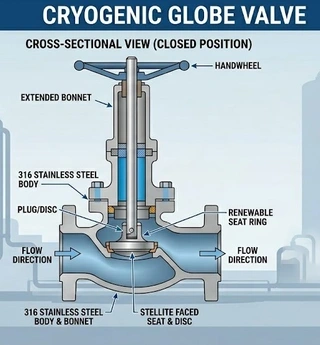
1. Extended Bonnet Design
One of the most characteristic features of cryogenic globe valves is the extended bonnet. Cryogenic media such as liquid nitrogen reach temperatures as low as -196°C. If the valve stem and packing area are directly exposed to such low temperatures, packing may crack or lose elasticity, causing seal failure.
The extended bonnet design separates the valve stem and packing area from the cryogenic medium, maintaining a relatively higher temperature in the packing zone. This prevents freezing and protects the sealing components from damage. The height of the bonnet is determined based on the operating conditions, media temperature, and pipeline insulation thickness. By protecting the valve’s sealing core, the extended bonnet is a defining feaure that differentiates cryogenic globe valves from standard valves.
2. Material Selection
Material selection is critical in cryogenic valve design. Ordinary carbon steel loses toughness and can fracture at low temperatures, so only certified cryogenic materials should be used. Common materials include:
- Stainless Steel: Austenitic stainless steels such as 304, 316, and 316L retain excellent toughness and ductility at -196°C, making them ideal for extreme cryogenic applications.
- Low-Temperature Carbon Steel: Grades such as LCC and LCB are suitable for moderate low-temperature conditions (-46°C to -101°C) but are not suitable for extreme cryogenic environments.
- Copper Alloys: Brass and bronze may be used in specific cryogenic applications with good performance.
All materials must maintain sufficient impact toughness and structural stability at the minimum operating temperature. Cryogenic impact tests certify that the materials can withstand thermal shock without failure.
3. Stem Sealing Design
Low temperatures can harden and shrink packing, reducing sealing force, increasing leakage risk, and raising operating torque. Cryogenic globe valves address this challenge through:
Using flexible graphite, PTFE, or specialized low-temperature packing combinations
Gland structures that compensate for thermal shrinkage, maintaining consistent sealing pressure
Spring-loaded packing in high-end models to ensure constant sealing force, independent of temperature variations
These design measures ensure reliable sealing performance and smooth operation under cryogenic conditions.
4. Seat and Disk Matching
Metallic components contract at low temperatures, and differences in thermal expansion between materials can compromise sealing integrity. Improper matching may result in uneven sealing pressure, surface deformation, or incomplete closure. Cryogenic globe valve design must ensure:
Thermal expansion coefficients of the seat and disk are compatible
Sealing surfaces have hardness and toughness suitable for cryogenic impact
Fully forged stainless steel construction for structural stability and reliable sealing
5. Anti-Frost and Freeze Prevention
Valve surfaces exposed to cryogenic environments are prone to frost or ice formation, leading to operational difficulties, potential freezing of the stem, and accelerated corrosion. Solutions include:
Anti-condensation surface treatments
External insulation layers
Locating actuators or handwheels away from cryogenic zones
These measures are particularly important in LNG facilities and other low-temperature chemical processing applications.
Advantages of Cryogenic Globe Valves
- Adaptability to Extreme Environments: Cryogenic globe valves maintain stable operation under extremely low temperatures and can withstand high-pressure conditions, making them indispensable in cryogenic fluid systems for liquid nitrogen, oxygen, or argon.
- High Reliability and Durability: Made from high-quality materials such as stainless steel, cryogenic valves exhibit excellent durability and low maintenance requirements. Their design supports long-term operation in harsh conditions, reducing downtime and maintenance costs.
- Precise Flow Control: Cryogenic globe valves provide precise flow regulation, enabling accurate control of process parameters without compromising efficiency or quality. This is crucial in applications requiring stringent temperature management.
- Ease of Operation: Compared to other low-temperature valves, cryogenic globe valves require lower operating torque. Manual valves are operated via handwheel or lever, while automated valves can use electric or pneumatic actuators with freeze-protection design.
- Tight Sealing Performance: Cryogenic globe valves maintain tight closure even under extreme low temperatures, minimizing leakage, reducing medium loss, and ensuring safe operation while lowering environmental risks.
Limitations of Cryogenic Globe Valves
- Higher Cost: Specialized materials, precision manufacturing, and rigorous testing make cryogenic globe valves more expensive than standard valves.
- Maintenance Requirements: Cryogenic valves require specialized cleaning, testing, and maintenance procedures using specific tools and low-temperature lubricants.
- Safety Risks: Improper handling of cryogenic media poses severe safety hazards. Liquid nitrogen exposure can cause frostbite or even death. Leaks can form ice layers, creating slip hazards, while weld failures may lead to sudden release of cryogenic fluids.
- Limited Operating Range: These valves are designed for cryogenic applications and may fail under high-temperature conditions, making proper selection critical.
- Compatibility Constraints: Not all cryogenic systems are compatible with standard cryogenic globe valves. Some applications may require custom designs, increasing costs and complexity.
Applications of Cryogenic Globe Valves
- Oil and Gas: Used in LNG storage and transport, cryogenic globe valves precisely control liquefied gas flow and ensure safe operation at approximately -162°C.
- Chemical Processing: In chemical plants, they handle liquid oxygen, nitrogen, and argon, maintaining optimal temperatures for accurate chemical reactions.
- Metal Processing: Cryogenic cooling improves material properties. These valves regulate coolant supply to stabilize processes and ensure product quality.
- Aerospace: Cryogenic valves maintain spacecraft cabin temperatures below -183°C and safely control rocket fuels and other volatile chemicals under extreme conditions.
- Medical: Used in cryogenic storage tanks for liquid nitrogen, they regulate flow to preserve biological samples, vaccines, and other temperature-sensitive materials.
- Food and Beverage: Cryogenic valves control liquefied gas flow in frozen food production, maintaining precise temperatures and extending shelf life.
- Energy: In LPG systems, they ensure precise temperature and pressure control, supporting safe and efficient energy transport.
Key Considerations When Selecting Cryogenic Globe Valves
- Operating Parameters: Minimum temperature, pressure range, media type, pipeline size, and flow requirements
- Material Certification: Ensure materials maintain toughness and strength at the lowest operating temperature
- Sealing Performance: Verify leakage standards; consider dual or specialized seals for critical applications
- Operation Type: Manual or automated with freeze-protection features
- Supplier Qualification: Choose suppliers with proven experience in cryogenic applications
- Cost-Benefit Analysis: Consider total life-cycle costs, including maintenance and downtime
Installation and Maintenance Guidelines
- Installation: Correct valve orientation with vertical or specified inclined stem; Adequate space for operation and maintenance; Proper insulation and stress-free mounting; Expansion joints where necessary.
- Insulation: Foam insulation: cost-effective for general low-temperature use; Vacuum insulation: high performance for extreme cryogenic conditions.
- Lubrication: Use specialized low-temperature lubricants that maintain viscosity and performance under cryogenic conditions.
- Regular Inspection: Monitor packing, frost accumulation, operating torque, and leakage regularly.
- Safety Procedures: Implement personal protective equipment requirements, emergency response protocols, thawing procedures, and valve handling instructions in emergencies.
Conclusion
Cryogenic globe valves are essential control devices in low-temperature industrial systems. Their specialized design and material selection ensure reliable operation under extreme cold. While higher in cost and maintenance requirements, their advantages in safety, durability, and precise flow control make them indispensable in liquefied gas transport, storage, and processing industries.
As cryogenic technology expands in medical, aerospace, and energy sectors, cryogenic valve technology continues to advance. Users should understand valve characteristics and limitations, select appropriate models, and strictly follow safety procedures to ensure long-term system stability and personnel safety. Partnering with experienced cryogenic equipment suppliers guarantees technical support, after-sales service, and optimal performance throughout the valve’s operational life.
Send your message to this supplier
Related Articles from the Supplier
Related Articles from China Manufacturers
What is a Cryogenic Ball Valve?
- Apr 22, 2019

What is a Cryogenic Gate Valve?
- Aug 15, 2025
What Is a Cryogenic Ball Valve?
- Jan 07, 2026

What is a tumble shot blasting machine?
- Apr 09, 2019
Related Products Mentioned in the Article

Supplier Website
Source: https://www.magpievalves.com/media-hub/what-is-cryogenic-globe-valve-a-detailed-introduction.html