
Wafer-Type Butterfly Valves vs. Lug-Type Butterfly Valves
In industrial piping systems, valves are key devices used to control the flow of liquids, gases, and slurries. Butterfly valves have become one of the most widely used types of valves due to their simple structure, convenient operation, and reliable performance. Among them, wafer-type butterfly valves and lug-type butterfly valves are the two most common structural forms. These two types have clear differences in design and function, and their applicable working conditions are also not the same. This article will provide a detailed comparison of the characteristics of these two butterfly valves, helping engineering and technical personnel make the correct selection based on actual needs.
Basic Working Principle of Butterfly Valves
Wafer-type butterfly valves and lug-type butterfly valves are completely identical in terms of working principle. Both control the flow of the medium by rotating a valve disc. The rotation angle of the disc varies between 0 degrees and 90 degrees. When the disc rotates to 90 degrees, the valve is fully open, and the medium can pass freely. When the disc rotates to 0 degrees, the valve is fully closed, cutting off the flow of the medium.
This quarter-turn drive method is simple to operate and allows for rapid opening and closing, enabling efficient flow control. After understanding this common principle, the following sections will provide a detailed analysis of the two types of butterfly valves.
What You Should Know about Wafer-Type Butterfly Valves?
Wafer-type butterfly valves are one of the most commonly used butterfly valve types in industrial applications. Their design is centered on simplicity and practicality, and they demonstrate good adaptability across many working conditions. The following introduces their structure, installation method, main advantages, limitations, and typical application scenarios.
1. Wafer Butterfly Valve Structural Design Features
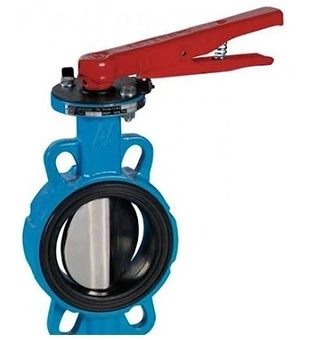
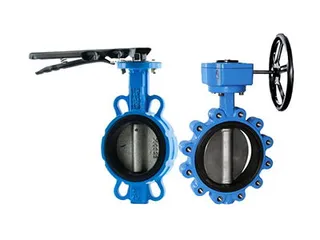
Wafer-type butterfly valves adopt a compact and thin structural design. The valve body itself does not have flanges or independent threaded holes. The overall valve is lightweight, with a simple structure and a relatively small number of components.
Manufacturers usually provide multiple combinations of disc and seat materials to adapt to different media and working conditions. The external surface of the valve body can also be coated with different materials according to operational requirements to enhance strength and corrosion resistance.
2. Wafer Butterfly Valve Installation Method
The installation method of wafer-type butterfly valves is relatively unique. The valve is clamped between two pipe flanges, and long bolts pass through both flanges to tightly secure the valve body in place.
This installation method does not require additional gaskets, as sealing and positioning rely on the compression force provided by the flanges on both sides. It should be noted that wafer-type butterfly valves must be connected to pipelines on both sides simultaneously and cannot be installed on only one side.
3. Main Advantages of Wafer Butterfly Valves
Wafer-type butterfly valves exhibit several advantages in practical applications, including the following aspects:
- Compact structure and high space utilization: Wafer-type butterfly valves have the shortest face-to-face dimension and the smallest installation length among valves of the same size. This makes them highly suitable for industrial environments with limited space.
- Cost-effective and economical: Due to their simple structure, reduced material requirements, and easy manufacturing processes, wafer-type butterfly valves have relatively low overall costs. This advantage is especially evident in large-diameter applications.
- Simple installation and low construction complexity: Installation only requires placing the valve between flanges and fastening it with bolts, without the need for complex alignment adjustments or additional gaskets.
- Low fluid resistance and low energy consumption: When fully open, the disc produces relatively little resistance to the fluid, resulting in low pressure drop and improved operational efficiency of the pipeline system.
- Convenient maintenance: Due to the simple structure and fewer components, wafer-type butterfly valves generally do not require frequent maintenance or cleaning and can operate stably in various industrial environments.
Despite the above advantages, wafer-type butterfly valves also have certain inherent limitations that must be considered during actual selection.
4. Limitations of Wafer Butterfly Valve
Wafer-type butterfly valves cannot be used as end-of-line valves. Because they rely on clamping between flanges on both sides, if only one flange is connected, the valve body may shift under pressure, leading to leakage or even causing the valve to be pushed out of the flange connection surface.
In addition, during disassembly and maintenance, both sides of the pipeline must be disconnected at the same time, and one side cannot be removed independently, which increases maintenance workload. Wafer-type butterfly valves are generally suitable for pipe diameters below DN600, and their pressure rating is typically not higher than PN16.
5. Typical Application Scenarios for Wafer Butterfly Valve
Based on the above characteristics and limitations, wafer-type butterfly valves are suitable for installation environments with limited space, positions in the middle of pipelines, and projects that are sensitive to cost.
They are widely used in HVAC chilled water systems, building water supply systems, and large-diameter low-pressure water systems. After understanding wafer-type butterfly valves, the following section analyzes another important butterfly valve type—the lug-type butterfly valve.
What is a Lug-Type Butterfly Valve?
Lug-type butterfly valves are structurally reinforced based on wafer-type butterfly valves and are more suitable for industrial environments with higher requirements. The following provides a detailed introduction from five aspects: structural design, installation method, main advantages, limitations, and typical application scenarios.
1. Structural Design Features of Lug Butterfly Valve
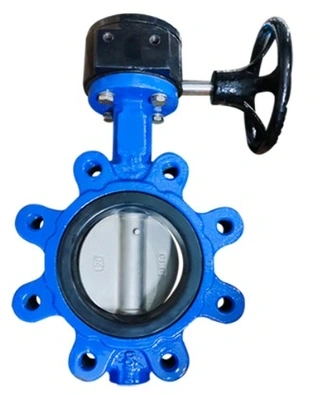
Lug-type butterfly valves are designed with threaded lugs on the valve body. These lugs are evenly distributed around the valve body and are used for bolt installation. The valve body is relatively thicker and stronger, providing higher overall mechanical strength.
Manufacturers also provide different disc and seat configurations based on specific requirements to meet diverse application needs.
2. Installation Method for Lug Butterfly Valve
Lug-type butterfly valves are installed using short bolts. The bolts are inserted from the outer side of the pipe flange and screwed directly into the threaded lugs of the valve body to secure the valve.
This installation method allows the valve to be independently fixed on one side without relying on the support of the opposite flange. During installation, it is necessary to ensure that the lugs are aligned with the flange bolt holes to avoid uneven stress on the valve body, and appropriate gaskets should be selected to prevent leakage.
3. Main Advantages of Lug Butterfly Valve
Lug-type butterfly valves offer several advantages in multiple aspects, especially for more demanding working conditions:
- Firm connection and high stability: The bolts are directly fixed into the valve body lugs, resulting in significantly higher connection strength and stability compared to wafer-type structures.
- Excellent isolation performance: During system operation, one side can be isolated without affecting the other side of the pipeline. This feature is particularly suitable for process flows requiring sectional control or localized maintenance.
- Good maintenance convenience: The valve can be removed by disassembling bolts on only one side, while the other side of the pipeline remains intact. This greatly reduces downtime and maintenance costs.
- Suitable for end-of-line applications: Even when connected to only one flange, lug-type butterfly valves can remain securely fixed and can even function as blind ends. This is one of their most prominent engineering advantages.
- Strong high-pressure resistance: Lug-type butterfly valves can typically withstand higher pressure ratings, generally up to PN25, with some products capable of even higher levels. They demonstrate better durability and reliability under high-load and demanding conditions.
- Good resistance to pipeline stress: They can withstand loads and flange forces from one side, making them more adaptable to complex working conditions.
Although lug-type butterfly valves have clear advantages, they also have some disadvantages that should be considered during selection.
4. Limitations of Lug Butterfly Valve
The initial cost of lug-type butterfly valves is usually higher than that of wafer-type butterfly valves. Because threaded lugs need to be machined, the manufacturing process is more complex and requires more material, resulting in a higher overall price.
In addition, due to the presence of lug structures, the face-to-face dimension of the valve is slightly larger than that of a wafer-type butterfly valve of the same specification.
5. Typical Application Scenarios for Lug Butterfly Valve
Based on the above characteristics, lug-type butterfly valves are suitable for systems that require frequent maintenance, sectional isolation, or the ability to withstand higher pressures.
They are commonly used at pump inlets and outlets, equipment connection points requiring isolation for maintenance, fire protection systems, and end-of-line pipeline conditions. They are also widely applied in chemical and process piping systems where high mechanical strength and operational reliability are required.
After understanding the characteristics of both types of valves, the following section provides a systematic comparison.
Key Differences Between the Two Types of Butterfly Valves
To help users make clearer selection decisions, this section compares wafer-type butterfly valves and lug-type butterfly valves from six key dimensions.
1. Structural Design Differences
Lug-type butterfly valves have threaded lugs on both sides of the valve body, allowing bolts to securely fix the valve to the pipeline. Wafer-type butterfly valves do not have threaded structures and rely on bolts passing through both flanges for clamping. This fundamental difference determines their performance in other aspects.
2. Installation Method Differences
Lug-type butterfly valves can be installed independently on one side and can be used as end-of-line valves. Wafer-type butterfly valves must be connected to flanges on both sides and cannot be used at the end of pipelines.
During installation of wafer-type butterfly valves, excessive bolt tightening should be avoided to prevent deformation of the valve body, and installation in systems with significant vibration should be minimized.
3. Maintenance Convenience Differences
When removing wafer-type butterfly valves, both sides of the pipeline must be disconnected, resulting in a higher maintenance workload. Lug-type butterfly valves only require disassembly on one side, making them more suitable for equipment connections that require frequent maintenance, such as pumps and filters.
This difference is particularly important for systems requiring regular servicing.
4. Sealing Performance Differences
Lug-type butterfly valves provide more reliable sealing performance due to their threaded lug and independent bolt connection design, which helps prevent leakage and backflow. Wafer-type butterfly valves rely on the clamping force of flanges on both sides for sealing and require higher installation alignment accuracy. Improper alignment may lead to leakage risks.
5. Size and Pressure Rating Differences
Wafer-type butterfly valves are typically suitable for pipe diameters below DN600 and are mostly used in conditions with pressure ratings not exceeding PN16. Lug-type butterfly valves can be applied to larger diameters and can withstand higher pressure ratings, typically up to PN25.
This difference gives lug-type butterfly valves a clear advantage in high-pressure and high-flow systems.
6. Cost Differences
Wafer-type butterfly valves have a simple structure, are easy to manufacture, and require less material, making them more economical overall. Lug-type butterfly valves, due to higher manufacturing complexity, have higher initial costs. However, from a long-term operational perspective, lug-type butterfly valves offer better overall cost-effectiveness in high-load conditions.
Selection Decision Guide
In actual selection processes, multiple key factors need to be considered. The most important decision criteria are as follows:
- Requirement for end-of-line use: This is the primary factor distinguishing the two structures. Wafer-type butterfly valves cannot be used at pipeline ends, while lug-type butterfly valves can serve as terminal valves.
- Maintenance frequency requirements: If the pipeline system requires frequent inspection or valve removal, lug-type butterfly valves offer clear advantages due to their one-sided disassembly capability. If the system operates long-term without maintenance, wafer-type butterfly valves are sufficient.
- Pressure rating and pipeline stress: In high-pressure conditions or systems with significant pipeline stress, lug-type butterfly valves provide higher structural strength and better reliability.
- Space limitations and budget: If installation space is extremely limited and the budget is tight, wafer-type butterfly valves are more advantageous due to their compact structure and lower cost.
- System importance: For critical process pipelines or systems with high safety requirements, lug-type butterfly valves offer more reliable sealing and isolation performance.
Conclusion
Wafer-type butterfly valves and lug-type butterfly valves both serve the fundamental function of controlling fluid flow, but they differ significantly in structural design, installation methods, sealing performance, application scope, and economic factors.
Wafer-type butterfly valves are characterized by their compact structure, convenient installation, and cost-effectiveness. They are suitable for general working conditions where space is limited and cost sensitivity is high, especially in large-diameter, low-pressure water systems.
Lug-type butterfly valves, on the other hand, offer firm connections, strong isolation performance, and excellent high-pressure resistance. They are more suitable for industrial systems requiring frequent maintenance, sectional isolation, or operation under higher pressure conditions, and they demonstrate greater reliability in demanding and complex environments.
By selecting the appropriate valve type based on specific working conditions, it is possible to ensure the safe and efficient operation of pipeline systems while achieving optimal economic benefits.
Send your message to this supplier
Related Articles from the Supplier
Wafer Butterfly Valves vs. Flanged Butterfly Valves
- Dec 29, 2025
What is Dual Plate Wafer Check Valve
- Jan 05, 2026
Related Articles from China Manufacturers

Wafer Type Control Valve: A Comprehensive Overview
- Oct 11, 2024
Wafer Type Check Valve Structure & Installation Tips
- Sep 09, 2021
JONLOO Wafer Type Dual Plate Check Valve
- Sep 28, 2017

Wafer and Lug Butterfly Valve: How to Choose?
- Jan 16, 2025
Related Products Mentioned in the Article

Zhejiang Kosen Valve Co., Ltd.
- https://www.kosenvalve.com/
- Business Type: Industry & Trading, Manufacturer,
Supplier Website
Source: https://www.kosenvalve.com/media-hub/wafer-type-butterfly-valves-vs-lug-type-butterfly-valves.html