
Cryogenic Valve Deep Cryogenic Treatment & Low-Temp Testing
In modern industry, the storage, transportation, and control of cryogenic media place extremely high requirements on equipment performance. Media such as liquefied natural gas, liquid hydrogen, liquid oxygen, and ethylene operate at extremely low temperatures, which not only place demands on valve materials for low-temperature resistance and high strength, but also impose strict requirements on sealing, wear resistance, and dimensional stability. Cryogenic valves play a key role under such extreme operating conditions, and their reliability is directly related to the safety and efficiency of industrial processes. Therefore, deep cryogenic treatment and low-temperature testing of cryogenic valves have become core steps to ensure their performance and service life.
Cryogenic Valves Application
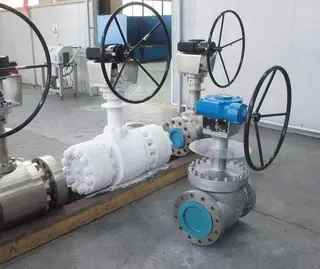
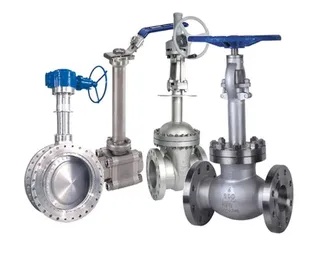
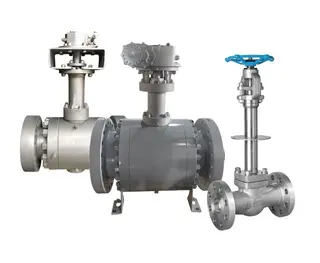
Cryogenic valves are a special type of valve mainly used for handling liquid cryogenic media. These media include ethylene, liquid oxygen, liquid hydrogen, liquefied natural gas, and liquefied petroleum products, with operating temperatures as low as -196°C. They are widely used in multiple industrial fields, such as ethylene units, LNG units, LPG (liquefied petroleum gas) and LNG storage tanks, receiving bases and satellite stations, air separation equipment, petrochemical tail gas separation equipment, cryogenic storage tanks and tankers, pressure swing adsorption oxygen generation units, etc. These facilities have extremely high requirements for cryogenic valve performance because they need to stably control the output of liquid cryogenic media in extremely low-temperature environments.
Deep Cryogenic Treatment Process of Cryogenic Valves
The reliability and stability of cryogenic valves in extreme low-temperature environments are extremely important, and the deep cryogenic treatment process is a key step to achieve these performances. Through deep cryogenic treatment, the components of cryogenic valves can maintain good mechanical properties and dimensional stability in low-temperature environments, thereby ensuring efficient operation of the valve in actual applications.
1. Principle of Deep Cryogenic Treatment
Deep cryogenic treatment is a key process in the production of cryogenic valves. It uses a cold medium (usually liquid nitrogen) as the cooling agent to cool quenched metal materials to a temperature far below room temperature (such as -196°C). This process can significantly improve the performance of metal materials. First, it can greatly reduce the residual austenite in the metal material. Residual austenite is an unstable structure that can easily transform into martensite in a low-temperature environment. Through deep cryogenic treatment, the residual austenite transforms into martensite, thereby increasing the material's hardness and strength. Secondly, deep cryogenic treatment can cause uniform, fine, and dispersed carbide precipitation in the metal matrix. These ultrafine carbide particles are only 20–60Å in size, maintain a coherent relationship with the matrix, and are uniformly distributed in the martensitic matrix. This microstructural change can reduce martensite lattice distortion, lower microscopic stress, and, during material plastic deformation, hinder dislocation movement, thereby strengthening the matrix structure. In addition, the precipitation of ultrafine carbide particles can also weaken grain boundary embrittlement and play a grain boundary strengthening role, thereby improving the performance of workpieces and molds, enhancing hardness, impact toughness, and wear resistance.
2. Process Flow of Deep Cryogenic Treatment
Component Placement and Liquid Nitrogen Connection: Place cryogenic valve components evenly in the cryogenic chamber. Then connect the pipes to the liquid nitrogen storage tank or tanker, ensuring they are fixed to prevent the connection pipes from detaching or flying off during nitrogen filling, which could cause injury.
Liquid Nitrogen Immersion and Temperature Control: Immerse all components to be treated completely in liquid nitrogen. During immersion, the evaporation of liquid nitrogen may cause insufficient liquid levels, so nitrogen must be replenished in time. Soaking time varies according to component size and wall thickness, until the temperature at all parts of the component stabilizes. To ensure uniform temperature across all parts, thermocouples are used for measurement.
Insulation and Repeated Treatment: According to relevant requirements for cryogenic valve deep cryogenic treatment and the applicable range of components, maintain insulation for a certain period. The duration depends on factors such as material and size of the components. After insulation, remove the components with special tools and allow them to return to ambient temperature. Then place the components back into the liquid nitrogen chamber and repeat steps 2–3 for a second treatment. After the second treatment, remove the components again, allow them to return to ambient temperature. At this point, the deep cryogenic treatment process is complete, and components can undergo subsequent machining.
3. Effects of Deep Cryogenic Treatment
Deep cryogenic treatment has significant performance improvement effects on cryogenic valve components. It can transform residual austenite, increase workpiece hardness and wear resistance, and stabilize component dimensions. In addition, deep cryogenic treatment precipitates ultrafine carbides, further enhancing wear resistance; refines grains, improving impact toughness. For martensitic stainless steel, deep cryogenic treatment can significantly improve corrosion resistance and polishability. Moreover, deep cryogenic treatment can improve the conductivity and corrosion resistance of non-ferrous metals, reduce mold deformation and cracking, and improve dimensional accuracy. The effect of deep cryogenic treatment penetrates into the interior of components, representing an overall effect. Therefore, treated components can be reground and reused, and quenching stress is reduced while dimensional stability is enhanced.
Low-Temperature Testing of Cryogenic Valves
The deep cryogenic treatment process provides a basic guarantee for the performance of cryogenic valves in extreme low-temperature environments, but to ensure stable operation in actual applications, strict low-temperature testing is required to verify overall performance. Low-temperature testing is not only a key step in cryogenic valve production but also an important means of quality control. Through low-temperature testing, the sealing, operational performance, and dimensional stability of the valve under low-temperature conditions can be comprehensively evaluated, ensuring safe and reliable operation in industrial fields such as LNG and ethylene petrochemical production.
1. Importance of Low-Temperature Testing
Low-temperature testing is an indispensable key step in cryogenic valve production. Complete, standard-compliant low-temperature testing equipment is an important guarantee for production and quality control. Low-temperature testing mainly examines the overall performance of cryogenic valves under low-temperature working environments and is a task that must be performed regularly. Through low-temperature testing, it can be ensured that cryogenic valves operate stably and reliably under extreme low-temperature conditions, avoiding safety accidents and economic losses caused by valve failure.
2. Low-Temperature Testing Equipment and Medium
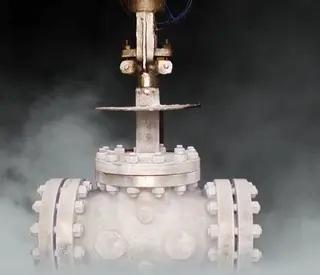
Low-temperature testing equipment is mainly used for deep cryogenic treatment of valve components and valve low-temperature type testing. Currently, low-temperature environments are mainly obtained through thermal cycling or low-temperature media (usually low-temperature liquids absorbing vaporization latent heat). However, for deep cryogenic environments below -100°C, immersion in low-temperature liquid is usually the only method. Liquid nitrogen is widely used due to its suitable temperature (-196°C), wide availability, non-polluting nature, and low cost. When using liquid nitrogen as the cooling medium, a certain proportion of alcohol can be added to obtain different temperature levels to meet the requirements of different low-temperature valve tests.
3. Process Flow of Low-Temperature Testing
Preparation: Before low-temperature testing, valves should be degreased and dried. Oil and moisture can become solidified in low-temperature environments, potentially causing damage to internal structures. After connecting the valve to the testing device, initial helium testing at room temperature and maximum operating pressure is conducted to ensure tightness of connections.
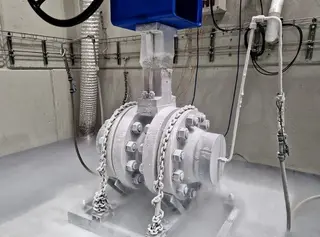
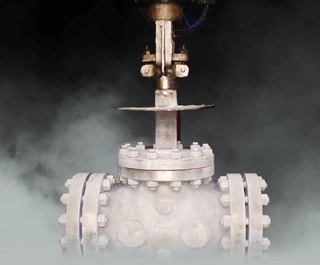
Cooling and Helium Circulation: During valve cooling, helium should continuously flow inside to remove moisture that may form during cooling. The entire test is conducted in a low-temperature testing tank, with the valve fully immersed in liquid nitrogen or a mixture of liquid nitrogen and alcohol, with the liquid level reaching the valve bonnet neck.
Testing Operation and Safety Protection: When the temperature of each part reaches the required value, testing can begin. Low-temperature testing mainly follows relevant standards to check the sealing and operational performance of the valve under low-temperature conditions. Multiple opening and closing operations are required during testing. Due to the special low-temperature environment, personnel safety must be strictly observed, including wearing protective equipment, ensuring ventilation, and warning and isolating the low-temperature area. After the test, proper post-test site protection must be ensured to maintain safety and cleanliness.
4. Low-Temperature Testing Standards
Currently, standards for valve low-temperature testing mainly include JB/T 7794 and BS 6364. These standards detail testing conditions, methods, and performance requirements for cryogenic valves. For valves operating below -100°C, major components should undergo deep cryogenic treatment before precision machining to reduce deformation caused by temperature differences and metallurgical changes. These standards provide a scientific basis for cryogenic valve production and quality control, ensuring reliability and safety in actual applications.
Cryogenic Valve Materials and Their Deep Cryogenic Treatment
Material selection is critical in cryogenic valve production. For components of ultra-low temperature valves operating below -100°C, Cr-Ni austenitic stainless steels such as F304, F304L, F316, and F316L are mainly used. These materials are metastable stainless steels that undergo metallurgical transformation to martensite at low temperatures. Because the body-centered cubic lattice of martensite has a larger specific volume than the face-centered cubic lattice of austenite, low-temperature phase transformation causes volume expansion, leading to component deformation. In addition, temperature reduction causes metal contraction, and uneven contraction produces thermal stress. When thermal stress exceeds the material's yield limit, irreversible permanent deformation occurs. Deep cryogenic treatment allows phase transformation and deformation to fully occur, and precision machining maintains relatively stable structure and dimensions. Specifically, components are immersed in liquid nitrogen, held at -196°C for 1–2 hours, then removed and allowed to naturally return to ambient temperature, repeating the cycle twice. Research indicates deep cryogenic treatment also strengthens mechanical properties, improving strength and hardness due to residual austenite transforming to martensite, ultrafine carbide precipitation causing dispersion strengthening, and grain refinement inducing hardening. Secondary deep cryogenic treatment is most effective, as structural changes still occur during the second treatment, while further cycles produce no significant change.
Conclusion
Cryogenic valves play an important role in modern industry, and deep cryogenic treatment and low-temperature testing are key processes to ensure performance. Deep cryogenic treatment significantly improves hardness, wear resistance, impact toughness, and dimensional stability by reducing residual austenite, precipitating ultrafine carbides, and refining grains. Low-temperature testing strictly verifies valve performance under actual low-temperature working conditions through degreasing, drying, helium testing, and low-temperature immersion, ensuring sealing and operational reliability. With the continued development of air separation, LNG, ethylene petrochemical, and other industries, demand for cryogenic valves will continue to grow, and deep cryogenic treatment and low-temperature testing processes will continue to improve, providing strong guarantees for safe and efficient industrial operation.
Send your message to this supplier
Related Articles from the Supplier
Related Articles from China Manufacturers
Cryogenic Valve Sealing and Leak Prevention
- May 13, 2026

A Brief on Cryogenic Valve
- May 27, 2017

Special Requirements of Cryogenic Valve
- Jun 14, 2017
Related Products Mentioned in the Article

Zhejiang Kosen Valve Co., Ltd.
- https://www.kosenvalve.com/
- Business Type: Industry & Trading, Manufacturer,
Supplier Website
Source: https://www.kosenvalve.com/media-hub/cryogenic-valve-deep-cryogenic-treatment-low-temp-testing.html