
A Complete Guide to Magnetic Drive Pumps
A magnetic drive pump is an industrial pumping device that uses magnetic fields to transmit torque. Unlike conventional water pumps or chemical pumps, the most significant difference is that a magnetic drive pump eliminates the mechanical seal structure and does not require a drive shaft to extend directly into the pump casing. Instead, it relies on magnetic coupling between an external magnet and an internal magnet to transmit the rotational power of the motor to the impeller without physical contact, thereby driving fluid movement.
This design creates a completely sealed internal pump chamber. Throughout the entire process, from fluid entering the pump to being discharged, it does not come into contact with the external environment. As a result, magnetic drive pumps can achieve truly zero-leakage operation. This characteristic makes them irreplaceable when handling toxic, hazardous, volatile, or high-purity liquids.
From a fundamental classification perspective, a magnetic drive pump is essentially a type of centrifugal pump. Fluid enters the impeller at the center of the pump inlet and gains energy as the impeller rotates at high speed. The fluid is then flung toward the outer edge of the impeller, enters the volute casing, and is finally discharged through the outlet. The only difference lies in the driving method: magnetic coupling replaces traditional shaft-driven transmission.
Working Principle of Magnetic Drive Pump
The power transmission process of a magnetic drive pump can be divided into three stages.
First stage: Motor drives the external magnet assembly.
The external magnet assembly is mounted on the motor shaft. When the motor starts, the external magnets rotate synchronously with it.
Second stage: Magnetic field coupling.
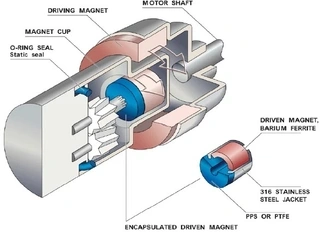
The external magnet assembly consists of multiple high-strength permanent magnets. As it rotates, it generates a changing magnetic field in the surrounding space. This magnetic field can penetrate the isolation sleeve made of non-magnetic materials and act on the internal magnet assembly inside the pump.
Third stage: synchronous rotation.
Under the influence of the magnetic field, the internal magnet assembly rotates synchronously with the external assembly. Since the internal magnet is directly connected to the impeller, the impeller also rotates, enabling fluid transport.
Because the external and internal magnet assemblies are completely separated by the isolation sleeve, there is no mechanical connection between them. Motor power is transmitted entirely through magnetic force, which is the fundamental reason why magnetic drive pumps achieve zero leakage.
The isolation sleeve is typically made of non-magnetic metals or high-performance engineering plastics. It must allow magnetic fields to pass efficiently while ensuring complete sealing of the fluid inside the pump. This design significantly improves sealing performance compared to traditional mechanical seal pumps.
Main Structural Components of Magnetic Drive Pump
A magnetic drive pump consists of several key components, each serving a specific function.
- External magnet assembly: Connected to the motor shaft, it is the power input end. It converts mechanical energy into a magnetic field and transfers motor torque via magnetic coupling.
- Internal magnet assembly: Installed on the impeller, it is the power receiving end. It rotates under magnetic force and directly drives the impeller. Since it is in contact with the process fluid, it must be made of corrosion-resistant materials.
- Isolation sleeve: This is the core sealing component of the magnetic drive pump. It separates the external magnet from the internal magnet, completely isolating the internal fluid chamber from the external environment. Its material selection directly affects sealing performance and service life.
- Impeller: The impeller converts mechanical energy into fluid energy. As it rotates, fluid is thrown from the center to the outer edge, increasing both pressure and velocity.
- Pump casing (volute casing) : The casing houses the impeller and guides fluid flow. Its internal hydraulic design has a direct impact on pump performance.
- Bearings and support system: Since there is no lubrication oil system inside a magnetic pump, bearings are typically made of ceramic, carbon, or silicon carbide self-lubricating materials. These materials are wear-resistant and suitable for corrosive media.
- Auxiliary cooling and lubrication channel: A portion of the pumped fluid is directed through specially designed channels to cool and lubricate the bearing system. This prevents overheating during long-term operation.
Common Types of Magnetic Drive Pump
Magnetic drive pumps are classified into several types based on structure and application requirements.
1. Horizontal centrifugal magnetic pump
The most common type. The motor and pump body are arranged horizontally, making installation and maintenance convenient. It is widely used in chemical processing and corrosive fluid handling.
2. Vertical submersible magnetic pump
Installed vertically, with the motor on top and pump body partially submerged in liquid. It is suitable for space-constrained environments or direct tank extraction.
3. Canned motor magnetic pump
The motor and pump are integrated into a single sealed unit. Both rotor and stator are enclosed within a containment sleeve, providing extremely high sealing performance and low noise operation.
4. Metal magnetic pump
Made from stainless steel, Hastelloy, or other alloys. Suitable for high temperature and high-pressure applications. Some versions include PTFE linings for enhanced corrosion resistance.
5. Plastic magnetic pump
Constructed from polypropylene, ETFE, or PVDF. These pumps offer excellent corrosion resistance, low weight, and low cost, typically used below 95°C.
Core Advantages of Magnetic Drive Pump
Magnetic drive pumps offer multiple significant advantages in industrial applications.
- Zero leakage operation: Unlike traditional pumps that rely on mechanical seals, magnetic drive pumps eliminate sealing failure risks entirely. This is critical for toxic, flammable, or high-value fluids.
- High safety performance: In chemical and pharmaceutical industries, leakage can cause fires, explosions, or poisoning. The fully sealed structure significantly enhances operational safety.
- Low maintenance cost: Mechanical seals in traditional pumps require regular replacement. Magnetic drive pumps eliminate this component, reducing downtime and maintenance costs over their lifecycle.
- Strong media compatibility: With appropriate material selection, they can handle acids, alkalis, solvents, plating solutions, and ultra-pure fluids.
- High reliability: Fewer moving wear parts result in longer continuous operation and reduced failure rates, especially in automated production lines.
Materials and Performance Characteristics
Material selection directly determines performance and service life.
Metal materials include ductile iron, cast iron, 316 stainless steel, and Hastelloy.
Cast iron: economical, high strength
316 stainless steel: strong corrosion resistance
Hastelloy: suitable for extreme chemical environments
Engineering plastics such as polypropylene, PVC, PVDF, ETFE, and polyethylene are widely used due to their low cost and excellent corrosion resistance.
In terms of performance, magnetic drive pumps follow the same hydraulic principles as centrifugal pumps. Flow rate, head, and efficiency calculations are similar.
However, they perform best with clean, low-viscosity fluids. Solid particles accelerate bearing wear and may destabilize the magnetic system.
Temperature range:
Plastic pumps: typically 80–95°C
Metal or lined pumps: higher temperature capability depending on design
Major Application of Magnetic Drive Pump
Magnetic drive pumps are widely used across industries requiring safe fluid handling.
- Chemical industry: Used for transporting sulfuric acid, hydrochloric acid, sodium hydroxide, and other corrosive chemicals.
- Water treatment: Used for dosing chemicals such as flocculants and disinfectants in wastewater and purification systems.
- Metal surface treatment: Used in electroplating and acid cleaning processes for circulating corrosive solutions.
- Pharmaceutical and biotechnology: Ensures contamination-free transfer of drug solutions and culture media.
- Semiconductor industry: Handles ultra-pure chemicals where even trace contamination is unacceptable.
- Food and beverage industry: Safe for liquid transfer due to absence of lubrication contamination.
- Environmental engineering: Used for waste liquid transfer with zero leakage risk.
- Oil and gas industry: Handles volatile hydrocarbons safely due to sealed structure.
Operating Precautions and Maintenance
To ensure long-term stable operation, the following points must be observed:
- Avoid dry running: Bearings rely on pumped fluid for lubrication and cooling. Dry operation can cause rapid wear, overheating, or demagnetization.
- Prevent cavitation: Ensure sufficient inlet pressure and optimize suction piping design to avoid vapor bubble formation.
- Maintain clean media: Install filters if necessary to prevent solid particles from damaging bearings.
- Control temperature and pressure: Operate within manufacturer specifications to avoid accelerated aging.
- Inspect cooling channels regularly: Blockage can lead to overheating of bearing areas.
- Proper installation: Alignment accuracy and pipeline support significantly affect performance and lifespan.
- Monitor magnet condition: Demagnetization under extreme conditions may reduce pump performance.
Conclusion
Magnetic drive pumps use magnetic coupling to achieve non-contact power transmission, fundamentally solving leakage issues associated with traditional pump systems. Their seal-free design improves safety, reduces maintenance costs, and extends continuous operating life.
Structurally, they consist of external and internal magnet assemblies, an isolation sleeve, impeller, and bearing system. The isolation sleeve is the key sealing element ensuring complete containment of the fluid.
With multiple configurations such as horizontal, vertical, metal, and plastic types, magnetic drive pumps can be adapted to a wide range of operating conditions.
Material selection, whether metal or engineering plastic, determines suitability for high temperature, high pressure, or highly corrosive environments.
They are widely used in chemical processing, water treatment, pharmaceuticals, semiconductors, food production, and other industries where safety and cleanliness are critical.
Proper operation, avoiding dry running, preventing cavitation, and maintaining clean fluids, is essential for long-term reliability.
As industrial safety and environmental requirements continue to increase, the application scope of magnetic drive pumps will continue to expand. For industries handling hazardous or high-purity fluids, they represent a highly reliable and preferred solution for modern fluid transfer systems.
Send your message to this supplier
Related Articles from the Supplier
A Complete Guide to Magnetic Drive Pumps
- Apr 25, 2026
A Complete Guide to Diaphragm Valve Maintenance
- Jan 06, 2026

A Complete Guide to Mechanical Steam Traps
- Jan 08, 2026

A Complete Guide to Fire-Safe Ball Valves
- Mar 30, 2026
A Complete Guide to Through Conduit Gate Valves
- Apr 23, 2026
A Complete Guide to Balanced Bellows Safety Valve
- May 21, 2026
A Complete Guide to Metal Seated Plug Valves
- Jun 03, 2026
Related Articles from China Manufacturers


A Complete Guide to Forging Process of Bearing Rings
- Jun 25, 2025

A Complete Guide to Car Door Lock Cylinders
- Aug 02, 2024


Related Products Mentioned in the Article

Zhejiang Kosen Valve Co., Ltd.
- https://www.kosenvalve.com/
- Business Type: Industry & Trading, Manufacturer,
Supplier Website
Source: https://www.kosenvalve.com/media-hub/a-complete-guide-to-magnetic-drive-pumps.html