Understanding Bronze Casting: Principles and Advantages

Metal processing into specific shapes is not a simple task. For this reason, engineers, architects, and the manufacturing industry widely adopt casting processes to form metals into the required dimensions and geometries. Among these processes, bronze casting is one of the most common and widely used methods, because bronze itself offers durability, ductility, antibacterial properties, and relatively high strength.
Before understanding the applications and advantages of bronze casting, it is necessary to clarify its basic concept and working principle. Casting is a metal forming method that uses molds to shape molten metal. The basic process consists of four steps: first, the metal is heated to an extremely high temperature until it transforms from a solid state into a liquid state; second, the molten metal is poured into a pre-designed mold so that it takes shape inside the cavity; third, after the metal cools and solidifies again, it is removed from the mold. At this point, the metal acquires the same shape as the mold.
Bronze casting applies this process specifically to bronze or bronze alloys, producing components in various shapes to meet the needs of construction, engineering, and manufacturing industries. This forming method allows the production of highly complex parts that are difficult or impossible to achieve through other methods such as forging or machining.
In terms of application, bronze casting has an extremely wide range of uses. Engineers, architects, designers, artists, and manufacturers all rely heavily on this process because it is an efficient and reliable metal forming method.
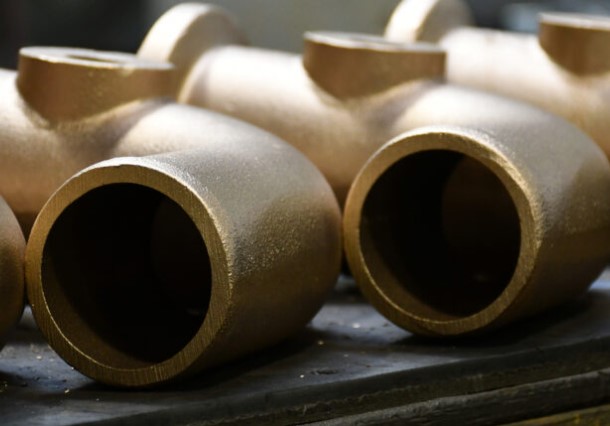
Bronze casting has a long history in architecture. Architects use bronze casting to produce door handles, window fittings, roof decorations, railings, and sculptures. Bronze’s corrosion resistance allows it to remain stable for many years in outdoor environments. In addition, the natural patina formed on its surface, known as verdigris, enhances its aesthetic appeal over time.
In practical applications, bronze casting is widely used to manufacture various mechanical parts such as nuts, bolts, gears, bearings, bushings, and wear plates. These components operate under high load and friction conditions. The wear resistance and self-lubricating properties of bronze make it particularly suitable for such applications.
Bronze casting is also widely applied in hardware fittings, including valves, pump housings, pipe connectors, and faucets. These products require strong sealing performance and corrosion resistance, both of which bronze materials can provide effectively.
Bronze casting is not limited to industrial production; it is also used for fine artistic creations. Artists and craftsmen use bronze casting to produce sculptures, medals, badges, and decorative items. The flexibility of this process allows it to meet demands ranging from heavy industrial manufacturing to delicate artistic expression.
From an advantages perspective, bronze and its alloys are widely used in casting mainly due to their excellent material properties. Compared with other metals, bronze offers high strength and durability while maintaining good ductility, making it easier to form into complex shapes. In addition, bronze has strong corrosion resistance, making it highly suitable for industrial environments and long-term use.
When equipment operates under high load and high pressure conditions, ordinary metal materials often cannot withstand extreme operating environments and may deform or fail. Therefore, selecting materials that can maintain stable performance in harsh environments is critical for ensuring continuous industrial operation. Engineers and manufacturers often choose copper-based alloys to meet such mechanical challenges. The following are six key ways in which bronze casting improves industrial component performance.
Bronze effectively reduces friction between metals. When two steel components slide against each other, high heat and rapid wear may occur. Bronze, due to its different material characteristics compared with steel, performs exceptionally well in applications such as bearings, bushings, and wear plates. This material difference helps prevent galling, which is surface damage caused by adhesion between contact surfaces.
In practical use, bronze often serves as a sacrificial material, absorbing wear first to protect more expensive steel shafts. Replacing bronze bushings is significantly cheaper and faster than replacing main drive shafts, providing clear economic benefits.
Bronze has outstanding corrosion resistance, especially in marine environments or chemically aggressive industrial conditions. Iron-based metals tend to rust and degrade in humid and oxygen-rich environments, while bronze alloys resist such corrosion.
A natural oxide layer forms on bronze surfaces, commonly known as patina. This protective layer prevents further corrosion and protects the internal metal structure. As a result, critical equipment such as propellers, pump bodies, and valves made from bronze can operate reliably in harsh environments for extended periods.
Bronze can withstand high loads without permanent deformation. Although it is generally softer than steel, certain alloys such as aluminum bronze exhibit high tensile strength and structural stability. These materials absorb impact and distribute loads evenly under high stress conditions, maintaining structural integrity. As a result, aluminum bronze is widely used in heavy machinery and high-load systems such as aircraft landing gear.
Bronze has excellent spark-free characteristics, which are especially important in high-risk industrial environments. In oil refineries, natural gas facilities, or grain storage areas, even a small spark may lead to serious accidents. Steel tools or components may generate sparks upon impact, while bronze does not. Therefore, bronze is widely used in explosion-proof tools and safety-critical components.
Bronze has excellent machinability. During machining, it can be precisely cut while maintaining tight dimensional tolerances. Bronze typically produces short, easily removable chips rather than long, tangled ones, reducing machine clogging risks and improving production efficiency. This makes it ideal for manufacturing high-precision components.
Bronze also has good thermal conductivity and heat dissipation capabilities. In electronic or mechanical systems, excessive heat can damage components. Bronze parts can act as heat transfer media, quickly conducting heat away from high-temperature zones and helping maintain stable operating conditions, thereby improving system reliability and service life.
If you are still unsure which alloy is suitable for metal casting, aluminum bronze is a highly recommended option. This alloy demonstrates strong adaptability in casting processes and has long-standing applications in critical industries such as aerospace and oil and gas.
When safety and strength are top priorities, aluminum bronze is often the more reliable choice. It is formed by adding aluminum into a copper matrix. The aluminum content directly affects the grade and performance of the alloy, resulting in variations in physical properties. Overall, aluminum bronze retains the core advantages of bronze while significantly enhancing performance.
Aluminum bronze has very high strength. In industries with strict safety requirements such as offshore oil and gas platforms, it is widely used in pumps, valves, and pipelines to ensure stable operation under high pressure and load conditions.
Aluminum bronze offers outstanding corrosion resistance. For a long time, ship propellers and marine equipment have used aluminum bronze to resist seawater corrosion and long-term immersion damage. It performs well not only in atmospheric conditions but also in high-temperature, low-temperature, and highly corrosive chemical environments. It also has bio-inert properties that inhibit microbial growth on its surface.
Aluminum bronze is a non-sparking material. Under any operating conditions, it does not produce sparks from impact or friction, making it essential in industries such as oil and gas, mining, aerospace, and transportation where explosion risks exist.
Aluminum bronze is non-magnetic, giving it a unique advantage in high magnetic field environments. For example, in hospitals near MRI equipment, it is ideal because it is not affected by magnetic interference and can be safely used in precision medical and industrial systems.
In addition to the above properties, aluminum bronze also provides good thermal and electrical conductivity while maintaining strong wear resistance. It performs reliably in metal-to-metal contact environments, ensuring long-term operational stability.
Another major advantage of aluminum bronze is its weldability. Even after casting, it can be repaired through welding. This makes it highly valuable in industrial maintenance. In many cases, components do not need to be disassembled for repair, significantly reducing maintenance costs and improving operational efficiency.
Bronze casting plays a crucial role in modern industrial and manufacturing fields due to its mature process system and excellent material properties. It allows precise formation of complex structures while achieving a strong balance between strength, durability, and machinability.
Bronze casting performs exceptionally well in wear resistance, corrosion resistance, safety, and processing performance. By selecting appropriate alloy types and casting techniques, enterprises can significantly improve the reliability and operational efficiency of key components.
As an important branch of bronze alloys, aluminum bronze has become an indispensable material in modern industrial casting due to its high strength, corrosion resistance, safety, non-magnetic nature, good thermal and electrical conductivity, and weldability. In applications involving corrosive media or underwater environments, aluminum bronze offers particularly strong advantages that many other bronze materials cannot fully replace.
