
Understanding Carbon Steel Forging from the Guide
Carbon steel forging is a time-tested metalworking process in which carbon steel is shaped into desired forms through a combination of heat and applied pressure. Essentially, the steel is heated to a specific temperature to achieve plasticity, then repeatedly hammered or pressed to form parts with the intended geometry. Unlike machining, which removes material, forging relies on plastic deformation in the solid state, producing components with superior structural integrity.
Carbon steel is an iron-carbon alloy with a carbon content typically ranging from 0.05% to 2.0%, though most industrially used carbon steels contain no more than 1.2% carbon. Apart from carbon and iron, other elements are present only in trace amounts, primarily residual impurities from production. Its low cost, wide availability, and versatility make carbon steel forging one of the most commonly used metals in industrial manufacturing.
Classification and Properties of Carbon Steel
Carbon steel can be divided into four major categories based on carbon content, each offering unique mechanical properties and applications.
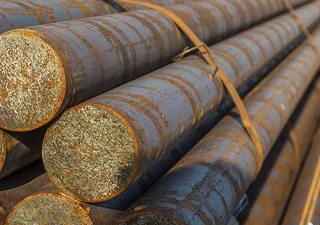
1. Low Carbon Steel
Low carbon steel contains approximately 0.05%–0.25% carbon and up to 0.4% manganese. Commonly referred to as “mild steel,” it has relatively low strength but excellent formability and is cost-effective. Surface hardness can be improved through carburization, while the core maintains toughness and ductility. Common grades include AISI 1018 and 1020, widely used for components where ease of machining and forming is prioritized over high strength. Applications include automotive panels, structural sections, and simple mechanical components.
2. Medium Carbon Steel
Medium carbon steel contains 0.29%–0.54% carbon and 0.60%–1.65% manganese. This type strikes a balance between strength and ductility while offering superior wear resistance. AISI 1045 is a representative medium carbon steel, frequently used in large parts, industrial machinery components, and automotive applications where load-bearing capacity and durability are critical.
3. High Carbon Steel
High carbon steel contains 0.55%–0.95% carbon and 0.30%–0.90% manganese. Its high carbon content confers excellent strength and shape retention, making it ideal for springs, high-strength wires, and cutting tools. Although the hardness of high carbon steel is advantageous, machining and forming it require greater skill and attention.
4. Ultra-High Carbon Steel
Ultra-high carbon steel contains 0.96%–2.1% carbon. These steels are extremely hard but inherently brittle, requiring careful handling during forging and machining. They are primarily used in the production of specialty tools, dies, and applications demanding extreme surface hardness.
Core Forging Process for Carbon Steel
The forging process transforms carbon steel into mechanically superior components through controlled heating and deformation. Hot forging is the most common method for carbon steel and involves several key steps:
1. Material Preparation and Heating
Steel ingots or billets are first cut to suitable sizes, then heated in a furnace to a temperature range of 1050°C–1250°C. This temperature ensures the steel achieves good plasticity while avoiding excessive grain growth, which could negatively impact the final mechanical properties. Proper temperature control is crucial to ensure uniformity and prevent defects in the forging process.
2. Hot Forging
Heated billets are transferred to forging equipment such as hammers or presses, where compressive forces shape the steel into the desired form. Depending on the complexity of the component, two primary forging methods are used:
Open-Die Forging: Suitable for simple shapes, open-die forging allows flexibility in forming while maintaining high material integrity.
Impression-Die (Closed-Die) Forging: Ideal for complex, precise components, this method uses dies to produce intricate shapes with minimal post-forging machining.
3. Trimming and Surface Treatment
Forged parts typically exhibit flash (excess material) and oxide scale on the surface. These are removed through trimming and cleaning processes, which prepare the parts for machining and further processing. Proper surface treatment enhances dimensional accuracy and ensures higher quality in the finished product.
4. Heat Treatment
Forged components may undergo heat treatments such as annealing, normalizing, quenching, and tempering. These processes refine the steel’s microstructure, enhancing mechanical properties, improving hardness, and optimizing machinability. Heat treatment ensures the forged part meets specific performance requirements, whether it is strength, toughness, or wear resistance.
5. Finishing and Inspection
Precision machining via CNC equipment brings the part to final dimensions, while strict quality inspections ensure compliance with design standards. Inspection methods include:
Dimensional checks
Hardness testing
Non-destructive testing (ultrasonic, magnetic particle)
These measures guarantee reliability and longevity, particularly for critical load-bearing applications.
Key Advantages of Carbon Steel Forging
Carbon steel forging is favored in industrial manufacturing for its multiple, irreplaceable advantages:
1. High Structural Integrity
During forging, repeated plastic deformation compresses internal pores and eliminates shrinkage defects, while refining the grain structure. This results in forgings with higher structural integrity than castings, enabling them to withstand higher pressures and temperatures, even under harsh operating conditions.
2. Superior Mechanical Performance
Forging aligns metal grains along the component’s contours, creating continuous, fiber-like structures. This directional grain flow enhances fatigue resistance and impact toughness, providing superior performance compared to cast or machined components. Properly designed forgings maximize the material’s natural strength along the flow lines, delivering exceptional durability in high-stress applications.
3. Cost-Effectiveness
Carbon steel is widely available and significantly cheaper than materials like stainless steel. While forging equipment requires investment, high-volume production achieves competitive unit costs. Combined with the long service life of forged components, carbon steel forging often results in lower total lifecycle costs.
4. Excellent Machinability
Many low- and medium-carbon steels offer excellent machinability after forging. Certain grades can also be welded, although high-carbon steels may require preheating or post-weld heat treatment. Forgings provide flexibility for subsequent machining, assembly, and fabrication.
Forging vs. Casting
Forging and casting are two primary methods of producing metal components, each suited for different applications:
1. Performance Comparison
Forged parts typically exhibit 15–20% higher strength and toughness than castings. Forging eliminates internal porosity and produces a denser, more uniform grain structure, enhancing fatigue and impact resistance. Castings can achieve more complex geometries, but they are more prone to defects, limiting their load-bearing capacity.
2. Cost Considerations
Casting generally requires lower initial investment and unit costs, making it suitable for large-scale production of complex shapes. Forging involves higher tooling and equipment costs, but superior reliability, longer service life, and enhanced mechanical performance justify the investment for critical components.
3. Application Scenarios
Forging is preferred for shafts, gears, connecting rods, flanges, and other high-stress or fatigue-prone parts. Casting is suitable for complex housings, enclosures, and components with low mechanical load requirements.
Typical Applications of Carbon Steel Forgings
Carbon steel forgings are widely used across industries due to their exceptional mechanical properties, reliability, and cost-effectiveness.
1. Automotive Industry
Forgings are heavily used in vehicles, often exceeding 250 components per car. Critical parts such as crankshafts, connecting rods, camshafts, drive shafts, gears, differential gears, and universal joints rely on forging to ensure durability, smooth operation, and performance under dynamic loads.
2. Oil & Gas Industry
In the oil and gas sector, carbon steel forgings are used for drill bits, drill collars, valve bodies, flanges, and pipe fittings. These components must withstand high pressure, high temperature, and corrosive environments. Forged components provide the structural integrity and pressure resistance required for safe and efficient operation.
3. Construction and Heavy Machinery
Excavators, bulldozers, cranes, and other heavy equipment rely on carbon steel forgings for structural components, hydraulic cylinders, and frames. These parts endure tremendous stress and impact, and forging provides the strength and toughness necessary for reliability and long service life.
4. Agricultural Machinery
Plowshares, cultivators, tractor drive shafts, connecting rods, and gears benefit from forging, which delivers durability, wear resistance, and impact tolerance essential for working in harsh environments like soil, sand, and rocks.
5. Hand and Cutting Tools
Forged carbon steel is widely used in wrenches, hammers, pliers, knives, axes, and saw blades. High-carbon steel achieves superior hardness and wear resistance after forging and heat treatment, maintaining sharpness and performance over prolonged use.
Common Carbon Steel Forging Materials
- AISI 1018: Low-carbon steel with moderate strength, excellent ductility, and low cost.
- AISI 1045: Medium-carbon steel with high strength and wear resistance, ideal for load-bearing parts.
- AISI 4140: Alloy structural steel with high strength for heavy-duty applications.
- A36/A105: Standard structural forging steels with well-rounded properties.
- 8620 Alloy Steel: High surface hardness with tough core, suitable for wear-resistant parts.
Material selection depends on load requirements, operating conditions, and whether heat treatment is needed.
Quality Control Essentials
Quality control in carbon steel forging spans the entire production process:
- Material Certification: Confirm chemical composition and traceability.
- Process Monitoring: Control heating temperature, forging ratio, and deformation rate.
- Dimensional Inspection: Verify critical dimensions against design specifications.
- Non-Destructive Testing: Detect internal or surface defects using ultrasonic or magnetic particle inspection.
- Hardness Verification: Confirm post-heat-treatment hardness meets design requirements.
- Custom forgings often optimize material usage, geometry, machining allowances, and dimensional precision, reducing overall production costs while ensuring performance.
Conclusion
Carbon steel forging is a mature, reliable, and cost-effective metal forming process. By combining the advantages of carbon steel with the benefits of forging, manufacturers can produce components that are strong, tough, and durable. These qualities meet the rigorous demands of automotive, oil and gas, heavy machinery, and agricultural industries.
While forging may be less suitable for extremely complex shapes, it remains the preferred method for critical load-bearing parts. By carefully considering part complexity, mechanical requirements, production volume, and budget, carbon steel forging delivers structural integrity, reliability, and long service life, making it a trusted and indispensable choice in industrial manufacturing.
Send your message to this supplier
Related Articles from the Supplier
Understanding Carbon Steel Forging from the Guide
- Mar 26, 2026
Understanding and Mitigating Oxidation in Forgings
- Mar 03, 2025
Understanding Forging and Heat Treatment Cracks
- Feb 09, 2026
Related Articles from China Manufacturers






Related Products Mentioned in the Article

Supplier Website
Source: http://www.creatorcomponents.com/news/understanding-carbon-steel-forging-from-the-guide.html