
Understanding Forging and Heat Treatment Cracks
In the metal processing and heat treatment industries, cracks are a common quality defect. However, not all cracks are the same; there are significant differences between forging cracks and heat treatment cracks (including quenching cracks, tempering cracks, etc.) in terms of formation mechanisms, appearance, and root causes. Accurately distinguishing between these two types of cracks not only helps quickly identify the problematic process stage but also enables companies to improve manufacturing techniques, reduce scrap rates, and save production costs.
This article systematically explains the differences between forging cracks and heat treatment cracks from multiple perspectives, including formation temperature, microstructural characteristics, and causes. It also provides practical metallographic analysis methods to help technicians accurately determine crack types in real-world applications.
Characteristics and Formation Mechanisms of Forging Cracks
Forging cracks refer to crack defects that occur during the metal forging process. Forging involves heating metal to high temperatures and applying pressure to deform it. If the process is improperly executed or the material contains defects, cracking can easily occur.
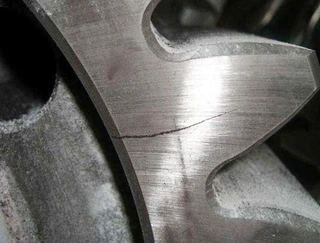
1. Formation Temperature of Forging Cracks
Forging cracks generally form at high temperatures. When metal undergoes plastic deformation within the forging temperature range (typically far above room temperature), cracks begin to develop if the stress exceeds the material’s capacity. Because these cracks form and propagate at elevated temperatures, they come into direct contact with air, resulting in oxidation inside the cracks.
2. Microstructural Characteristics of Forging Cracks
When observed under a microscope (at 100× or 500× magnification), forging cracks display several typical features:
Oxide scale filling: The interior of the crack is filled with oxide scale, serving as direct evidence of high-temperature oxidation.
Decarburization on both sides: The microstructure adjacent to the crack consists of ferrite, showing clear decarburization. This occurs because carbon reacts with oxygen at high temperatures, reducing the carbon content.
Thick morphology: These cracks are relatively wide and often appear in multiple forms without obvious tips or clear directionality.
Partial decarburization: Some forging cracks are thinner, and instead of full decarburization, the surrounding area shows a semi-decarburized state.
3. Causes of Forging Cracks
The primary causes of forging cracks include:
Raw material defects: Surface or internal defects such as hairline fractures, sand holes, cracks, inclusions, subsurface bubbles, shrinkage cavities, white spots, and laminations can act as crack initiation points during forging.
Improper process operations:
- Overheating: Excessively high heating temperatures lead to coarse grains.
- Overburning: Heating temperatures approaching or exceeding the solidus cause grain boundary oxidation or melting.
- Low final forging temperature: Reduced metal plasticity increases deformation resistance.
- Excessive cooling rate after forging: Generates excessive thermal and structural stresses.
Characteristics and Formation Mechanisms of Heat Treatment Cracks
Heat treatment cracks occur during processes such as quenching, tempering, and cold treatment, with quenching cracks being the most common. Compared with forging cracks, heat treatment cracks form at much lower temperatures.
1. Differences Between Heat Treatment and Forging Temperatures
For structural steels, heat treatment temperatures are generally far lower than forging temperatures. Even for high-speed steels and highly alloyed steels that require higher quenching temperatures, the heating and holding times are significantly shorter than those in forging. This temperature difference fundamentally determines the distinct formation mechanisms of the two crack types.
2. Cracks Generated During Quenching Heating
If process parameters are not properly controlled during the quenching heating stage, early cracking may occur:
Excessive heating temperature or prolonged holding time: Early cracks may form during heating, distributed along coarse grain boundaries, with slight decarburization on both sides.
Excessive heating rate: Rapid heating can also cause early cracking. These cracks typically show no obvious decarburization on either side, but oxide scale is present inside the crack and at its tail.
Instrument malfunction causing overheating: Faulty high-temperature instruments may result in abnormal temperature rises, producing extremely coarse microstructures with cracks distributed along grain boundaries.
3. Essential Characteristics of Quenching Cracks
Quenching cracks are macroscopic cracks primarily caused by macroscopic stresses. In actual production, steel workpieces often develop quenching cracks due to the following factors:
Design factors: Unreasonable structural design leading to stress concentration.
Material factors: Improper steel selection or actual carbon content exceeding the specified grade.
Process factors: Incorrect quenching temperature control or inappropriate cooling rates.
These factors increase internal quenching stress, allowing existing microcracks to expand into macrocracks or increasing the number of microcracks, thereby reducing resistance to brittle fracture and raising the likelihood of quenching cracks.
4. Common Factors Affecting Quenching Cracks
Raw material defects: Undetected surface or internal cracks and inclusions may develop into quenching cracks. Severe internal inclusions or hidden cracks will expand further during quenching.
Poor original microstructure: Non-uniform structures or severe segregation increase cracking risk.
Improper quenching temperature:
Instrument readings lower than actual temperatures may cause overheating quenching, resulting in coarse grains and coarse martensite.
Actual carbon content higher than the specified grade effectively raises the quenching temperature under standard processes, promoting overheating and grain growth.
Improper cooling: Excessive or uneven cooling generates high internal stresses.
Machining defects: Rough, deep tool marks can lead to cracking or early failure during quenching, even outside stress concentration areas.
Part geometry: Unreasonable shapes or large cross-sectional differences cause stress concentration during quenching.
Delayed tempering: Failure to temper promptly after quenching leaves excessive residual stress that can cause cracking.
Key Differences Between Forging Cracks and Heat Treatment Cracks
After understanding the formation mechanisms, how can these cracks be quickly distinguished during inspection? This is a central issue in failure analysis. Misjudgment can lead to incorrect process improvements; for example, treating forging cracks as quenching cracks may result in unnecessary heat treatment adjustments, while the true defect source remains unresolved.
1. Formation Temperature and Oxidation Degree
Forging cracks form at high temperatures, contain oxide scale, and exhibit obvious decarburization layers on both sides. Quenching cracks form at lower temperatures (below the Ms point), so fracture surfaces are not oxidized and show no surrounding decarburization. This is the most fundamental difference.
2. Fracture Surface Color
Observing the fracture surface allows accurate differentiation:
Quenching cracks: White, off-white, or light reddish (water rust from water quenching).
Forging cracks: Dark brown, often with visible oxide scale.
3. Crack Morphology
Forging cracks: Thick, often multiple, without obvious tips or directionality.
Quenching cracks: Usually deep and large, often straight and knife-cut in appearance, unrelated to grinding direction.
4. Microstructural Features
When observing the fracture path under a microscope:
Quenching cracks: Intergranular fracture along grain boundaries.
Fatigue cracks: Transgranular fracture (not along grain boundaries).
Pre-forging cracks: Surrounded by a decarburized layer.
5. Presence of Decarburization
This is one of the most important identification criteria:
Decarburization around the crack → Not a quenching crack; it existed before quenching (formed during forging or rolling).
No decarburization → Possibly a quenching crack, as cracks formed during quenching cooling will never decarburize.
Process Measures to Prevent Cracks
The ultimate purpose of crack identification is prevention. Targeted control measures should be implemented according to the characteristics of forging and heat treatment processes.
1. Preventing Forging Cracks
Strictly inspect raw materials and eliminate defective billets.
Control heating temperatures to avoid overheating and overburning.
Ensure adequate final forging temperatures.
Manage post-forging cooling rates; use isothermal annealing when necessary.
2. Preventing Quenching Cracks
Design part structures rationally to avoid sharp corners and abrupt section changes.
Select appropriate steel and control actual carbon content.
Strictly control quenching temperatures and regularly calibrate instruments.
Choose suitable cooling media and methods.
Temper promptly to eliminate residual stress.
Improve machining quality and avoid deep tool marks.
3. Preventing Grinding Cracks
Control grinding parameters to prevent excessive temperatures.
Use sufficient cutting fluid to reduce surface temperature.
Select grinding wheels with appropriate hardness and grit size.
Apply specialized grinding processes for high-hardness components.
Conclusion
Accurately distinguishing between forging cracks and heat treatment cracks is an essential skill in metal processing quality control. By examining formation temperature characteristics, oxidation levels, decarburization, fracture surface color, and microstructural morphology, technicians can effectively determine the crack type and the process stage in which it originated. Mastering these analytical methods not only helps resolve current quality issues but also enables fundamental process improvements, defect prevention, and enhanced product quality and production efficiency. In practical work, it is recommended to establish a comprehensive quality traceability system, strictly control each stage, from raw materials to forging, heat treatment, and machining, and maintain complete process records. When crack defects occur, combining metallographic analysis with process investigation allows the root cause to be identified quickly and accurately, enabling effective corrective actions.
Send your message to this supplier
Related Articles from the Supplier
Understanding Forging and Heat Treatment Cracks
- Feb 09, 2026
Understanding and Mitigating Oxidation in Forgings
- Mar 03, 2025
Understanding Carbon Steel Forging from the Guide
- Mar 26, 2026
Related Articles from China Manufacturers








Related Products Mentioned in the Article

Supplier Website
Source: http://www.creatorcomponents.com/news/understanding-forging-and-heat-treatment-cracks.html