Closed-Die Forging: Process, Advantages, and Applications
In modern industrial manufacturing, metal components can be produced through various forming processes. Among them, forging is widely recognized as one of the most important manufacturing methods because it significantly improves the internal structure and mechanical properties of metals. As a mature and widely used forging technology, closed-die forging enables manufacturers to produce components with high dimensional accuracy, excellent mechanical performance, and reliable consistency. It is extensively applied in industries such as automotive manufacturing, aerospace, engineering machinery, energy equipment, and precision manufacturing.
This article provides a comprehensive overview of closed-die forging, including its definition, working principle, manufacturing process, key advantages, major applications, limitations, advanced technologies, and guidance for selecting the appropriate forging method.
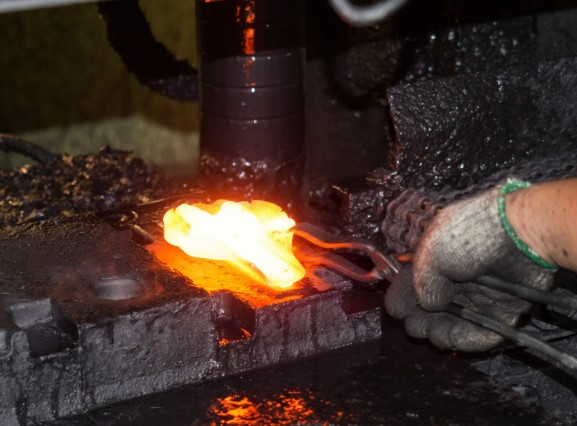
Closed-die forging, also known as impression-die forging, is a metal forming process in which a heated metal billet is placed between two dies containing specially designed cavities. The forging equipment, such as a hammer or press, applies high pressure to force the metal to undergo plastic deformation and flow into the die cavity, eventually forming the desired component shape.
During the process, both the upper and lower dies are machined with cavities that correspond to the final geometry of the product. When pressure is applied, the billet experiences extremely high compressive forces within a very short period. The metal flows under pressure and fills the detailed sections of the die cavity.
For large or complex forgings, multiple forging operations are usually required to ensure complete cavity filling and achieve the required internal structure and mechanical properties.
Unlike simple forming processes, closed-die forging provides precise control over metal flow, allowing manufacturers to produce near-net-shape components with improved strength, accuracy, and reliability.
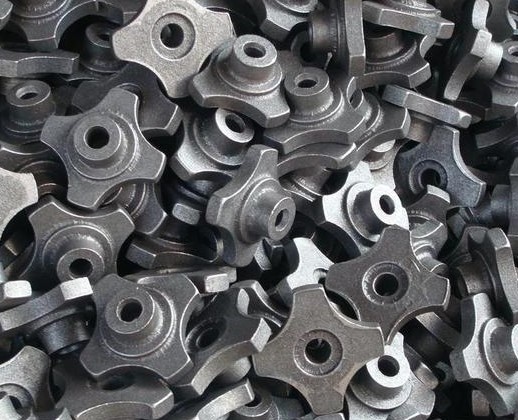
Closed-die forging and open-die forging are two common forging methods, but they differ significantly in die structure, material flow control, and application fields.
In open-die forging, the workpiece is compressed between flat or simple-shaped dies without being completely enclosed. The metal has more freedom to flow outward, and the final shape depends heavily on operator experience and process control. This method is suitable for large and relatively simple components such as shafts, cylinders, and rings. Due to lower tooling costs, it is often preferred for small-batch production.
In contrast, closed-die forging completely surrounds the heated billet within precision-designed dies. The controlled cavity forces the metal to flow according to the required geometry, resulting in higher dimensional accuracy and better consistency.
Closed-die forging is commonly used for complex and precision components such as gears, connecting rods, brackets, crankshafts, and automotive structural parts. Although die costs are higher, the process becomes highly economical for large-scale production because of improved efficiency and reduced machining requirements.
The closed-die forging process generally includes five major stages: die design and manufacturing, material preparation and heating, multi-stage forming, flash removal, and post-processing.
The forging die is one of the most important factors affecting product quality, dimensional accuracy, and production efficiency. Die design is developed according to product drawings, technical requirements, material characteristics, and manufacturing conditions.
Engineers must consider metal flow behavior, shrinkage allowance, draft angles, forging pressure, and machining allowance when designing the die cavity. High-quality dies ensure that forged components meet design requirements and maintain consistent quality during mass production.
Generally, the complete process from die design and machining to trial forging and production approval takes around two to three weeks, depending on product complexity and manufacturing difficulty.
Closed-die forging can process various metals, including carbon steel, alloy steel, stainless steel, aluminum alloys, copper alloys, and titanium alloys.
Stainless steel offers excellent corrosion resistance and mechanical strength, making it suitable for food processing equipment, chemical systems, marine applications, and medical devices.
Carbon steel provides good strength, machinability, and cost efficiency, making it one of the most commonly used forging materials for industrial components.
Alloy steel provides higher strength, improved wear resistance, and better high-temperature performance, making it suitable for heavy-duty components operating under demanding conditions.
Before forging, the billet must be heated to the appropriate forging temperature. Proper heating improves material plasticity, reduces deformation resistance, and enhances metal flow, preventing defects such as cracks during forming.
Industrial closed-die forging usually involves several forming stages rather than completing the final shape in one operation.
The first stage is preforming, where the billet is shaped to distribute material properly and prepare it for subsequent operations. This may involve upsetting, drawing, bending, or blocking processes.
The second stage is pre-forging, where the workpiece gradually approaches the final geometry. Proper material distribution and smooth transitions help reduce defects such as folds and incomplete filling.
The final stage is finish forging, where the component reaches its final dimensions and shape under controlled pressure.
For small production quantities, manufacturers may sometimes reduce tooling costs by eliminating the finishing die and completing final dimensions through machining after pre-forging.
During conventional closed-die forging, excess metal is squeezed out through the gap between the upper and lower dies, creating a thin layer known as flash.
Although flash is removed after forging, it plays an important role during forming. The resistance created by flash increases internal die pressure, forcing the metal to fill complicated areas of the cavity and improving the completeness of the forged shape.
After forging, flash is removed through trimming operations to achieve the required final dimensions and appearance.
After forging, components typically undergo additional operations such as trimming, heat treatment, machining, surface treatment, and quality inspection.
Depending on application requirements, inspection methods may include dimensional inspection, hardness testing, ultrasonic testing, and other nondestructive testing procedures to ensure structural integrity and compliance with technical standards.
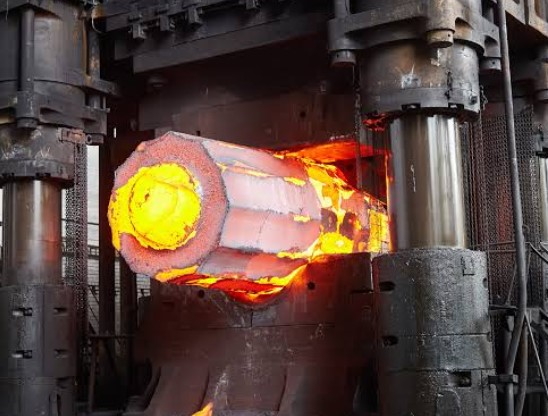
The widespread application of closed-die forging across various industrial fields is mainly attributed to its numerous significant advantages. These advantages include excellent mechanical properties, high dimensional accuracy, superior surface quality, wide material compatibility, suitability for mass production, and a high level of automation.
One of the greatest benefits of closed-die forging is improved internal structure. Under high temperature and pressure, metal grains flow continuously along the shape of the component, forming a dense grain structure with continuous flow lines.
This improves strength, toughness, fatigue resistance, and overall mechanical performance. Compared with cast components, forged parts generally provide higher reliability and longer service life, especially under heavy loads, impact conditions, and repeated stress.
Because the metal is completely controlled inside precision dies, closed-die forging achieves much higher dimensional accuracy than open-die forging.
The process reduces machining allowance, improves material utilization, shortens manufacturing cycles, and enables near-net-shape production. The consistency and interchangeability of forged components are also significantly improved.
Precision-machined die surfaces allow closed-die forgings to achieve better surface finishes than traditional forging methods.
Improved surface quality reduces the need for additional grinding and polishing processes, lowering production costs and increasing efficiency.
Closed-die forging is suitable for a wide range of metals, including steel alloys, stainless steel, aluminum alloys, copper alloys, and titanium alloys. This flexibility allows manufacturers to select materials according to strength, corrosion resistance, temperature capability, and cost requirements.
Closed-die forging is particularly suitable for high-volume manufacturing. Although the initial die investment is relatively high, the cost can be distributed across thousands of components, reducing the unit cost.
The controlled material flow also reduces waste, improves production efficiency, and simplifies manufacturing operations.
Modern closed-die forging lines often use automated heating systems, robotic handling equipment, automatic feeding systems, and intelligent process control technologies.
Some advanced production lines also integrate online heat treatment, allowing forged parts to be quenched or normalized immediately after forming. This reduces production time and energy consumption.
Closed-die forging is widely used in industries requiring high-strength and reliable components.
- In the automotive industry, it is used for connecting rods, crankshafts, gears, steering knuckles, wheel hubs, and transmission components.
- In the aerospace industry, closed-die forging produces turbine blades, compressor disks, rotors, shafts, landing gear components, and structural brackets. These parts require exceptional reliability under extreme conditions.
- In construction machinery and rail transportation, forged hydraulic components, bearing housings, brake discs, wheel hubs, and axle components provide excellent durability and load resistance.
- In the energy sector, forged valves, flanges, pipe fittings, and pressure-bearing components are widely used in oil and gas, power generation, and high-pressure equipment.
- In medical devices and precision machinery, stainless steel forgings are used for surgical instruments, implants, and high-precision mechanical components.
Despite its advantages, closed-die forging also has several limitations.
- First, component size is restricted by forging equipment capacity and die dimensions. Extremely large components usually require open-die forging or other specialized processes.
- Second, complex geometries with deep cavities, complicated internal structures, or highly irregular shapes may be difficult to manufacture because metal flow inside the die is limited.
- Third, die manufacturing costs are relatively high. For small-batch production or frequently changing product designs, the initial tooling investment may not be economically justified.
To improve material efficiency and product performance, several advanced technologies have been developed.
Flashless forging uses completely enclosed dies to eliminate flash generation and maximize material utilization. However, it requires higher precision in die design, billet control, and equipment operation.
Cast-forging combined technology integrates casting and forging. A cast preform is immediately forged while still hot, combining the shape flexibility of casting with the mechanical advantages of forging.
Spray deposition preform technology uses metal droplet deposition to create preforms with optimized structures before final closed-die forging.
When selecting a forging method, manufacturers should consider component geometry, production volume, accuracy requirements, material properties, and total manufacturing costs.
Closed-die forging is ideal for components with moderate complexity, high strength requirements, strict dimensional tolerances, and large production quantities.
For low-volume production, extremely large components, or parts with highly complex structures, alternatives such as open-die forging, machining, or casting may provide more economical solutions.
Closed-die forging is a mature and highly efficient metal forming technology that plays an essential role in modern manufacturing. Its advantages, including superior mechanical properties, high dimensional accuracy, excellent surface quality, broad material compatibility, and suitability for mass production, make it a preferred choice for critical components in automotive, aerospace, energy, machinery, and precision industries.
Although challenges such as high tooling costs and design limitations exist, advances in automation, simulation technology, and intelligent manufacturing continue to improve the efficiency and economic value of closed-die forging.
For manufacturers requiring strong, reliable, and durable components, understanding the principles, advantages, and limitations of closed-die forging is essential for selecting the right manufacturing solution, improving product quality, reducing costs, and enhancing market competitiveness.
