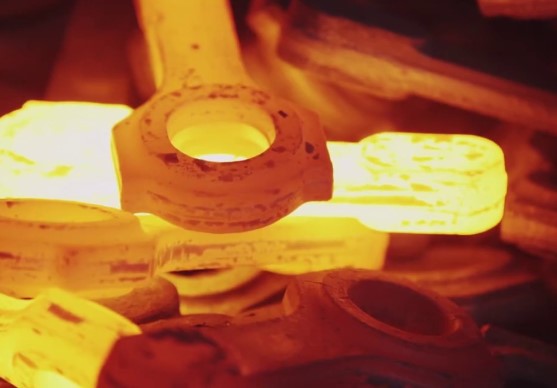
The forged connecting rod is one of the most critical transmission components in an automotive engine. Its primary function is to convert the reciprocating linear motion of the piston inside the cylinder into the rotational motion of the crankshaft, which ultimately drives the wheels. In simple terms, without the connecting rod, the engine would be unable to transfer the energy generated from combustion, and the vehicle would not be able to operate.
The operating environment of a connecting rod is extremely demanding. When an engine reaches speeds of 3,000 to 5,000 revolutions per minute, the connecting rod is subjected to extremely high-frequency alternating stresses. Every power stroke of the cylinder generates significant impact loads, while the connecting rod must also withstand torsional forces transmitted from the crankshaft. This high-speed fatigue loading condition imposes extremely strict requirements on the strength, toughness, and durability of the component.
In addition, since the crankshaft operates in a high-speed balanced rotation state, the weight of the forged connecting rod must be strictly controlled within a narrow range. If it is too heavy, it will negatively affect engine balance and responsiveness; if it is too light, it may fail to withstand operational loads. Therefore, connecting rod manufacturing places very strict requirements on material selection, forming processes, and equipment precision.
After understanding the importance of connecting rods, it is necessary to examine how they are classified in production. Different materials and structural designs lead to different manufacturing processes and application scenarios.

Connecting rods are mainly divided into two categories: quenched-and-tempered steel connecting rods and non-quenched-and-tempered steel connecting rods.
Quenched-and-tempered steel connecting rods undergo quenching and high-temperature tempering after forging. This heat treatment process optimizes the internal microstructure of the steel, providing the required strength, toughness, and fatigue resistance. This is currently the most widely used traditional manufacturing route.
Non-quenched-and-tempered steel connecting rods follow a different technical approach. By precisely controlling the cooling rate after forging, the material can achieve the required mechanical properties without additional heat treatment. This process eliminates heat treatment steps, reduces energy consumption, and lowers production costs, making it an increasingly important green manufacturing technology.
Structurally, connecting rods can be divided into split-type and integral-type connecting rods.
Split-type connecting rods have the rod body and rod cap formed separately during forging. This structure simplifies the mold design but requires higher assembly accuracy in later stages.
Integral connecting rods are forged as a single piece, with the rod body and cap formed together and later separated through machining. Depending on the separation method, they can be further divided into fracture-type and expansion-type designs. Integral forging provides better grain flow alignment and improved strength distribution, making it the mainstream choice for high-performance connecting rods today.
A qualified forged connecting rod undergoes more than ten precise manufacturing steps. The typical process includes: cutting, peeling, medium-frequency heating, billet forming and material distribution, die forging, punching, trimming and thermal correction, heat treatment or controlled cooling, shot blasting, magnetic particle inspection, visual inspection, cold precision pressing, dimensional inspection and straightening, anti-rust packaging, and final storage.
Cutting is the first step in connecting rod production. In mass production, bar shearing machines are typically used. Compared to sawing, shearing offers higher efficiency and lower cost. Since no upsetting deformation occurs at this stage, quality requirements are relatively moderate. However, the cut surface must not exhibit significant deformation, as it can negatively affect subsequent heating and forming processes.
Connecting rods are precision die forgings that require high-quality heating. Medium-frequency induction heating furnaces are widely used due to their advantages:
- Low energy consumption (typically below 0.5%)
- Fast heating speed with minimal oxidation scale
- High temperature control accuracy
- Uniform heating performance
Temperature control is critical. If the temperature is too low, metal flowability decreases, preventing complete die filling and increasing mold wear or cracking risk. If the temperature is too high, excessive flow and oxidation occur, degrading surface quality. Therefore, heating must be maintained within a strict process window.
After heating, the bar material undergoes billet forming to prepare for die forging. Roller forging machines are commonly used, while cross-wedge rolling is less frequently applied.
The quality of billet forming directly affects the final product. Key factors include mold surface condition, transition radius design, billet surface quality, and mold wear. Improper control may lead to folding defects or incomplete filling. Therefore, deformation ratios, groove design, and forward slip values must be carefully designed, and billet cross-sections must be precisely matched with groove dimensions.
Die forging is the core shaping stage and is typically divided into pre-forging and finish forging.
Pre-forging distributes the metal flow and prepares the billet for final forming. It also helps remove oxidation scale during transfer to the finishing die. Proper roller design assists in positioning and cleaning the billet surface.
Common equipment includes hot die forging presses, automatic control hammers, electric screw presses, and hydraulic forging hammers. Selection depends on product requirements, production volume, and investment scale.
Trimming and punching are usually performed while the forging is still hot. This reduces deformation resistance and internal stress, improving efficiency. Composite dies are often used to complete both operations simultaneously.
Common issues include uneven burr formation and improper die clearance, typically controlled within 0.5–0.8 mm. Wave-shaped trimming dies, high-precision presses, and reliable guiding systems are used to prevent deformation.
For quenched-and-tempered steel rods, quenching and high-temperature tempering are required to achieve desired mechanical properties. For non-quenched steels, controlled cooling after forging replaces heat treatment, reducing energy consumption and process steps.
After heat treatment or cooling, additional processes include shot blasting, magnetic particle inspection, visual inspection, cold precision pressing, straightening, and dimensional correction. Shot blasting removes oxide scale, magnetic inspection detects surface and near-surface defects, and straightening ensures geometric accuracy. Finally, anti-corrosion packaging is applied before storage or shipment.
- Strength and Durability: Forging refines and aligns metal grain flow along stress directions, significantly improving mechanical performance. Compared with cast rods, forged rods avoid internal defects such as porosity and inclusions. They also outperform machined rods in fatigue resistance, making them more reliable under high-stress conditions.
- Performance Enhancement Potential: Higher strength allows engines to operate at higher compression ratios and more aggressive ignition strategies. This is particularly important in high-performance engines, where conventional cast or stock rods would face significantly increased failure risk.
- Thermal Stability: The dense forged structure reduces internal voids and defects, improving resistance to deformation under high temperatures. This makes forged rods especially suitable for long-term high-load operation.
- Customizability: Forged connecting rods can be optimized in terms of geometry, weight distribution, and dimensions according to specific engine requirements. This makes them highly valuable in performance tuning and custom engine applications.
- Racing Engines: Racing engines are the most typical application of forged connecting rods. They operate under extreme speed and load conditions. Forged rods improve power-to-weight ratio, enhance acceleration, and increase durability under extreme stress.
- High-Performance Street Engines: Although less extreme than racing environments, high-performance street engines still require strong and reliable components. Forged rods improve responsiveness and ensure stable performance under daily driving conditions.
- Custom Engines: Custom engines require tailored solutions. Forged connecting rods offer flexibility in design optimization, making them ideal for modified vehicles and specialized applications.
Due to the complexity of plastic deformation, several defects may occur during production. In billet forming, defects such as folding and incomplete filling can arise due to improper deformation design. In die forging, incorrect temperature control may lead to poor metal flow, while poor die design can cause incomplete filling. During trimming, improper clearance may generate burrs and deformation.
Therefore, continuous optimization of materials, processes, and equipment is essential to improve quality, reduce costs, and increase efficiency.
Common closed-die forging equipment includes hydraulic hammers, automatic hammers, and electric screw presses.
Hydraulic hammers offer high impact energy and are suitable for large forgings but have limited automation. Automatic hammers allow precise energy control and are suitable for automated production lines. Electric screw presses provide high precision and low noise, making them suitable for controlled, automated manufacturing.
Equipment selection depends on product specifications, production volume, automation level, budget, and facility constraints.
Automotive engine connecting rods are complex closed-die forged components whose manufacturing precision directly affects engine performance and reliability. From raw material selection to final inspection, every step requires strict process control.
As engine performance continues to improve, the demand for higher-quality connecting rods is increasing. Scientific material selection, optimized forging processes, and advanced equipment configuration are essential for achieving high-performance products.
Compared with cast or machined rods, forged connecting rods offer superior strength, durability, thermal stability, and design flexibility. This is why they have become the standard choice in racing engines and high-performance automotive applications.
