
A Complete Guide to Underground Storage Tanks
Underground Storage Tanks (USTs) are common energy storage systems in industrial facilities and critical infrastructure. They are widely used in hospitals, energy systems, emergency power supply networks, as well as petroleum, chemical, and related industries. These tanks are primarily used to store regulated energy substances such as diesel, gasoline, kerosene, aviation fuel, and heating oil. Throughout long-term operation, they serve as essential backup energy reserves that support continuous facility operation.
This article provides a systematic overview of underground storage tanks from six key perspectives: their basic concept, leakage risks, safety design, daily management, decommissioning procedures, and overall advantages, helping readers gain a comprehensive understanding of this important infrastructure system.
What Are Underground Storage Tanks?
According to the definition provided by the United States Environmental Protection Agency, an underground storage tank refers to any tank system, including connected piping, in which at least 10% of its total volume is located below ground level. These systems are typically used to store fuels or hazardous chemicals, with capacities ranging from 1,000 gallons to 30,000 gallons. Because the tank body is buried underground, its design, installation, and operation must comply with strict environmental protection standards and safety regulations.
In critical facilities such as hospitals, data centers, and emergency command centers, power interruptions can lead to severe operational failures. Taking hospitals as an example, during extreme weather events or natural disasters, medical institutions must maintain at least 96 hours of continuous power supply to support electricity, lighting, hot and cold water systems, air handling systems, and patient care equipment. To achieve this, hospitals often rely on underground storage tank systems to supply fuel to boilers and backup generators, ensuring uninterrupted infrastructure operation during external energy disruptions.
Beyond healthcare facilities, USTs are also widely used in gas stations, airport fueling systems, automotive maintenance facilities, dry-cleaning industries, and residential or commercial heating systems. In these applications, underground storage tanks not only provide fuel storage but also play a crucial role in operational safety and continuity.
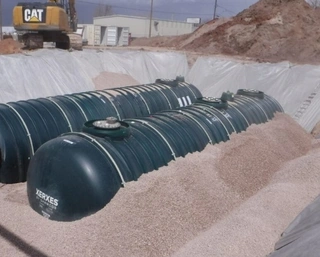
Leakage Risks and Consequences of Underground Storage Tanks
During operation, underground storage tanks may leak due to various factors such as material aging, corrosion, installation defects, or mechanical failure. Leakage often occurs not only in the tank body but also in connection points or piping systems. Once a leak occurs, its impact is wide-ranging and severe, affecting supply continuity, environmental safety, economic cost, and regulatory liability.
1. Impact of Supply Disruption on Critical Facilities
When a storage tank leaks, the first consequence may be a disruption in fuel supply. In hospitals and other critical facilities, any interruption in fuel supply systems can directly affect boilers and generator operations, thereby threatening the overall functioning of the facility. In severe cases, this may lead to partial or complete shutdown of essential services and compromise patient safety. Therefore, tank leakage is not merely a mechanical failure but a systemic risk tied to public safety.
2. Soil and Groundwater Contamination
Environmental damage is another serious consequence of UST leakage. Since these tanks can store large volumes of fuel, even minor leaks may contaminate surrounding soil and groundwater. Because the tanks are located underground, leaked substances can easily infiltrate soil layers and spread into groundwater systems, causing widespread ecological damage. Such contamination often requires long-term remediation, and the difficulty of recovery increases significantly with the duration and volume of the leak.
3. Economic Costs and Regulatory Liability
The cost of cleanup and remediation after a leak is typically very high. In severe cases, remediation expenses can exceed one million dollars, and the recovery process may take years to complete. In addition, government regulatory agencies may intervene in investigations and impose fines or other legal penalties for violations. If leaks are not detected promptly, both financial losses and environmental risks can escalate further. Therefore, UST leakage not only creates direct economic burdens but may also lead to long-term legal responsibility.
Safety Design & Material for Underground Storage Tanks
To address leakage risks, modern UST systems have developed multiple protective design strategies. Through structural improvements, real-time monitoring technologies, and the use of more corrosion-resistant composite materials, current systems can provide early warnings before leaks occur and containment after leaks happen, significantly reducing environmental and safety risks.
1. Double-Wall Structural Protection
To reduce leakage risk, modern underground storage tanks commonly adopt a double-wall design, typically consisting of double steel tanks or steel combined with fiberglass-reinforced composite structures. This configuration includes an inner and outer protective layer. If the inner tank is damaged due to corrosion or mechanical impact, the outer layer prevents fuel from directly entering the soil, forming a secondary containment barrier. This significantly improves safety and reliability. In particular, fiberglass outer layers provide excellent corrosion resistance and can offer additional protection even under construction stress or external impact.
2. Interstitial Monitoring and Sensor Systems
Between the two layers of a double-wall tank, an interstitial space of approximately 1 to 2 inches is typically installed and equipped with sensor systems. This space is used for real-time detection of liquid or gas changes. If the inner tank leaks, fuel or vapor enters the interstitial area and triggers an alarm through the sensors. This real-time monitoring mechanism provides early warning at the initial stage of leakage, allowing timely maintenance and risk control. Although double-wall tanks have higher initial costs, their service life often exceeds 30 years, offering advantages in total lifecycle cost.
Comparison Between Underground and Above-Ground Storage Tanks
In terms of storage system selection, underground and above-ground tanks each have distinct characteristics.
Underground storage tanks offer the advantage of saving surface space and reducing exposure to unauthorized access or vandalism. The ground surface can be used for building expansion, equipment installation, or other production and commercial purposes, which is particularly important in land-scarce regions. In addition, underground installation reduces visual impact on the environment and maintains a cleaner facility appearance.
However, underground tanks are more difficult to maintain and inspect. Leak detection is more complex, and once a leak occurs, groundwater contamination risk is significantly higher, leading to stricter regulatory oversight.
In contrast, above-ground storage tanks are easier to inspect and maintain. Leakage problems are more readily detected and addressed promptly. Since they are not in direct contact with soil, corrosion risk is lower, and their overall service life can reach 40 to 50 years. However, they occupy more surface space and may face limitations in facility planning.
In practical applications, selection must be based on space availability, safety requirements, and regulatory compliance conditions.
Regulatory Registration and Lifecycle Supervision
From installation through operation and decommissioning, underground storage tanks must undergo regulatory registration and remain under continuous supervision. Authorities require strict compliance with environmental protection and safety standards. Operators are responsible for routine inspection, leak monitoring, and maintenance documentation throughout the system lifecycle.
Comprehensive Advantages of Underground Storage Tanks
Although underground storage tanks carry inherent leakage risks and involve complex regulatory procedures during decommissioning, modern engineering solutions such as double-wall structures, real-time monitoring systems, and standardized lifecycle management have significantly mitigated these risks.
At the same time, USTs offer substantial advantages in space utilization, operational safety, temperature stability, material durability, and regulatory compliance. These benefits make them highly valuable in key sectors such as petroleum, chemical processing, healthcare, and energy infrastructure, and they remain a preferred choice in many storage system designs.
1. Space Utilization Efficiency
One of the most significant advantages of underground storage tanks is efficient land use. Since the tank is fully buried, surface space becomes available for buildings, equipment layout, or other commercial uses. This is particularly important in densely populated or land-constrained regions. Additionally, underground installation reduces visual environmental impact, contributing to a cleaner and more organized facility appearance.
2. Operational Safety and Temperature Stability
In terms of safety, underground tanks have a natural advantage. Their buried location reduces the risk of fire and explosion, especially when storing flammable liquids such as petroleum products. This structure also reduces exposure to external ignition sources and human interference. Furthermore, underground placement provides resistance to external impacts such as vehicle accidents, extreme weather, or natural disasters, thereby reducing the likelihood of damage or leakage.
Temperature stability is another key feature. Because the tank is insulated by surrounding soil, it is less affected by external temperature fluctuations and maintains a relatively stable internal environment. This is especially important for temperature-sensitive substances, helping preserve material stability and reducing energy consumption associated with temperature control systems.
3. Durability and Protective Performance
From a durability perspective, underground storage tanks are typically constructed using corrosion-resistant and anti-aging materials, giving them a long service life. Compared to above-ground tanks exposed to environmental conditions, USTs are less affected by weathering, ultraviolet radiation, and mechanical damage, resulting in more stable and reliable structures over time. This durability leads to lower replacement frequency and reduced long-term maintenance costs.
In terms of protection, because underground tanks are not visible, they are less vulnerable to theft, sabotage, or unauthorized interference. This is particularly important for high-value or hazardous materials. The concealed installation method enhances system security and makes unauthorized access more difficult, improving overall protection levels.
4. Regulatory Compliance and Environmental Protection
From a compliance perspective, modern underground storage tanks are equipped with advanced leak detection systems and corrosion protection structures to meet strict environmental and safety regulations. These systems help monitor potential leakage risks in real time, reduce environmental contamination probability, and ensure compliance with regulatory requirements. This also helps companies avoid legal and financial liabilities associated with environmental damage, making compliance a key reason for widespread UST adoption.
Conclusion
The management of underground storage tanks involves multiple stages, including design, operation, monitoring, maintenance, and decommissioning. Each stage plays a critical role in ensuring safety, regulatory compliance, and environmental protection. From initial site selection and engineering design to operational leak detection and final safe removal, every step must strictly follow technical standards and legal requirements.
By adopting modern technologies such as double-wall construction and real-time monitoring systems, combined with standardized decommissioning procedures, the environmental and operational risks associated with underground storage tanks can be effectively controlled. As a result, UST systems continue to provide safe, reliable, and long-term support for industrial and public infrastructure worldwide.
Send your message to this supplier
Related Articles from the Supplier
A Complete Guide to Underground Storage Tanks
- May 25, 2026



How to clean a plate heat exchanger
- Nov 26, 2018
Related Articles from China Manufacturers

A Complete Guide to Forging Process of Bearing Rings
- Jun 25, 2025

A Complete Guide to Car Door Lock Cylinders
- Aug 02, 2024


Related Products Mentioned in the Article

DFC Tank Pressure Vessel Manufacturer Co., Ltd.
- http://www.dfctank.com/
- Business Type: Manufacturer,
Supplier Website
Source: https://www.dfctank.com/news/a-complete-guide-to-underground-storage-tanks.html