
Rack and Pinion Actuator: Design, Operation & Applications
In modern industrial production, the automation control of pipeline systems has become a critical factor in ensuring production efficiency and safe operation. Valves, as core components of fluid control systems, have a direct impact on the stability of the entire production process due to the accuracy and reliability of their opening and closing actions. However, many industrial valves are installed in dispersed locations and require frequent operation. Manual operation is not only inefficient but also poses safety risks. As a result, valve actuators have been developed to convert control signals into mechanical motion, enabling remote and automated valve operation.
Among various types of actuators, the rack and pinion actuator has become one of the most widely used driving devices in industrial applications due to its simple structure, stable output, and high cost-effectiveness. Whether in petrochemical industries, power generation, water treatment, or food and pharmaceutical sectors, rack and pinion actuators play an indispensable role. This article provides a systematic introduction to this key industrial equipment from aspects such as working principles, structural types, control modes, selection considerations, and comparisons with similar products.
What Is a Rack & Pinion Actuator?
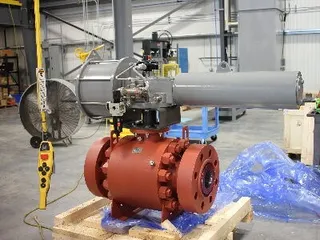
A rack and pinion actuator is a device used to drive quarter-turn valves. Quarter-turn valves refer to valve types that achieve full open or full close by rotating 90 degrees, such as butterfly valves, plug valves, and ball valves. In addition, this type of actuator can also be used for the control of industrial or commercial dampers.
1. Working Principle of Rack & Pinion Actuator
The rotational motion of a rack and pinion actuator is achieved through the interaction of linear motion and a pair of gears. The circular gear is called the “pinion,” which meshes with a linear toothed component known as the rack. In pneumatic actuators, the piston is connected to the rack. When compressed air or spring force acts on the piston, the rack is pushed or pulled, generating bidirectional linear motion. This motion is transmitted to the pinion, which converts it into rotational movement in both directions.
Specifically, in pneumatic systems, the actuator usually consists of a cylinder, piston, and spring, providing linear driving force. When gas (air, gas, or oil) pressurizes one side of the piston, the pinion shaft rotates in one direction. When the pressure is released, the spring force in spring-return actuators drives the pinion to rotate in the opposite direction. In double-acting actuators, no spring is used; instead, air or oil is alternately supplied to both sides of the piston to achieve bidirectional rotation.
2. Structural Characteristics
The rack and pinion pneumatic actuator is compact and space-saving, with high reliability, strong durability, and long service life. However, its main drawback is that piston seals and mechanical transmission components are subject to wear over time.
Most actuators of this type are designed for approximately 100 degrees of travel and can be adjusted clockwise or counterclockwise to achieve full open and full close positions. Standard ISO mounting interfaces are widely adopted, allowing easy and direct installation with valves.

Types and Structure of Rack & Pinion Actuators
Rack and pinion actuators are mainly divided into double-acting types and single-acting (spring-return) types. They also include limit control and torque control functions. The following sections introduce these configurations in detail.
1. Double-Acting Actuators
Double-acting actuators feature a dual air inlet and exhaust structure. A control valve alternately supplies and releases air to both sides of the piston, enabling reciprocating motion. The control valve coordinates the input and discharge of compressed air or gas, producing linear movement inward or outward, which drives the pinion to rotate clockwise or counterclockwise.
This mode is often described as “air to open / air to close.” It relies entirely on the air source for bidirectional driving and is suitable for industrial systems with stable pneumatic supply. It does not use a spring but depends on alternating air or oil supply to achieve rotation in both directions.
2. Single-Acting (Spring Return) Actuators
A single-acting actuator relies on air pressure for movement in one direction, while a built-in spring provides the return force in the opposite direction. Under normal air supply conditions, compressed air pushes the piston to operate the valve. When the air supply fails, the stored energy in the spring is released, automatically returning the actuator to a preset safety position.
This configuration is known as “spring return” and provides fail-safe protection in case of air supply loss. Typical modes include “air-to-open spring-to-close” or “air-to-close spring-to-open,” depending on the required safety position.
3. Limit Control and Torque Control
Rack and pinion actuators can drive valves to full open or full close positions and automatically stop when reaching preset trigger points.
In limit seating mode, the actuator stops when the valve reaches a predefined travel position. In torque seating mode, the control system shuts off operation based on a preset torque threshold. If excessive torque is detected, the actuator immediately stops to prevent overload damage. This protection mechanism is particularly useful when foreign particles or internal blockage cause abnormal resistance, allowing the system to safely stop at an intermediate position and avoid equipment failure.
Working Process of Rack & Pinion Actuators
The working process includes three main stages: power transmission, control modes, and safety protection mechanisms.

1. Power Transmission Process
The actuator provides stable torque output throughout its travel range. The piston’s linear motion drives the rack, whose toothed surface meshes with the pinion, converting linear motion into rotational motion. The pinion is connected to the valve stem, enabling opening or regulating functions.
Adjustable limit devices are usually installed inside the actuator to restrict travel and ensure accurate stopping at preset positions.
2. Control Modes
Rack and pinion actuators can operate as simple on/off devices or provide proportional control.
In on/off mode, the actuator fully opens or closes the valve based on control signals and stops when inactive, reducing energy consumption and wear.
In proportional control mode, the actuator adjusts valve opening gradually based on control signals, enabling precise regulation of flow rate, reaction speed, liquid level, or temperature. This is widely used in reactor systems, heating and cooling systems, and industrial ventilation systems, including dampers, flue gas dampers, and air inlets. Heat pumps, gas, and oil-fired boilers also commonly use such actuators for stable process control.
3. Safety Protection Mechanisms
Modern actuators often include temperature sensors to prevent overheating and protect the drive system.
In some conditions, viscous or abrasive media may increase resistance or cause jamming. In such cases, actuators with higher torque output are selected to ensure proper operation.
Manual override devices may also be installed for emergency operation. Additionally, by monitoring motor current or pneumatic load changes, the system can automatically shut off power or air supply when overload is detected, preventing motor burnout or actuator damage. These overload protection features are essential in high-risk industrial environments.
Comparison with Scotch-Yoke Actuators
Rack and pinion actuators provide stable torque output, compact structure, and high cost-performance. Scotch-yoke actuators use a sliding yoke mechanism to convert motion, producing a variable torque curve, suitable for gate valves and globe valves requiring high torque at both ends.
Rack and pinion actuators maintain relatively constant torque throughout rotation, making them ideal for ball and butterfly valves. They are compact, lightweight, and highly reliable with fewer moving parts. Scotch-yoke actuators, on the other hand, provide higher torque at the beginning and end of travel, making them suitable for heavy-duty applications.
In selection, rack and pinion types are preferred for stable torque applications and limited installation space. Scotch-yoke types are preferred for high-torque requirements in opening and closing stages. Rack and pinion actuators generally offer better cost-effectiveness and lower maintenance requirements under clean operating conditions.
Application Fields for Rack & Pinion Actuator
Rack and pinion actuators are widely used in industrial valve automation, process control systems, and various operating environments.
They are commonly applied in butterfly valves, ball valves, plug valves, globe valves, and gate valves, each requiring different motion characteristics and torque requirements.
In process control systems, they are used in reactors, heating and cooling systems, and industrial ventilation systems, including dampers and air control devices. They are also used in heat pumps, gas boilers, and oil-fired boilers.
In harsh environments, high reliability, corrosion resistance, and remote control capability are required. Safety is critical, especially in systems handling toxic or hazardous media. Long design life and minimal maintenance requirements make these actuators suitable for decades-long industrial operation.

Selection Considerations for Rack & Pinion Actuators
Key selection factors include driving energy type, torque matching, and safety requirements.
- Driving Energy Selection: Compressed air or gas remains the most widely used energy source due to its safety and availability. It can be stored in pressure vessels for emergency use and has no spark risk, making it suitable for explosive environments.
- Torque Matching: Different valves require different torque and thrust characteristics. High-resistance conditions such as viscous or abrasive media require higher torque actuators to ensure reliable operation.
- Safety and Reliability: Safety is always a top priority in industrial automation. Pneumatic actuators are highly reliable, as failure may lead to serious safety incidents such as toxic leakage. Therefore, high manufacturing quality and corrosion resistance are essential for long-term service.
Conclusion
The rack and pinion actuator is a core driving device in industrial valve automation. With its compact structure, stable torque output, and high reliability, it plays a vital role in various industrial applications. It converts linear piston motion into rotational motion through a rack and pinion mechanism, enabling precise control of quarter-turn valves such as butterfly valves, ball valves, and plug valves.
In selection, factors such as energy source, actuator type, torque range, installation space, operating conditions, and safety requirements must all be considered. Rack and pinion actuators are best suited for applications requiring stable torque, while scotch-yoke actuators are more suitable for high-torque demands at both ends of travel.
Send your message to this supplier
Related Articles from the Supplier

Related Articles from China Manufacturers

What Is a Roof Rack Lock?
- Jan 19, 2024


Related Products Mentioned in the Article

Supplier Website
Source: https://www.valvecontrol.cn/news/rack-and-pinion-actuator-design-operation-applications.html