
Guide to Marine Valve Selection and Application
Marine valves are indispensable key components in ship piping systems, responsible for controlling fluid flow and ensuring the safe operation of vessels. Whether for cargo ships, passenger ships, or engineering vessels, various types of marine valves are required to achieve core functions such as seawater cooling, ballast regulation, and fuel transfer. This article provides a comprehensive introduction from the aspects of marine valve types, application scenarios, common failures, and material selection, helping ship engineers, procurement personnel, and maritime practitioners gain an in-depth understanding of this important equipment.
What Are Marine Valves?
Marine valves are fluid control devices specially designed for ship environments, used to regulate, open, close, or divert water, oil, gas, and other media in pipeline systems. Compared with ordinary industrial valves, marine valves must have stronger corrosion resistance, higher sealing reliability, and the ability to adapt to harsh offshore environments.
Ships sail for long periods in high-salinity, high-humidity marine environments, while also being subjected to continuous vibration, extreme temperature changes, and severe pressure fluctuations. Therefore, marine valves must adopt special materials and structural designs to ensure stable and reliable operation under complex sea conditions.
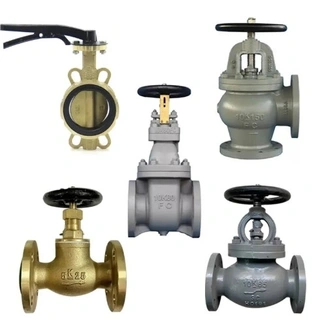
Core Functions of Marine Valves
In ship systems, the main functions of marine valves include three aspects:
- Flow Control: By adjusting the valve opening, the flow rate of fluids is controlled to ensure efficient operation of various systems. For example, in cooling systems, seawater flow is regulated to control engine operating temperature.
- Flow Direction Control: Changing the flow direction of fluids or distributing fluids to different pipelines. This is particularly important in ship environments where multiple systems operate together.
- System Isolation: In maintenance or emergency situations, specific pipeline sections are closed to ensure maintenance safety or prevent accident expansion. For example, in the event of a fire, fuel pipelines can be quickly isolated.
Common Types of Marine Valves and Their Characteristics
There are many types of marine valves, each designed for specific purposes and working conditions. Understanding the structural characteristics and working principles of different valves is the basis for correct selection. The following introduces six of the most common types of valves on ships.
1. Gate Valve
Gate valves use a gate plate structure, achieving fluid on/off control through the lifting and lowering of the gate.
Good sealing performance: a reliable seal can be formed between the gate and the seat, suitable for applications requiring complete shut-off
Low flow resistance: when fully open, the gate is completely withdrawn from the flow channel, allowing fluid to pass with minimal pressure loss
Slow opening and closing: not suitable for applications requiring frequent and rapid operation
In ship applications, gate valves are commonly used in ballast systems for full open or full close control. Since ballast systems require precise control of large volumes of seawater in and out, the good sealing and low flow resistance of gate valves make them an ideal choice.
2. Ball Valve
Ball valves achieve opening and closing control through the rotation of a ball with a through hole.
- Fast operation: only a 90-degree rotation is needed for full open or full close
- Reliable sealing: elastic materials are usually used between the ball and seat, providing good sealing performance
- Easy operation: low torque required for manual handle or actuator operation
Ball valves are widely used in ship fuel systems for controlling fuel flow and rapid pipeline isolation during maintenance or emergencies. They are also commonly used in pipeline systems requiring frequent operation.
3. Butterfly Valve
Butterfly valves use a disc-type closing element, achieving flow control through the rotation of the butterfly plate:
- Compact structure: small size and light weight, saving installation space
- Low cost: more economical compared with other valves of the same diameter
Good regulation performance: suitable for flow regulation rather than only on/off control
In ship cooling systems, butterfly valves are commonly used to regulate seawater flow and control the operating temperature of heat exchange equipment. They are also widely used in fuel pipelines, ventilation systems, and other applications.
4. Check Valve
A check valve is an automatic valve that opens or closes based on the flow direction of the medium:
- One-way flow: allows fluid to flow in only one direction, preventing backflow
- Automatic operation: no external operation required, opening and closing based on fluid pressure
- System protection: prevents equipment damage or system failure caused by reverse flow
In ship bilge systems, check valves are used to prevent seawater or sewage from flowing back and keep compartments dry. At pump outlet pipelines, check valves prevent backflow from impacting the pump body when the pump stops.
5. Globe Valve
Globe valves use a linear motion opening and closing structure, where the valve disc moves along the centerline of the seat:
- High regulation accuracy: enables relatively precise flow adjustment
- Good sealing performance: suitable for throttling control systems
- High flow resistance: fluid must change direction through the valve, resulting in relatively high pressure loss
Globe valves are commonly used in ship steam systems and compressed air systems where precise regulation is required.
6. Safety Valve
A safety valve is a protective valve that automatically opens when system pressure exceeds a set value:
- Automatic protection: opens automatically under overpressure without manual intervention
- Reusable: automatically closes when pressure returns to normal, allowing repeated use
- Adjustable setting: opening pressure can be set according to system requirements
Safety valves are widely used in boilers, pressure vessels, and compressed air systems requiring pressure protection, and are important devices for ensuring ship safety.
Main Application Areas of Marine Valves
After understanding valve types and characteristics, it is necessary to clarify their specific application scenarios on ships. Different ship systems have different functional requirements for valves. Proper matching of valve types with application scenarios is key to ensuring efficient system operation. The following are five main application areas of marine valves.
1. Seawater Cooling System
The seawater cooling system is one of the most common application areas of marine valves. Main engines, generators, air compressors, air conditioning compressors, and other equipment generate large amounts of heat during operation, which must be removed by the cooling system.
In this system, gate valves are used for main pipeline on/off control, butterfly valves are used to regulate seawater flow, and ball valves are used for equipment isolation and maintenance. Check valves are installed at pump outlets to prevent seawater backflow.
2. Ballast Water System
The ballast system is crucial for maintaining ship stability. By injecting or discharging seawater into ballast tanks, the ship’s draft, balance, and navigation performance can be adjusted.
Gate valves and butterfly valves are widely used in ballast systems. Gate valves are used for on/off control of ballast tank inlet and outlet pipelines, while butterfly valves are used for flow regulation. Since large volumes of seawater are involved, corrosion resistance and sealing reliability are particularly important.
3. Fuel System
The ship fuel system supplies fuel to main engines and generators and is the core of ship power. The fuel system has extremely high requirements for sealing performance, as any leakage may cause serious safety hazards and environmental pollution.
Ball valves are widely used in fuel systems for flow control and emergency isolation. Since fuel is flammable, fuel system valves must also meet fire and explosion protection requirements.
4. Bilge Water System
The bilge water system is used to collect and discharge accumulated water in ship compartments, including rainwater, wash water, and equipment leakage.
Check valves play an important role in bilge systems by preventing discharged wastewater from flowing back into compartments.
5. Firefighting System
Ship firefighting systems must quickly supply large amounts of extinguishing water or foam in emergency situations. Valves in firefighting pipelines must open quickly, provide reliable sealing during standby, and ensure full opening when needed.
Material Selection for Marine Valves
The material selection of marine valves directly affects their service life and reliability. The following are several commonly used materials and their applicable conditions:
1. Bronze
Bronze is a traditional marine valve material with excellent corrosion resistance in seawater environments. After contact with seawater, bronze forms a protective oxide layer that effectively prevents rust.
- Characteristics: strong resistance to saltwater corrosion, long service life, low maintenance cost
- Applications: seawater intake systems, ballast systems, bilge systems, firefighting pipelines
- Limitations: relatively high cost, lower mechanical strength than steel
2. Brass
Brass valves are suitable for freshwater or low-pressure systems and have the advantages of low cost and easy processing. However, brass is prone to dezincification corrosion in seawater environments and is not recommended for direct seawater contact conditions.
3. Stainless Steel
Stainless steel (304, 316, and duplex stainless steel) is a very important material in modern marine valves. 316 stainless steel performs better in chloride corrosion resistance due to the addition of molybdenum, making it particularly suitable for marine environments.
- Characteristics: high mechanical strength, high temperature and pressure resistance, stable overall performance
- Applications: engine room pipelines, ballast control systems, seawater treatment and discharge systems
- Limitations: higher cost than ordinary carbon steel, some grades are sensitive to chloride ions
4. Cast Iron and Ductile Iron
Cast iron valves are low-cost and structurally strong, but have poor seawater corrosion resistance and usually require coating or lining treatment for marine use. Ductile iron has better toughness and is commonly used in ship HVAC systems or some ballast applications.
5. Titanium and Nickel-Based Alloys
In extreme conditions or high-end applications (such as offshore platforms, submarines, and high-performance military vessels), titanium alloys and nickel-based alloys (such as Monel alloys) are used for marine valves. These materials have extremely strong seawater corrosion resistance and high strength-to-weight ratio, but are very expensive and are usually used only for special engineering applications.
Conclusion
As core control components of ship piping systems, marine valves directly affect ship safety, service life, and operational performance. Different types of marine valves have different characteristics and application scenarios, and must be selected according to specific working conditions. At the same time, regular inspection and maintenance are equally important for extending valve service life and ensuring ship safety. With the development of the shipbuilding industry, marine valve technology continues to advance. The application of new materials, new structures, and intelligent control technologies will further improve valve performance and reliability, providing stronger support for safe navigation of ships.
Send your message to this supplier
Related Articles from the Supplier
Guide to Marine Valve Selection and Application
- Apr 17, 2026
Guide to Material Selection for Valve Body & Trims
- Jul 04, 2025

Guide to Bellows Sealing for Industrial Valves
- Nov 08, 2025

Guide to Cast Iron Valve Surface Coating Processes
- Nov 20, 2025
Related Articles from China Manufacturers

Guide to Liquid Die Forging Technology
- May 20, 2025

Guide to Nickel-Based Alloy Open Die Forging
- Dec 09, 2025
Guide to Multi-Directional Die Forging Technology
- Feb 04, 2026
Guide to Metal Forging with Presses
- Mar 17, 2026

Guide to Non-Ferrous Metal Forging Process
- Nov 06, 2025
Guide to Aluminum Alloy Forging Technology
- Nov 13, 2025
Related Products Mentioned in the Article

Supplier Website
Source: https://www.bossealvalves.com/news/guide-to-marine-valve-selection-and-application.html