
Spring Energized Seals: Types, Materials and Applications
In industrial equipment operation, media leakage is a common and challenging problem. Whether it is lubricating oil seeping from a gearbox or high-pressure gas escaping from a valve connection, such leakage directly affects equipment performance, safety, and service life. The root cause of leakage lies in the fact that most mechanical equipment is composed of multiple components, and the contact interfaces between these parts inevitably contain microscopic gaps. To solve this issue, a component capable of forming a reliable barrier between mating surfaces is required. This is where seals come into play.
Among various sealing technologies, spring energized seals have become one of the most reliable solutions for demanding conditions such as high temperature, high pressure, strong corrosion, and extreme temperature environments, thanks to their unique structural design and excellent adaptability. This article systematically explains the basic role of seals, the working principle of spring energized seals, their structural composition, spring types, material properties, and their applications in key industries such as oil and gas and aerospace, providing a comprehensive understanding of this core technology.
What Are Seals and Their Basic Function?
Seals are essential components in many mechanical and electromechanical systems. Common sealing products include O-rings, gaskets, and various molded or extruded sealing elements. Their primary function is to create a sealing barrier between two or more mating surfaces to prevent media leakage.
Most mechanical systems are not made of a single part but are assembled from multiple components. At the connection areas of these parts, sealing structures are required to ensure system integrity and reliability. Many systems contain internal fluid or gas channels. For example, lubricating oil and coolant circulate inside equipment, while combustion gases are discharged through designated passages. Without effective sealing, these media would leak from connection points, leading to performance degradation and even safety risks.
Therefore, the role of seals is to confine liquids or gases within designated flow paths, allowing them to circulate properly inside the system without leakage.
Basic Concept of Spring Energized Seals
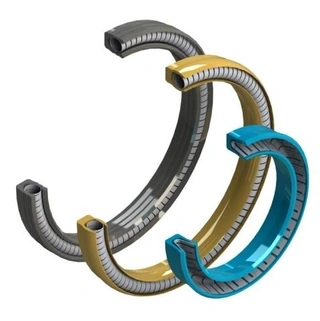
Spring energized seals are a high-performance type of sealing solution. The term refers to seals that use an internal spring structure to store mechanical energy, which continuously applies force to the sealing lips.
All springs inherently store energy. When subjected to external force, they deform and accumulate mechanical energy, either through compression or tension. Spring energized seals mainly store energy through compression, converting it into continuous pressure on the sealing interface.
Compared with traditional seals, spring energized seals offer significant advantages. When conventional sealing elements cannot achieve zero-leakage performance, spring energized seals often become the more reliable choice. They can withstand higher temperatures and pressures, making them widely used in mechanical sealing applications.
In actual operation, seals are often exposed to both temperature and pressure. For example, lubricating oil or coolant expands when heated during operation, increasing internal pressure and affecting sealing performance. In such high-temperature and high-pressure environments, spring energized seals can self-adjust. When subjected to thermal expansion or high-pressure gas, the sealing material deforms, while the internal spring continuously provides counteracting force, keeping the sealing lip tightly in contact with the sealing surface. This continuous elastic compensation ensures stable sealing performance even under fluctuating conditions.
Structural Design of Spring Energized Seals
From a structural perspective, spring energized seals generally consist of two main components: a high-performance polymer jacket and an internal spring as the energy source.
1. Seal Jacket Materials
The outer sealing jacket is usually made of fluoropolymers or engineering plastics. Common materials include PTFE and its filled variants, as well as PEEK, UHMWPE, TPE, and PCTFE.
PTFE is the most widely used material due to its broad temperature range, typically from -268°C to above 260°C. It also offers extremely low friction, excellent chemical resistance, dry-running capability, and strong weather resistance.
By adding different fillers such as glass fiber, carbon, graphite, molybdenum disulfide, bronze, ceramic, or stainless steel, the mechanical properties of PTFE can be significantly improved. These fillers enhance wear resistance, strength, and load-bearing capacity. PTFE also performs well under high-speed or non-lubricated conditions and is highly inert to most chemical media.
2. Function and Material Selection of Springs
The spring is the core energy component of the seal. Its function is to provide continuous radial force, ensuring effective sealing under low pressure, high pressure, and temperature variations.
Since PTFE and similar materials have high stiffness and low elasticity, the spring is necessary to maintain constant preload, ensuring continuous contact between the sealing lip and the mating surface.
Spring materials are typically stainless steel, such as grades 301, 302, 304, and 316. In more demanding environments, high-performance alloys like Inconel, Elgiloy, or Hastelloy may be used for enhanced corrosion and temperature resistance.
3. Types of Springs and Applications
Spring energized seals commonly use three main types of springs:
- Cantilever V-shaped spring: This spring is formed from stamped metal strips and has a linear load characteristic. The force increases with deformation. It concentrates load at the sealing lip and is suitable for reciprocating motion. It also provides a scraping effect to remove residual media and can be stacked to increase load capacity.
- Slant coil spring: This spring provides a relatively stable and uniform load with minimal variation. It is ideal for rotary applications due to its low friction and consistent sealing force.
- Helical band spring: This spring is formed by winding a metal strip into a spiral structure. It provides high unit load and is suitable for static face sealing or cryogenic conditions. However, due to high load and potential permanent deformation, it is generally not used in dynamic applications.
4. Working Principle
During installation, the seal jacket and spring are radially compressed. The spring generates continuous radial force, causing the sealing lip to expand outward and maintain contact with the sealing surface.
Before system pressure builds up, the spring provides the primary sealing force. As pressure increases, it further enhances the sealing effect. This combined mechanism of spring force and media pressure ensures effective sealing during both low-pressure startup and high-pressure operation.
This structure also compensates for equipment misalignment, manufacturing tolerances, thermal expansion, and long-term wear, ensuring long-term sealing stability.
Application Fields of Spring Energized Seals
Spring energized seals are widely used in industries such as oil and gas, aerospace, chemical processing, energy systems, medical equipment, military applications, transportation, and automotive engineering.
1. Oil and Gas Industry
In the oil and gas sector, typical applications include quick-connect couplings, rotary joints, subsea valves and manifolds, flow meters, hydraulic fittings, pumps, drilling and downhole tools, wellhead systems, and offshore floating production systems.
These environments involve extreme conditions such as low temperatures, rapid gas decompression, high pressure and temperature, strong corrosion, and low emission requirements.
Spring energized seals are commonly used in API 6A gate valves and API 6D ball valves, especially in stem and seat sealing positions. They prevent internal leakage while also blocking external contamination, ensuring system safety and reliability.
2. Special Working Conditions
Spring energized seals are suitable for conditions where traditional seals fail, including explosive decompression environments, extreme temperatures, high surface speeds, non-lubricated systems, ultra-high pressure, and vacuum conditions. In these scenarios, rubber or polyurethane seals often fail, while spring energized seals maintain stable performance.
3. Motion Types
These seals can be used in dynamic and static conditions, including reciprocating, rotary, and oscillating motions. Selection depends on temperature, pressure, speed, media compatibility, friction, wear, and structural design of the sealing cavity.
Selection Considerations
When selecting spring energized seals, engineers must evaluate several key parameters:
- Temperature range: Material selection depends on maximum and minimum operating temperatures. PTFE covers a wide range, while filled materials may vary in performance.
- Pressure conditions: Different spring types respond differently to pressure. V-springs increase load significantly under pressure, while slant coil springs remain relatively stable.
- Motion speed: High-speed rotation requires low friction designs, while reciprocating motion benefits from scraping capability.
- Media compatibility: PTFE is chemically inert to most substances, but special environments may require alternative materials like PEEK.
- Environmental conditions: Factors such as abrasion, underwater operation, and outdoor exposure affect wear resistance and durability requirements.
Conclusion
Spring energized seals are a highly reliable sealing solution designed for critical and extreme operating conditions. Their core advantage lies in the continuous radial force provided by the internal spring, ensuring tight contact between sealing surfaces and achieving near zero-leakage performance.
When conventional rubber or polyurethane seals cannot meet requirements for high temperature, high pressure, or aggressive media, spring energized seals offer a superior alternative. Even in standard applications, engineers often choose them to improve system safety and operational stability.
These seals consist of a polymer jacket and a metal spring. The jacket is typically made of PTFE or filled PTFE, while the spring may be a cantilever V-spring, slant coil spring, or helical band spring. The combined effect of spring force and media pressure ensures consistent sealing performance across all operating stages.
Spring energized seals are widely used in oil and gas, aerospace, chemical processing, energy systems, and medical equipment, playing a critical role in applications such as subsea valves, wellhead systems, and valve stem sealing. Proper selection and application significantly enhance equipment reliability and safety.
Send your message to this supplier
Related Articles from the Supplier
Related Articles from China Manufacturers

Related Products Mentioned in the Article

Supplier Website
Source: https://www.valvepackingsealkits.com/news/spring-energized-seals-types-materials-and-applications.html