
Industrial Vee Packing: Design, Materials & Applications
In the world of industrial sealing, O-rings are the most common choice due to their simplicity, cost-effectiveness, and wide availability. They are used in everything from hydraulic cylinders to pumps, valves, and general machinery. However, when engineering systems operate under complex conditions, such as high pressure, reciprocating motion, abrasive media, or rapid temperature fluctuations, standard O-rings often fall short. They may leak, wear excessively, or fail to maintain sealing integrity under dynamic loads. In such challenging environments, a Vee Packing provides a superior solution and has become the preferred choice for engineers seeking reliable and durable sealing performance.
A Vee Packing is a specialized dynamic sealing device designed to handle reciprocating motion and high-pressure conditions effectively. Its defining feature is the unique V-shaped cross-section of the seal, which allows it to harness system pressure to enhance the sealing force automatically. This self-energizing mechanism ensures that the Vee Packing adapts to changing operational pressures, providing superior sealing where conventional O-rings cannot.
In industrial terminology, Vee Packing is also known as a Chevron Packing or Parachute Packing. These alternate names reflect its characteristic V-shaped geometry and the way it expands under pressure, similar to a parachute opening to resist fluid flow. The design is simple in principle yet highly effective in practice, embodying a “simple but ingenious” approach to sealing technology.
Structure of a Vee Packing
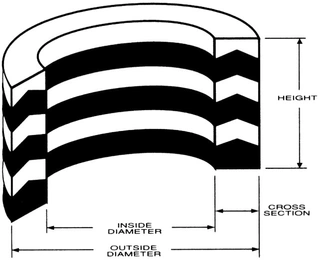
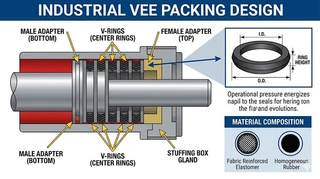
A typical Vee Packing assembly consists of three main components:
- Top Male Adapter: Provides a flat and stable surface at the top of the packing stack, ensuring even compression.
- Stacked Vee Rings (Pressure Rings): The core sealing elements, each with a V-shaped cross-section. These rings expand radially under axial load, pressing against the rod and housing to create a tight seal.
- Bottom Female Adapter: Provides a flat base to transfer axial forces evenly into the stack and maintain alignment of the rings.
The male and female adapters support the Vee Rings and distribute forces uniformly, preventing extrusion and uneven wear. The Vee Rings themselves are responsible for the actual sealing, and their effectiveness relies on both their geometry and material composition.
Working Principle of Vee Packing
The principle behind a Vee Packing's operation is known as pressure adaptation or self-energizing sealing. When system pressure acts on the assembly, the force is transmitted through the female adapter to the stacked Vee Rings. The axial pressure compresses the rings, causing their angled surfaces to expand outward. This expansion forces the lips of each Vee Ring against the surfaces to be sealed: the inner diameter contacts the reciprocating rod, while the outer diameter presses against the stationary housing.
As system pressure increases, the Vee Rings expand further, automatically increasing the sealing force. This characteristic—“the higher the pressure, the tighter the seal”—makes Vee Packing particularly effective in high-pressure applications. It also allows the seal to maintain performance even when operational pressure fluctuates, a scenario in which traditional O-rings may fail.
The multi-layer design of Vee Rings further enhances reliability. Fluid attempting to leak from the high-pressure side must pass through multiple Vee Rings. Each layer reduces the pressure significantly, creating a series of barriers that dramatically minimize leakage. Even if a small amount of fluid passes the first ring, the subsequent layers continue to provide effective sealing. This layered, pressure-reducing configuration is key to the Vee Packing's ability to withstand extreme pressures and maintain long-term operational reliability.
Key Differences Between Vee Packing and O-Rings
While both O-rings and Vee Packing are widely used in industrial sealing, they differ fundamentally in design, material flexibility, and application suitability:
- Standardization: O-rings are highly standardized, allowing engineers to select components based on groove dimensions and nominal sizes. Vee Packing, on the other hand, lacks universal standards. The so-called “6225 standard” is actually a military specification, not an industry-wide guideline. Most Vee Packings require customization according to the specific application, including ring number, height, and material composition.
- Material Flexibility: O-rings are generally made from a single material, limiting their ability to address multiple challenges simultaneously. Vee Packing assemblies can combine multiple materials, such as chemically resistant FKM for aggressive fluids, fabric-reinforced rubber for abrasion resistance, and low-friction PTFE for smooth operation. Each layer is optimized for specific challenges within the same sealing assembly.
- Pressure Adaptability: O-rings rely on pre-compression to form a seal, which may be inadequate under fluctuating pressures or excessive in high-pressure environments, leading to wear. Vee Packing automatically adjusts its sealing force according to system pressure, maintaining reliability across a wide range of operating conditions.
- Motion Compatibility: O-rings are best suited for static or slow-rotating applications. Vee Packing, with its multi-lip Vee Rings and low-friction properties, is ideal for reciprocating motion, such as hydraulic piston rods or plungers. It reduces wear and ensures smooth operation even under rapid or high-frequency movements.
Material Selection for Vee Packing
The material composition of a Vee Packing is critical to its performance, durability, and suitability for specific operating environments. Depending on the application, engineers can select from the following categories:
- Rubber Materials: Nitrile rubber (NBR) is suitable for general hydraulic oils and mineral oils. Hydrogenated NBR (HNBR) improves temperature resistance and wear characteristics, making it suitable for harsher conditions. Fluoroelastomer (FKM) offers excellent chemical and high-temperature resistance, commonly used in acidic or high-temperature oil applications.
- Fabric-Reinforced Rubber: Combines the elasticity of rubber with the strength of fabrics such as cotton, nylon, or aramid fibers. This reinforcement enhances wear resistance, extrusion resistance, and durability in high-pressure or particle-laden environments.
- PTFE: Polytetrafluoroethylene provides low friction and exceptional chemical inertness. Pure PTFE is suitable for contamination-sensitive industries such as food, pharmaceutical, and chemical processing. Filled PTFE, enhanced with glass, graphite, or bronze, improves wear resistance, thermal conductivity, and operational performance in high-speed or high-temperature conditions.
- High-Performance Engineering Plastics: Materials such as PEEK (polyether ether ketone) and UHMWPE (ultra-high molecular weight polyethylene) are used in extreme temperatures or aggressive chemical environments. Polyurethane (PU) offers excellent wear resistance and elasticity, making it well-suited for high-pressure hydraulic systems.
In practice, a Vee Packing assembly often combines different materials. For example, the Vee Ring closest to the pressure source may be FKM for chemical resistance, the middle layer may be fabric-reinforced rubber to absorb pressure and reduce extrusion, and the atmospheric-side ring may be PTFE to minimize friction and prevent contamination. This layered material strategy allows a single Vee Packing assembly to handle multiple operational challenges simultaneously.
Applications of Vee Packing
Vee Packing is highly versatile and used across a wide range of industrial applications:
- Hydraulic Systems: Vee Packing seals piston rods in hydraulic cylinders, plungers in presses, and high-pressure lines in construction machinery such as excavators and bulldozers. These applications require seals to withstand significant pressure fluctuations, harsh environments, and long operating cycles.
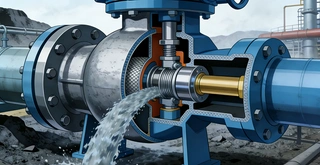
- Pumps and Valves: Reciprocating pump plungers, centrifugal pump shafts, and valve stems (gate valves, globe valves) utilize Vee Packing's pressure-adaptive design. In the oil and gas industry, high-pressure fracturing pumps and abrasive media pumps rely on Vee Packing to maintain reliable sealing under extreme conditions.
- Vertical Transport Equipment: Elevators, automotive lifts, and forklifts require hydraulic sealing systems that ensure leak-free operation and smooth motion over extended periods. Vee Packing provides the necessary reliability and longevity in these safety-critical applications.
- Heavy Machinery: Equipment such as rubber molding machines, plastic extruders, hydraulic presses, and log splitters benefit from Vee Packing's durability, self-adjusting sealing, and resistance to intermittent loads or shock forces.
- Specialized Industries: Aerospace and defense equipment demand reliable sealing under extreme temperature and pressure conditions. Municipal infrastructure systems require long-term maintenance-free operation. Agricultural and construction machinery operate in harsh environments where Vee Packing protects hydraulic systems against leakage and contamination.
Key Design Considerations for Vee Packing
Designing a custom Vee Packing assembly requires careful analysis of application conditions:
- Number of Rings: Determined by system pressure. Low-pressure applications may use three rings, while ultra-high pressure systems may require five or more. More rings enhance reliability and pressure capacity but also increase friction and assembly length. Engineers must balance sealing performance with compactness.
- Dimensions: Inner diameter must match the rod for proper fit, outer diameter must prevent extrusion while facilitating installation, and height determines axial compression and adjustment range.
- Adapter Configuration: Depending on equipment design, flat metal support surfaces may eliminate the need for additional adapters. Otherwise, male and female adapters ensure even load distribution and maintain sealing alignment.
- Compression Adjustment: Preload is controlled via packing height or gland bolt tension. Insufficient compression can cause low-pressure leakage, while excessive compression increases friction, wear, and energy loss.
- Environmental Factors: Designers must account for temperature, pressure, fluid type, ozone exposure (for outdoor applications), rapid decompression (e.g., petroleum extraction), and aggressive media such as steam or amines. Each factor affects material choice, ring configuration, and assembly design.
Installation and Maintenance
Correct installation is essential for Vee Packing performance. Grooves and rod surfaces must be clean and free of burrs or scratches. Vee Rings should be installed sequentially with the lips facing the pressure source, and multi-layer joints staggered to prevent leakage paths. Gland bolts must be tightened gradually and evenly, followed by trial operation to monitor temperature and leakage.
Vee Packing offers significant maintenance advantages due to adjustability. As wear increases, tightening the gland often restores sealing without replacing the rings. When adjustment capacity is exhausted, only the Vee Rings need replacement, while adapters can be reused, reducing cost and downtime. Regular inspections of leakage, friction, and visual condition allow accurate prediction of remaining service life and proactive maintenance planning.
Selecting a Vee Packing Supplier
Given the high degree of customization, a supplier's technical capability is critical. Key criteria include:
- Engineering Support: Ability to analyze applications, recommend suitable materials, and design customized assemblies.
- Material Diversity: Availability of rubbers, fabric-reinforced elastomers, PTFE compounds, and high-performance plastics.
- Quality Control: ISO 9001 certification ensures consistency and reliability in high-pressure applications.
- Manufacturing Flexibility: Ability to accommodate small-batch or urgent orders and adjust ring numbers, dimensions, and materials quickly.
- Industry Experience: Proven track record in hydraulics, oil and gas, chemical, and heavy machinery sectors, with understanding of application-specific challenges.
Conclusion
Vee Packing exemplifies the philosophy of “simple yet ingenious” industrial sealing design. By harnessing the principle of self-energizing pressure, it addresses complex sealing challenges in high-pressure, reciprocating, and harsh operating environments. Compared to standardized O-rings, Vee Packing offers virtually unlimited customization through adjustments in ring number, material composition, and dimensional parameters.
Understanding the working principle, material options, and design considerations of Vee Packing enables engineers to make informed decisions when selecting seals for critical industrial systems. In applications involving high pressure, dynamic motion, or harsh conditions, Vee Packing is often a more reliable, durable, and cost-effective solution than conventional O-rings. Advances in materials, including new FKM grades, high-performance thermoplastics, and nanocomposites, continue to expand its capabilities, enabling operation at higher temperatures, with stronger corrosion resistance and longer service life. As a result, Vee Packing remains an essential sealing solution and a cornerstone of industrial equipment performance.
Send your message to this supplier
Related Articles from the Supplier
How to Select Industrial Valves for Chemical Plants
- Feb 03, 2026
Common Sealing Forms of Industrial Valves
- Jun 19, 2025

Related Articles from China Manufacturers

Industrial Surplus World Launches New Valve Division
- Apr 30, 2014

Industrial Locks — Tiandi Connecting Rod Locks
- Jun 04, 2021

Industrial demand for oil casings
- Feb 16, 2017
Industrial valve and pipe installation instructions
- Oct 13, 2019
Industrial Surplus World Launches New Valve Division
- Sep 23, 2016
Related Products Mentioned in the Article

Supplier Website
Source: https://www.magpievalves.com/media-hub/industrial-vee-packing-design-materials-applications.html