
Single-Seated Control Valve vs. Double-Seated Control Valve
In industrial automation control systems, control valves are key devices used to regulate fluid flow, pressure, and temperature. Among them, single-seated control valves and double-seated control valves are two of the most common types. Although their basic functions are similar, they differ significantly in terms of structure, performance, and application scenarios.
This article provides a comprehensive analysis of the differences between these two types of control valves from the perspectives of structural principles, performance characteristics, advantages and disadvantages, application scenarios, and selection recommendations, helping engineers and technical personnel make more rational valve selection decisions.
Structural Principle Comparison
The fundamental difference between single-seated control valves and double-seated control valves lies in the configuration of the valve plug and valve seat.
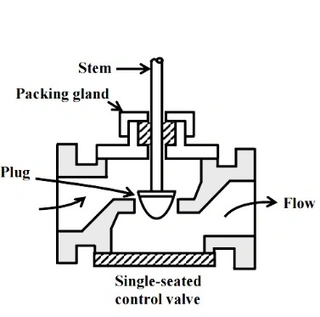
A single-seated control valve adopts a structure where one valve plug works with one valve seat, similar to sealing a pipeline with a stopper. A double-seated control valve, by contrast, utilizes two plugs and two seats arranged vertically to form a unique force-balancing system.
This structural difference directly determines the differences in force distribution, sealing performance, and guiding methods. The following sections analyze their structural features and working principles.
1. Structural Characteristics of Single-Seated Control Valves
A single-seated control valve adopts a single sealing line structure, which works similarly to plugging an opening with a stopper. Its main components include the valve body, valve plug, guide sleeve, bonnet, valve stem, and packing.
The structure contains only one valve seat and one valve plug, creating a single sealing contact surface between the plug and seat.
In terms of guiding methods, single-seated control valves usually adopt a top-guided structure, while some small-flow spherical control valves adopt seat guiding. Some improved designs use top-and-bottom dual guidance to enhance guiding accuracy and stability.
When the actuator drives the valve stem in a linear motion, the valve plug moves accordingly, changing the flow passage area and thereby regulating the fluid flow.
Depending on the direction in which the flow area changes, single-seated control valves can be divided into direct-acting valves and reverse-acting valves. In a direct-acting valve, the flow area decreases when the valve plug moves downward, while the opposite occurs in a reverse-acting valve.
For single-guided straight-through single-seated valves with diameters smaller than 25 mm, the structure is usually direct-acting only. If air-to-open control is required, a reverse-acting actuator must be used.
2. Structural Characteristics of Double-Seated Control Valves
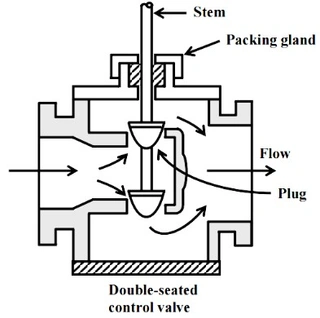
The defining feature of a double-seated control valve is that two valve seats and two valve plugs are installed inside the valve body, and the plugs adopt a dual-guided structure.
Fluid enters from one side, flows through the upper and lower valve seats and plugs, and then merges before exiting from the other side. This “split-flow and recombination” design is the fundamental characteristic distinguishing double-seated control valves from single-seated control valves.
The upper and lower valve plugs experience fluid thrust forces in opposite directions. The upper plug receives an upward force, while the lower plug receives a downward force. Ideally, these forces offset each other, significantly reducing the unbalanced force acting on the valve plug.
This balanced structure is the key reason why double-seated control valves can withstand large pressure differentials.
Another advantage is the flexibility in switching between direct-acting and reverse-acting configurations. Because of the top-and-bottom dual guiding structure, simply reversing the installation of the valve plug and seat allows the conversion between the two configurations without replacing the actuator or changing its action type.
Performance Parameter Comparison
The single sealing line of single-seated control valves and the balanced dual-seat structure of double-seated control valves result in very different technical characteristics during operation.
1. Leakage Performance
Single-Seated Control Valve: Low leakage is the most prominent advantage of single-seated control valves. Because there is only one sealing line, the valve plug and seat can achieve a very tight fit. Using metal-to-metal hard sealing or metal-to-PTFE soft sealing, the standard leakage rate can reach 0.01% C (C = rated flow coefficient). This allows the valve to meet strict sealing and shut-off requirements.
Double-Seated Control Valve: Higher leakage is the main disadvantage of double-seated control valves. Due to machining tolerances, the two sealing surfaces cannot always achieve perfect sealing simultaneously. As a result, leakage is typically 10 to 100 times greater than that of single-seated control valves. Temperature changes can further increase leakage due to differences in thermal expansion coefficients of materials. However, modern improved designs can achieve leakage classes I–V.
2. Allowable Pressure Differential
Single-Seated Control Valve: Single-seated control valves have a relatively small allowable pressure differential. For example, a DN100 valve typically allows about 120 kPa. This is because fluid thrust acting on the valve plug produces a large unbalanced force, which becomes particularly significant under high pressure differentials. Therefore, single-seated control valves are not suitable for large-diameter or high-pressure differential applications.
Double-Seated Control Valve: Double-seated control valves can withstand much larger pressure differentials. For the same DN100 size, the allowable pressure differential can reach about 280 kPa. Because the forces acting on the upper and lower plugs largely balance each other, the unbalanced force is significantly reduced. This advantage is particularly evident in high differential pressure conditions.
3. Flow Capacity and Flow Coefficient
Single-Seated Control Valve: Single-seated control valves have a relatively smaller flow coefficient. For example, a DN100 straight-through single-seated control valve typically has a flow coefficient of around 100. This means the flow capacity is limited for the same valve size, often requiring actuators with higher thrust.
Double-Seated Control Valve: Double-seated control valves provide greater flow capacity. Compared with other control valves of the same size, they allow more fluid to pass through. For the same diameter, the flow coefficient of a double-seated valve is typically 20%–50% higher than that of a single-seated valve. A DN100 double-seated control valve can reach a flow coefficient of 160. Therefore, double-seated control valves can use actuators with smaller thrust to achieve the same flow capacity, reducing system cost.
4. Weight and Size
Traditional double-seated control valves are often considered bulky and heavy, mainly due to their complex dual-seat structure.
However, modern alternatives such as compact sleeve valves and eccentric hemispherical valves can reduce weight and height by 30%–70% while maintaining performance, significantly improving installation and maintenance convenience.
Applicable Media and Operating Conditions
The precision sealing capability of single-seated control valves and the high pressure differential capability of double-seated control valves lead to different adaptability when handling various media.
Understanding their application boundaries and limitations is essential for proper valve selection.
1. Application Range of Single-Seated Control Valves
Single-seated control valves are suitable for clean media environments.
Suitable for:
- Clean liquids, gases, and steam
- Applications requiring strict sealing and shut-off
- Low pressure differential conditions
- Building water supply systems
- General industrial clean water environments
Not suitable for:
- Media containing large particles that may cause blockage
- High pressure differential conditions
- Fibrous or high-viscosity fluids
2. Application Range of Double-Seated Control Valves
Double-seated control valves have unique characteristics in terms of media adaptability.
Suitable for:
- Clean media with large pressure differentials
- Large flow and high pressure drop applications
- Processes where leakage requirements are not strict
- Applications requiring frequent maintenance or disassembly
- Slurry media that may cause clogging but require periodic cleaning
Not suitable for:
- Applications requiring strict leakage control
- High-viscosity fluids or media containing suspended solids (traditional structures)
- Flashing and cavitation conditions under high pressure differentials
Because of the more complex flow path, solid particles may become trapped in the upper and lower guide areas, and the valve has relatively poor resistance to erosion.
Special Considerations for Pneumatic Control Valves
When paired with pneumatic actuators, the differences between single-seated and double-seated control valves become more apparent.
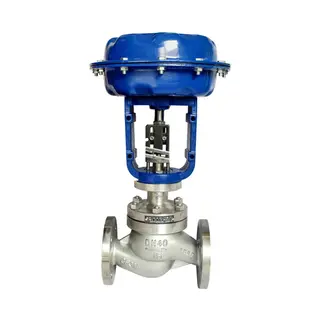
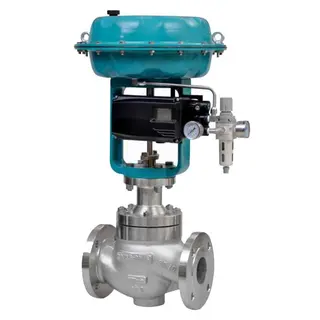
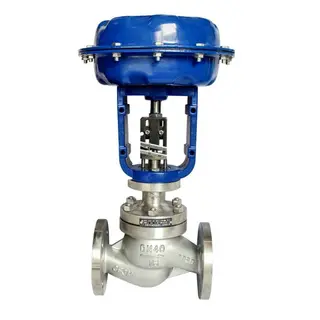
A pneumatic single-seated control valve features a top-guided structure, compact body design, and an S-shaped flow path that reduces pressure loss while providing large flow capacity and high control accuracy.
A pneumatic double-seated control valve adopts a dual-seat valve body with an additional bottom flange opening, making maintenance easier and improving structural stability. It is particularly suitable for high-pressure and high differential pressure applications.
Valve Selection Decision Guide
In practical engineering applications, the following selection steps are recommended.
Step 1: Determine Leakage Requirements
Strict leakage requirements → Single-seated control valve or eccentric hemispherical valve
Less strict leakage requirements → Double-seated control valve
Step 2: Evaluate Pressure Differential
Low differential pressure (<120 kPa for DN100) → Single-seated control valve
High differential pressure (>120 kPa) → Double-seated control valve, sleeve valve, or eccentric hemispherical valve
Step 3: Analyze Media Characteristics
Clean media → Either valve type depending on pressure and leakage requirements
Particle-containing or high-viscosity media → Avoid traditional double-seated valves
Step 4: Consider Maintenance and Space
Limited installation space → Compact valve designs
Frequent maintenance required → Double-seated control valves or eccentric hemispherical valves
Step 5: Evaluate Economic Factors
Consider both initial investment and life-cycle cost. Modern alternative valves may have higher initial costs but often provide better long-term economic performance.
Conclusion
Single-seated control valves and double-seated control valves each have clear performance boundaries and application scenarios.
Single-seated valves offer excellent sealing performance and low leakage, making them suitable for clean media and strict shut-off requirements, but they are limited by lower allowable pressure differentials.
Double-seated valves provide higher pressure differential capacity and greater flow capability, making them suitable for large-flow and high pressure drop applications. However, they also have disadvantages such as higher leakage, susceptibility to clogging, and heavier structures.
Modern industrial requirements demand control valves that combine tight sealing, high pressure differential capability, adaptability to complex media, and lightweight design. New technologies such as eccentric hemispherical valves are gradually expanding the options available to engineers.
Ultimately, valve selection should always follow the fundamental principle: choose the valve according to the operating conditions. Understanding the differences between single-seated and double-seated control valves provides a solid foundation for selecting the most appropriate process control solution.
Send your message to this supplier
Related Articles from the Supplier
Single Disc Gate Valve vs. Double Disc Gate Valve
- Jan 26, 2026
Related Articles from China Manufacturers
Single-Seated vs. Double-Seated Control Valves
- May 20, 2026
What is Single Seated Control Valve?
- Jul 01, 2024
Related Products Mentioned in the Article

Zhejiang Kosen Valve Co., Ltd.
- https://www.kosenvalve.com/
- Business Type: Industry & Trading, Manufacturer,
Supplier Website
Source: https://www.kosenvalve.com/media-hub/single-seated-control-valve-vs-double-seated-control-valve.html