
Single-Plate Check Valves vs. Dual-Plate Check Valves
In industrial piping systems, check valves play a critical role in ensuring unidirectional fluid flow and preventing backflow. Among the various types of check valves, single-plate check valves and dual-plate check valves are two of the most widely used structural designs. These valves are extensively employed in industries such as petrochemicals, power generation, water treatment, and heating, ventilation, and air conditioning (HVAC). This article provides a systematic comparison of these two check valve types in terms of structural principles, performance characteristics, application scenarios, selection criteria, and maintenance costs, helping engineers and procurement professionals make informed decisions.
Basic Concept and Function of Check Valves
A check valve, also known as a one-way valve or non-return valve, is an automatic valve that opens and closes based on fluid flow. Its primary function is to allow fluid to flow in one direction while automatically closing when backflow occurs, thereby preventing medium reversal. This capability is crucial for protecting pumps, compressors, and other key equipment from water hammer and reverse pressure damage.
Among the various types of check valves, wafer-style check valves have gained prominence in modern industrial piping systems due to their compact structure and ease of installation. Wafer-style check valves are installed between two flanges without additional bolting, occupying minimal space while being lightweight and cost-effective. They also respond quickly to reverse flow, ensuring system safety. Within the wafer-style family, single-plate and dual-plate designs are the two most fundamental and widely used types.
What is Single-Plate Check Valves?
Before comparing the performance differences between single-plate and dual-plate check valves, it is essential to understand their basic structure and operating principle. The single-plate check valve, as the simplest form of wafer-style check valve, embodies the industrial philosophy of simplicity and reliability.
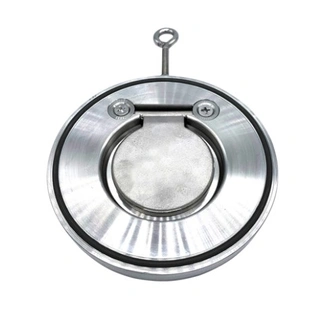
1. Basic Structure of Single-Plate Check Valve
The single-plate check valve consists of a single disc connected to the valve body via a hinge. The disc swings around the hinge axis to open or close the valve. Its structure is straightforward, with few moving parts, and primarily comprises the valve body, a single disc, a hinge mechanism, and a sealing surface.
Valve body materials typically include cast iron, ductile iron, stainless steel 304 (CF8), or stainless steel 316 (CF8M), chosen according to fluid properties and operating conditions. Sealing materials include EPDM, NBR, PTFE, and metal sealing surfaces, depending on the application.
2. Working Mechanism of Single-Plate Check Valve
The operation of a single-plate check valve relies entirely on the pressure difference across the valve. When upstream pressure exceeds downstream pressure, fluid pushes the disc upward around the hinge to open the valve, allowing flow. When flow diminishes, stops, or reverses, the disc falls back onto the seat under its own weight or the reverse pressure, cutting off flow and preventing backflow.
Some single-plate check valves are equipped with spring-assisted mechanisms. The spring helps accelerate disc closure when the pressure differential disappears, reducing closure delay and improving response time.
3. Performance Characteristics of Single-Plate Check Valve
- Structural Advantages: The single-plate check valve's primary advantage is its simplicity. With fewer internal parts, it is easy to manufacture and assemble, offering high reliability with fewer potential failure points and convenient maintenance.
- Installation Flexibility: Single-plate check valves are suitable for horizontal installation, while some models can also be installed vertically. However, since the disc requires swing space, adequate room must be left for operation during installation.
- Cost Efficiency: Thanks to its simple design and mature manufacturing process, single-plate check valves have lower initial procurement costs, making them suitable for budget-conscious projects.
- Flow Characteristics: The solid disc obstructs part of the flow even when open, resulting in relatively high pressure drop and flow resistance.
- Closure Characteristics: Relying on gravity or a simple spring for closure, response speed is relatively slow. Sudden flow changes can cause disc flutter or vibration, sometimes leading to noticeable water hammer effects.
An Introduction to Dual-Plate Check Valves
Having understood the single-plate check valve, we now examine the dual-plate design. Dual-plate check valves address several limitations of the single-plate type through structural innovation. Their symmetrical dual-disc layout and spring-assisted mechanism represent significant advancements in modern check valve technology.
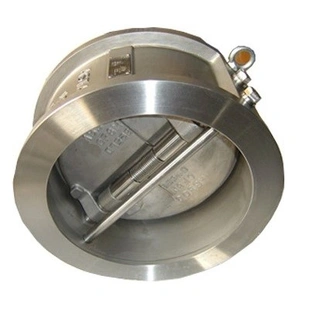
1. Basic Structure of Dual-Plate Check Valve
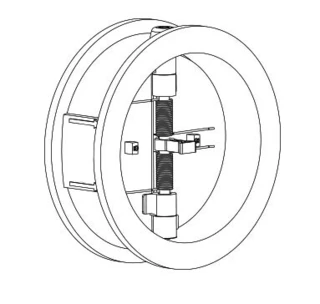
The dual-plate check valve consists of two semi-circular discs connected by a central hinge, forming a butterfly-like structure. A spring mechanism on the back of each disc provides additional closure force. This design results in a more compact valve with a thinner profile than a single-plate valve.
Valve body materials include cast iron, ductile iron, carbon steel (WCB), and stainless steel 304 and 316, allowing adaptation to different corrosive environments and pressure-temperature conditions.
2. Working Mechanism of Dual-Plate Check Valve
During forward flow, pressure forces the two semi-circular discs to swing open around the central hinge, allowing fluid to pass through the middle. When flow decreases, stops, or reverses, the spring mechanism quickly pulls the discs back to the closed position, assisted by the reverse pressure.
The spring-assisted closure is the core feature of dual-plate check valves. The preloaded spring is precisely calculated to allow smooth opening during normal flow while providing rapid closure the instant flow ceases, significantly reducing closure time.
3. Performance Characteristics of Dual-Plate Check Valve
- Superior Flow Performance: When fully open, the dual discs allow fluid to flow through the central gap with minimal obstruction, reducing pressure drop significantly compared to single-plate valves. This low-resistance feature lowers energy consumption and reduces pumping costs.
- Rapid Response: The spring-assisted closure enables disc movement within milliseconds, far faster than single-plate valves. This rapid response effectively reduces water hammer, protecting downstream pipelines and equipment from pressure shocks.
- Compact Design: The dual-plate design significantly reduces axial dimensions, creating a flatter valve profile suitable for installation in space-limited areas, such as equipment rooms, ship compartments, or offshore platforms.
- Balanced Load: The symmetrical disc arrangement balances fluid forces, reducing uneven wear and extending valve service life while improving operational stability.
Water Hammer Control: Quick closure fundamentally reduces both the likelihood and intensity of water hammer, which is particularly critical for high-pressure pumping systems and long-distance pipelines.
Core Differences Between Single and Dual-Plate Check Valves
- Structural Differences: Single-plate valves are simple, with fewer components, and maintenance focuses on the hinge and seal. Dual-plate valves are more complex, incorporating springs and dual hinges, but their symmetrical design distributes forces evenly.
- Flow Efficiency: Single-plate valves partially block the flow, resulting in higher resistance and a pressure drop 1.5 to 2 times greater than dual-plate valves. In large systems, this difference translates into significant energy costs. Dual-plate valves, with nearly full-bore flow paths, provide smoother flow and long-term energy savings.
- Water Hammer Control: Water hammer arises from rapid valve closure or sudden pump stoppage, creating pressure shockwaves that can damage pipelines, valves, and equipment. Single-plate valves close more slowly, sometimes fluttering during sudden flow changes, which can exacerbate water hammer. Dual-plate valves close quickly, effectively suppressing water hammer and improving system safety.
- Installation Space: Single-plate valves require swing space for the disc, while dual-plate valves are thinner and more compact, making them ideal for retrofits or new installations in restricted spaces.
- Service Life: Single-plate valves perform well under moderate conditions, but in high-pressure or pulsating flow, disc vibration can shorten lifespan. Dual-plate valves, with balanced force distribution, lower wear, and rapid closure minimizing water hammer, often have longer service life under demanding conditions.
- Lifecycle Cost: Single-plate valves have lower initial costs but higher energy consumption and potentially more frequent maintenance under high differential pressure. Dual-plate valves have higher upfront investment but deliver savings through reduced energy consumption, fewer failures, and lower maintenance, typically offsetting the cost difference within two to three years.
Suitable Applications for Single-Plate Check Valves
Single-plate check valves are best suited for:
- Low-pressure water systems: Municipal water supply, building drainage, irrigation systems with moderate pressure and flow.
- Cost-sensitive projects: Small-scale projects, temporary installations, or non-critical pipelines.
- Spacious installation environments: Horizontal pipelines with ample maintenance space.
- Clean fluid conditions: Fluids with minimal particulate content to prevent seal damage or blockage.
- Water-hammer-insensitive systems: Short-distance piping, small-diameter lines, or systems with downstream buffering.
Typical applications include HVAC hot and cold water circulation, fire protection networks, general industrial utility pipelines, and small water treatment systems.
Suitable Applications for Dual-Plate Check Valves
Dual-plate check valves are better suited for:
- High-pressure, high-flow systems: Petrochemical pipelines, power plant boiler feedwater, long-distance oil and gas transport.
- Water hammer-sensitive locations: Pump and compressor outlets, vertical lift lines.
- Space-constrained environments: Ships, offshore platforms, compact equipment units, underground tunnels.
- Energy-efficient projects: Large continuous-operation systems, where low pressure drop significantly reduces energy costs.
- Pulsating or frequent start-stop operations: Rapid response ensures system stability.
Typical applications include oil and gas extraction and transport, thermal and nuclear power plants, chemical processing units, ship ballast and bilge systems, mining dewatering and ore processing, and high-pressure pump protection.
Valve Selection Process
When selecting a check valve, follow these steps:
- Identify fluid characteristics: Consider type (liquid, gas, slurry), temperature, corrosiveness, and viscosity. Corrosive fluids require stainless steel or special alloys; particulate-laden fluids may need hardened seals.
- Determine operating parameters: Assess working pressure, temperature, maximum flow, normal flow, and pressure fluctuation. High differential pressure favors dual-plate design.
- Evaluate installation conditions: Measure available space, pipeline orientation (horizontal or vertical), and flange compatibility (ASME, DIN, JIS, etc.).
- Analyze operational requirements: Consider water hammer sensitivity, start-stop frequency, energy-saving goals, and maintenance capability.
- Compare lifecycle costs: Evaluate not only initial procurement cost but also energy consumption, maintenance, and downtime.
- Confirm compliance with standards: Ensure valves meet project-specific industry standards such as API 594, API 6D, BS EN 593, ASME B16.34.
Conclusion
Single-plate and dual-plate check valves each have unique advantages and suitable applications. Single-plate valves are cost-effective, simple, and easy to maintain, making them competitive in low-pressure, low-budget, and spacious installations. Dual-plate valves offer higher flow efficiency, rapid response, superior water hammer control, and a compact design, making them the preferred choice for high-pressure, energy-efficient, and space-limited applications.
Selection should not be based solely on price. Consider fluid characteristics, operating parameters, installation constraints, operational requirements, and lifecycle costs. For new projects, dual-plate valves often provide better long-term economic benefits; for retrofits or budget-limited scenarios, single-plate valves remain viable.
Regardless of type, proper material selection, correct installation, and diligent maintenance are crucial for reliable operation and extended service life. With increasing industrial energy-efficiency demands and compact equipment trends, dual-plate check valves are increasingly preferred, though single-plate valves continue to maintain a market presence in specific sectors. Understanding the fundamental differences between these two designs and selecting valves based on actual needs ensures safe, efficient, and cost-effective operation of piping systems.
Send your message to this supplier
Related Articles from the Supplier
Single Disc Gate Valve vs. Double Disc Gate Valve
- Jan 26, 2026
Related Articles from China Manufacturers
Comparing Single Plate and Dual Plate Check Valves
- Apr 12, 2024


Single Axis Robot
- Sep 27, 2021

Single-Channel Pipettes and Multi-Channel Pipettes
- Mar 19, 2024
Related Products Mentioned in the Article

Zhejiang Kosen Valve Co., Ltd.
- https://www.kosenvalve.com/
- Business Type: Industry & Trading, Manufacturer,
Supplier Website
Source: https://www.kosenvalve.com/media-hub/single-plate-check-valves-vs-dual-plate-check-valves.html