
Pinch Valves vs. Diaphragm Valves: Soft-Sealed Valve Comparison
In industrial process control, valves are the core equipment for regulating medium flow and pressure. Whether in chemical production, mining processing, or water treatment systems, valve selection directly affects system operational efficiency, maintenance costs, and service life. Among various valve types, pinch valves and diaphragm valves, as two mainstream soft-sealed valves, are frequently compared by engineers due to their unique sealing principles and applicable scenarios. This article provides an in-depth analysis of the differences between these two valve types across working principle, structural features, performance comparison, application scenarios, and maintenance costs, to help you make the optimal choice according to actual working conditions.
What Is a Pinch Valve?
As a widely applied soft-sealed valve in the industrial field, the pinch valve demonstrates significant advantages under specific working conditions thanks to its unique structural design and reliable performance. The following will analyze its technical features from three dimensions: working principle, structural characteristics, and core advantages.
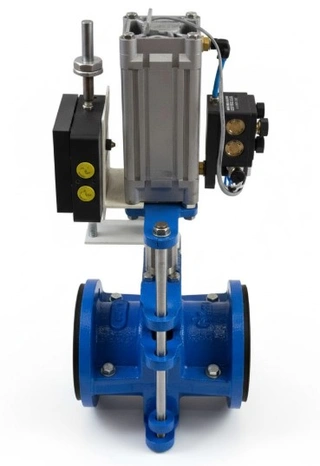
1. Pinch Valve Working Principle
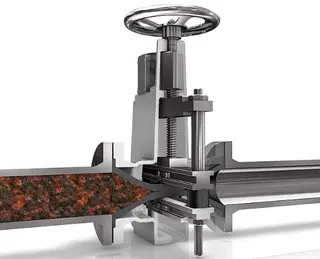
The core working principle of a pinch valve is very simple and intuitive: by applying compressed air or mechanical force into the valve body, the internal rubber sleeve is pinched and deformed, thereby controlling the flow of the medium.
- Open state: The sleeve maintains its natural shape, the internal passage is completely open, and the medium can flow freely.
- Closed state: External pressure pinches the sleeve, gradually narrowing the passage until the medium flow is completely blocked.
This pinching mechanism allows the pinch valve to achieve 100% tight sealing, with the medium always confined inside the rubber sleeve and fully isolated from the metal parts of the valve body.
2. Pinch Valve Structural Features
The valve body material of a pinch valve is flexible and can be made of cast iron, aluminum, stainless steel, or engineering plastics. The internal core component is the rubber sleeve, which is the only flow-contacting part and wear-prone component. According to different operational requirements, pinch valves can be designed in multiple forms:
- Pressure-relief type: Suitable for situations requiring rapid pressure release
- Manual type: Operated by handwheel or lever, suitable for simple conditions
- Normally closed type: Automatically closes when air is lost, providing safety assurance
- High-performance type: Suitable for high-pressure, high-temperature, or extreme working conditions
In terms of size range, pinch valves cover diameters from 25 mm to 1200 mm, equivalent to 1 inch to 48 inches, capable of meeting the needs of small equipment to large industrial pipelines.
3. Major Advantages of Pinch Valve
The popularity of pinch valves in certain fields stems from their unique technical advantages:
- Full-bore design: When fully open, the sleeve returns to its natural state, and the flow channel is nearly unobstructed, resulting in minimal pressure drop. This design is particularly suitable for high-flow requirements and maximizes system throughput.
- Non-clogging characteristic: Pinch valves perform excellently when handling complex media. Due to the smooth and simple internal flow path, media containing particles, fibers, or high viscosity can pass smoothly without clogging.
- Complete isolation design: The medium contacts only the rubber sleeve, fully isolated from the valve body metal parts. This not only prevents leakage risks but also avoids corrosion of the valve body by corrosive media, significantly extending the overall valve lifespan.
- Rapid closure capability: Pinch valves perform well under emergency conditions. The closure action is fast, capable of completely cutting off medium flow in a short time.
- Easy maintenance: The only wear-prone component is the rubber sleeve. Replacement does not require disassembling the valve body, making the process simple and fast, greatly reducing maintenance costs and downtime.
Diaphragm Valve Basics
Diaphragm valves, like pinch valves, belong to the category of soft-sealed valves but differ significantly in design philosophy and application focus. They achieve medium isolation and flow control through a flexible diaphragm and play an important role in precise control and sanitary applications. The following section explains them from three aspects: working principle, structural classification, and core advantages.
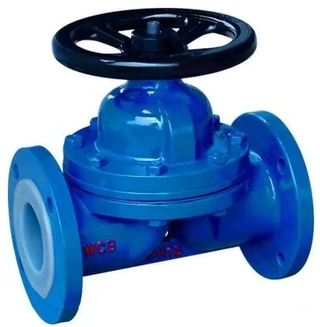
1. Diaphragm Valve Working Principle
Diaphragm valves use a vertical spring mechanism as the core driving component. Operators adjust the spring position via a handle or handwheel, moving the flexible diaphragm up and down to control medium flow.
- Open state: The diaphragm is lifted from the flow path, allowing smooth medium passage
- Regulating state: The diaphragm partially presses down, adjusting the opening to meet different flow requirements
- Closed state: The diaphragm tightly contacts the sealing surface at the bottom of the valve body, blocking medium flow
The diaphragm acts as a barrier between the flow path and the valve body, both providing a sealing function and completely isolating the medium from the upper valve mechanism.
2. Diaphragm Valve Structural Classification
Diaphragm valves are mainly divided into two structural types:
- Weir type: The flow path is designed with a raised weir structure, using a relatively flat rubber diaphragm with a short stroke. Suitable for general process applications in chemical plants, water treatment, and ships. Offers high flow control accuracy but relatively limited flow capacity.
- Straight-through type: Uses a semi-full-bore design with relatively low flow resistance. Employs a convex rubber diaphragm pressing down to regulate flow. Commonly used in mining or other high-flow applications. Compared to the weir type, it provides better flow performance, but still less than pinch valves.
3. Diaphragm Valve Core Advantages
Diaphragm valves also have irreplaceable advantages in industrial applications:
- Precise flow control: Fine adjustment via handwheel or actuator allows accurate flow control, especially suitable for processes with strict parameters.
- Reliable sealing performance: The seal between the diaphragm and valve body is well-designed; in the closed state, it provides reliable sealing to prevent leakage.
- Fail-safe design: Can be configured to fail open or fail closed, automatically entering a preset safe state in the event of air supply interruption, avoiding operational risks.
- Automation integration: Easily integrated with pneumatic or electric actuators for remote and automated operation, reducing manual intervention.
- Online maintenance: Some designs allow maintenance without interrupting system operation, reducing downtime losses.
Performance Comparison
After understanding the basic structure and characteristics of the two valves, the key question is: how to determine which valve is more suitable for specific working conditions? This section compares pinch valves and diaphragm valves across five dimensions: flow performance, sealing effectiveness, wear resistance, maintenance cost, and pressure-temperature suitability, providing an objective basis for selection decisions.
1. Flow Performance Comparison
Pinch valves have obvious advantages in flow performance. Their full-bore design ensures an unobstructed flow path with minimal pressure drop, close to that of the pipeline itself, maximizing system throughput, with smooth flow and low turbulence.
In contrast, diaphragm valves adopt weir or semi-full-bore designs, with partial obstruction, moderate pressure drop, and localized resistance. Their flow capacity is 20–30% lower than pinch valves. In high-flow conditions, velocity decreases and local flow disturbances may occur.
Pinch valves excel in high-flow scenarios, especially suitable for rapid slurry discharge while maintaining system pressure. Diaphragm valves, limited by structure, are more suitable where high precision is required but total flow volume is moderate.
2. Sealing Performance Comparison
Both valve types achieve reliable sealing but via different mechanisms:
Pinch valves: Seal completely via sleeve closure, with fast shut-off and 100% tight sealing. The elastic sleeve tolerates small particles without damaging the sealing surface.
Diaphragm valves: Seal by pressing the diaphragm against the valve body seat. Sealing is stable and reliable, but during closure, the medium does not stop instantly; it takes time to fully block flow. This is because the medium can form retention zones around the diaphragm, causing a slight delay in closure and affecting instantaneous sealing.
3. Wear Resistance and Service Life
Differences are notable when handling abrasive media:
Pinch valves: Rubber sleeves have good wear and damage resistance, typically lasting 12–24 months in abrasive media. Sleeve replacement is simple and low-cost, providing stable performance in harsh environments.
Diaphragm valves: Diaphragms wear faster, requiring more frequent inspection and maintenance. If the valve body lining or unlined parts wear, the entire valve may need replacement, increasing maintenance cost. Under normal conditions, high-quality diaphragm valves still offer a reasonable service life.
4. Maintenance Cost Comparison
Maintenance convenience is a critical industrial metric:
Pinch valves: Only the rubber sleeve needs replacement; spare part cost is low, replacement is simple, no valve body disassembly is needed, labor cost is low, and downtime is short. Usually, maintaining sleeve inventory is sufficient.
Diaphragm valves: Diaphragm replacement requires valve body disassembly; if the valve body is worn internally, repair cost rises significantly. Labor and material costs are higher, and maintenance cycles are more frequent.
5. Pressure and Temperature Suitability
- Pressure: Standard pinch valves ~10 bar, special types >25 bar; diaphragm valves usually 16 bar, some only 5 bar. Pinch valves have clear advantages in high-pressure, large-diameter applications.
- Temperature: Pinch valves up to ~120°C, limited by sleeve material; diaphragm valves up to 175°C, showing better temperature adaptability.
- Size range: Pinch valves (flanged) 1–48 inches; diaphragm valves (threaded) 3/8–3 inches, (flanged) 1/2–14 inches. Pinch valves offer more options for large-diameter applications.
Situations Favoring Pinch Valve Selection
Based on the above comparison, the following conditions suggest prioritizing pinch valves:
- Abrasive media: Mining slurry, sand, high-concentration slurries—rubber sleeve shows excellent wear resistance and low replacement cost.
- Particle- or fiber-laden media: Wastewater treatment, pulp transport, food processing—full-bore design prevents clogging, smooth flow, and low maintenance.
- High-viscosity media: Asphalt, heavy oil, chemical slurries—the large sleeve opening allows viscous media to pass without jamming.
- Rapid shut-off needs: Emergency discharge, safety isolation—the fast closure ensures timely medium cut-off.
- Large-diameter, high-flow requirements: Especially above 4 inches, and large sizes above 14 inches, pinch valves are more economical and performant.
- Budget-sensitive and limited maintenance capability: Low initial cost and simple maintenance suit limited technical resources.
Situations Favoring Diaphragm Valve Selection
The following conditions suggest prioritizing diaphragm valves:
- Precise flow control: Chemical dosing, pharmaceutical production, laboratory systems—the control accuracy of diaphragm valves is unmatched by pinch valves.
- Strict sanitary requirements: Food, pharma, biotech—diaphragm valves are easy to clean, dead-zone free, and compliant with hygiene standards.
- High-temperature applications: Above 120°C—diaphragm valve materials provide better temperature adaptability.
- High automation integration: Remote control or automatic adjustment—standardized design simplifies integration.
- Strict fail-safe requirements: Systems must automatically enter safe state on air or power loss—fail-safe design ensures reliable protection.
- Corrosive media requiring precise control: PTFE-lined diaphragm valves can handle strong corrosives while providing accurate flow adjustment, which pinch valves cannot achieve simultaneously.
Selection Decision Framework
For systematic valve selection, it is recommended to follow these steps:
- Clarify medium properties: Determine abrasiveness, particle content and size, viscosity, corrosiveness, and required anti-corrosion materials.
- Determine process requirements: Maximum, normal, and minimum flow; control precision; response speed; operating pressure and temperature.
- Assess system constraints: Pipe size; automation requirements; safety design (fail-safe); maintenance resource capability and spare part availability.
- Economic analysis: Initial investment; operating and maintenance costs; downtime losses; total lifecycle cost considering all factors.
Conclusion
As two important soft-sealed valves, pinch and diaphragm valves each have unique advantages and application scenarios. Pinch valves, with full-bore design, non-clogging characteristics, rapid closure, and low maintenance costs, excel in handling abrasive, particle-laden, or high-viscosity media, particularly in large-diameter, high-flow industrial applications. Diaphragm valves, with precise flow control, reliable sealing, good temperature adaptability, and ease of automation, dominate applications requiring precision and sanitary standards.
In practice, there is no absolutely “better” valve, only a more suitable one. Engineers should select the valve type based on medium properties, process requirements, system constraints, and economic considerations. For diameters above 4 inches, or handling high-concentration slurries or highly abrasive media, pinch valves are usually the optimal choice. For precise control, high-temperature applications, or sanitary requirements, diaphragm valves are preferred.
Regardless of the valve chosen, correct installation, standardized operation, and regular maintenance are key to ensuring long-term stable performance. Users are advised to communicate fully with valve suppliers before procurement to obtain professional guidance for specific working conditions, achieving the best cost-performance ratio and system reliability.
Send your message to this supplier
Related Articles from the Supplier

Pinch Valve Selection Guide: What You Should Know
- Jul 16, 2026
Related Articles from China Manufacturers
Pinch Valve Advantages & Disadvantages
- Jul 04, 2017
JONLOO Pinch Valve Sleeves
- Sep 30, 2019
How Pinch Valve Works
- Mar 09, 2021
Austrian Liner Pinch Valve
- Mar 02, 2017
Related Products Mentioned in the Article

Zhejiang Kosen Valve Co., Ltd.
- https://www.kosenvalve.com/
- Business Type: Industry & Trading, Manufacturer,
Supplier Website
Source: https://www.kosenvalve.com/media-hub/pinch-valves-vs-diaphragm-valves-soft-sealed-valve-comparison.html