
Double Eccentric vs. Triple Eccentric Butterfly Valves
In industrial piping systems, butterfly valves are important fluid control devices widely used in various industries. With the continuous development of technology, the structural design of butterfly valves has been continuously optimized, evolving from the original concentric butterfly valve to the double eccentric butterfly valve and the triple eccentric butterfly valve. These two eccentric-structure butterfly valves each have distinct performance characteristics and are suitable for different operating conditions. This article introduces in detail the structural principles, performance features, application scenarios, and selection recommendations of double eccentric and triple eccentric butterfly valves, helping engineering and technical personnel better understand and select appropriate valve types.
What Is a Double Eccentric Butterfly Valve?
In the field of industrial valves, butterfly valves have become indispensable key equipment in fluid control systems due to their simple structure, compact size, light weight, and convenient operation. With the continuous progress of industrial technology, traditional concentric butterfly valves have become difficult to meet the needs of complex working conditions, and the double eccentric butterfly valve emerged accordingly. As a representative of high-performance butterfly valves, the double eccentric butterfly valve achieves significant improvements in sealing performance, service life, and scope of application through its unique eccentric structural design, and is widely used in various industrial piping systems.
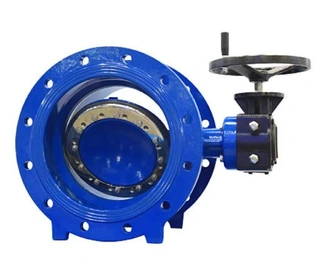
1. Basic Concept of the Double Eccentric Structure
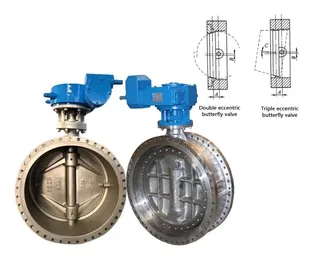
A double eccentric butterfly valve, also known as a high-performance butterfly valve, features a “double eccentric” design. The so-called double eccentricity means that the valve stem axis deviates from two reference positions.
The first eccentricity refers to the valve stem axis being offset from the center of the sealing surface, that is, the valve stem axis is located behind the butterfly plate surface. This design allows both the butterfly plate and the valve seat contact surfaces to act as sealing surfaces, fundamentally overcoming the inherent shortcomings of the concentric butterfly valve and eliminating the possibility of internal leakage at the upper and lower intersection points between the valve stem axis and the sealing valve seat.
The second eccentricity refers to the lateral offset between the center of the valve body flow passage and the valve stem axis. In other words, the valve stem axis divides the butterfly plate into two unequal parts. This eccentric design enables the butterfly plate to quickly disengage from or approach the valve seat during the opening and closing process, effectively reducing travel friction between the butterfly plate and the sealing valve seat.
2. Double Eccentric Butterfly Valve Sealing Principle
The outer ring of the butterfly plate and the sealing valve seat of the double eccentric butterfly valve are usually machined into spherical surfaces. Sealing is achieved by relying on the elastic deformation generated when the outer spherical surface of the butterfly plate compresses the inner spherical surface of the sealing valve seat.
In terms of material selection, the valve seat of the double eccentric butterfly valve is usually made of polytetrafluoroethylene (PTFE), which has excellent corrosion resistance and can effectively resist the erosion of various chemical media.
To expand its application in high-temperature environments, the double eccentric butterfly valve can also adopt a metal sealing valve seat. The use of a metal sealing valve seat enables the valve to adapt to higher working temperatures and meet the needs of special operating conditions.
3. Double Eccentric Butterfly Valve Performance Advantages
The double eccentric design brings significant performance improvements. During opening, the butterfly plate can quickly disengage from the valve seat, greatly reducing unnecessary excessive extrusion and scraping between the butterfly plate and the valve seat. This reduces opening resistance and wear, effectively extending the service life of the valve seat.
Because the scraping phenomenon is significantly reduced, the double eccentric butterfly valve can use a metal valve seat, which improves its application performance in high-temperature environments. Compared with the concentric butterfly valve, the double eccentric butterfly valve can withstand higher pressure, with an ANSI pressure rating up to Class 600. The double eccentric valve disc can withstand pressures up to 1,480 psi (10 MPa).
In terms of operating performance, due to the eccentric geometric structure, the valve plate only produces contact friction with the valve seat within a range of 1° to 3° during the 90° rotation process. The double offset structure of the valve plate and valve shaft forms a cam effect in the valve seat, reducing the torque required for operation and making control more efficient.
4. Double Eccentric Butterfly Valve Application Limitations
Although the double eccentric butterfly valve has many advantages, it also has certain limitations. For double eccentric butterfly valves using metal sealing valve seats, the sealing surfaces of the butterfly plate and valve seat are in line contact, and the sealing belongs to a position sealing structure. This structure cannot withstand high pressure. If used under high-pressure conditions, it will produce a large amount of leakage.
Therefore, in high-pressure environments or systems requiring tight shut-off, it is not recommended to use double eccentric butterfly valves with metal sealing valve seats. In addition, since sealing depends on compression and contact, this structure is relatively sensitive to alignment and is not suitable for extremely high-pressure shut-off occasions requiring metal-to-metal sealing.
5. Main Applications of Double Eccentric Butterfly Valve
Double eccentric butterfly valves are widely used in drainage, sewage treatment, construction, petroleum, chemical industry, textile, papermaking, hydropower, metallurgy, and energy industries. They are particularly suitable for HVAC systems, pulp and paper, and chemical processing medium-pressure systems. In operating conditions involving high pressure and particulate media, double eccentric butterfly valves perform particularly well.
Learn about Triple Eccentric Butterfly Valve
Although the double eccentric butterfly valve significantly improves performance compared with the concentric butterfly valve, under extreme working conditions such as high pressure and high temperature, the limitations of its sealing structure gradually become apparent. To further break through these technical bottlenecks, engineers developed the triple eccentric butterfly valve by introducing a third eccentricity. This innovation fundamentally changes the sealing mechanism, realizes metal hard sealing and zero leakage, and elevates the application performance of butterfly valves to a new level, making them ideal for harsh working conditions.
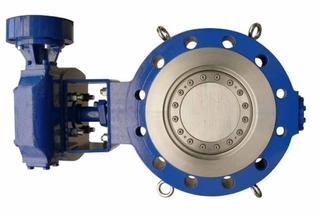
1. Innovative Triple Eccentric Structure
The triple eccentric butterfly valve is further optimized on the basis of the double eccentric structure by adding a third eccentricity. In addition to the two shaft offsets of the double eccentric butterfly valve, the third offset is reflected in the geometric shape of the sealing surface.
Specifically, the third eccentricity introduces an angular offset, so that the sealing surface presents an inclined conical shape. The outer side of the butterfly plate periphery is machined into an outer inclined conical surface, and the inner side of the sealing valve seat is machined into an inner inclined conical surface. After this design, the sealing cross-section changes from circular to elliptical, and the sealing surface of the butterfly plate becomes asymmetrical.
One side is parallel to the body centerline, while the other side is inclined to the body centerline. Since the sealing surface is inclined and divided by the valve stem axis into a relatively larger side and a smaller side, the larger side of the butterfly plate presses upward against the valve seat along a large inclined curved surface, while the smaller side presses downward along a smaller inclined curved surface.
2. Triple Eccentric Butterfly Valve Sealing Mechanism
The sealing mechanism of the triple eccentric butterfly valve is fundamentally different from that of the double eccentric butterfly valve. The sealing between the butterfly plate sealing ring and the valve seat does not rely on elastic deformation of the valve seat but completely relies on compression of the contact surfaces.
This design makes the opening and closing process basically frictionless, and as the closing pressure increases, the sealing becomes tighter. Triple eccentric butterfly valves usually use metal hard sealing valve seats to solve high-temperature resistance issues.
A multilayer sealing ring composed of alternating thin stainless steel sheets and graphite sheets is embedded around the butterfly plate periphery. This sealing structure combines the advantages of metal hard sealing and elastic soft sealing, solving leakage problems while ensuring reliable sealing performance.
3. Triple Eccentric Butterfly Valve Performance Advantages
The triple eccentric butterfly valve has excellent sealing performance and can achieve zero leakage, improving system reliability. It has low friction resistance, flexible opening and closing, and lower operating torque than other metal sealing valves, making it easier to achieve automated control.
In terms of service life, the triple eccentric butterfly valve can withstand repeated opening and closing operations and has a long service life. Its pressure-bearing and high-temperature resistance capabilities are strong, with a wide scope of application. The metal-to-metal sealing design makes it very suitable for high-temperature steam, gas, and high-pressure applications, and it can achieve zero leakage even in extreme environments.
4. Triple Eccentric Butterfly Valve Material Selection
There is a wide range of sealing material options for triple eccentric butterfly valves, enabling them to cope with high and low temperatures and various corrosive media such as acids and alkalis. Hard sealing materials are more suitable for high-temperature environments, while soft sealing materials are more suitable for achieving zero leakage. This flexibility allows the triple eccentric butterfly valve to adapt to more complex and variable working conditions.
5. Triple Eccentric Butterfly Valve Applications
Triple eccentric butterfly valves are particularly suitable for manufacturing large-diameter valves. When used as shut-off valves, they can replace gate valves and ball valves; when used for flow regulation, they can replace bulky globe valves. This has important application value in large pipeline systems and can effectively reduce system costs and installation space.
Comparative Analysis
Double eccentric and triple eccentric butterfly valves differ significantly in design philosophy and functional positioning.
- Structural Complexity: Double eccentric butterfly valves have two offsets, relatively simple structures, and lower manufacturing costs. Triple eccentric butterfly valves add angular eccentricity, resulting in more complex sealing geometry and higher manufacturing requirements, leading to higher costs but superior performance.
- Sealing Performance: Double eccentric butterfly valves use a position sealing structure with line contact sealing surfaces and rely on extrusion for sealing, making them unsuitable for high-pressure or tight shut-off systems. Triple eccentric butterfly valves use surface sealing with inclined conical sealing surfaces and rely on compression of contact surfaces, achieving zero leakage and better sealing performance as pressure increases.
- Pressure and Temperature Resistance: Double eccentric butterfly valves have improved pressure resistance compared with concentric valves but remain limited under high-pressure conditions. Triple eccentric butterfly valves have significantly enhanced pressure-bearing capability and are suitable for high-pressure systems in oil and gas, power, and refining industries. In terms of temperature resistance, double eccentric valves can use metal seats but are still structurally limited. Triple eccentric valves maintain excellent sealing performance under high-temperature steam, superheated steam, high-temperature gas, and oil service conditions.
- Service Life and Operation: Double eccentric butterfly valves have longer service life than concentric valves but still experience sealing surface wear under demanding conditions. Triple eccentric butterfly valves are basically frictionless during operation, resulting in minimal wear and longer service life. Although the initial investment is higher, long-term operating costs are lower. In terms of operating torque, triple eccentric butterfly valves require less torque and are more suitable for automation and frequent operation.
Application Scenarios and Selection Recommendations
Double eccentric butterfly valves are suitable for medium-pressure systems below ANSI Class 600, corrosion-resistant applications such as chemical and papermaking industries, fluid control involving particulate media, HVAC systems, water supply and drainage systems, cost-sensitive projects, and working conditions where temperature and pressure are not extreme.
Triple eccentric butterfly valves are suitable for high-pressure systems exceeding ANSI Class 600, critical isolation requiring zero leakage, high-temperature environments such as high-pressure steam (above 150 PSI), superheated steam, high-temperature gases and oils, large-diameter pipeline systems, frequent operation with long service life requirements, harsh conditions in oil and gas, power, and refining industries, and extreme applications requiring metal-to-metal sealing.
When selecting between double eccentric and triple eccentric butterfly valves, factors such as working pressure, working temperature, leakage requirements, medium characteristics, valve diameter, installation space, budget constraints, life cycle cost, operating frequency, and automation requirements should be comprehensively considered.
Conclusion
Double eccentric butterfly valves and triple eccentric butterfly valves represent two important development stages of butterfly valve technology. The double eccentric butterfly valve significantly improves sealing structure and performance and is suitable for most medium-pressure and medium-temperature industrial applications with good cost performance. The triple eccentric butterfly valve achieves metal hard sealing and zero leakage through structural innovation, expanding butterfly valve applications to high-pressure, high-temperature, and extreme working conditions.
In practical engineering applications, valve selection should be based on specific operating conditions, performance requirements, and budget considerations. For general industrial applications, double eccentric butterfly valves can meet most needs; for critical applications involving high pressure, high temperature, or zero leakage requirements, triple eccentric butterfly valves are the more reliable choice.
Send your message to this supplier
Related Articles from the Supplier
What is Double Eccentric Segmented Ball Valve
- Jan 13, 2026
What are Double Block and Bleed Ball Valves?
- Dec 27, 2024
Single Disc Gate Valve vs. Double Disc Gate Valve
- Jan 26, 2026
Related Articles from China Manufacturers

Related Products Mentioned in the Article

Zhejiang Kosen Valve Co., Ltd.
- https://www.kosenvalve.com/
- Business Type: Industry & Trading, Manufacturer,
Supplier Website
Source: https://www.kosenvalve.com/media-hub/double-eccentric-vs-triple-eccentric-butterfly-valves.html