
How to Select Alternators in Diesel Generator Sets
Among all components in a diesel generator set, alternator selection is the most easily overlooked yet one of the most problematic areas. Many people focus on the brand and power of the diesel engine, assuming that as long as the engine is strong enough, power generation will not be an issue. In reality, the engine and alternator are two independent systems. The engine generates mechanical energy, while the alternator converts mechanical energy into electrical energy. If the two are mismatched, at best it results in wasted resources; at worst, it can cause alternator burnout, damage connected electrical equipment, or even lead to total failure of the power supply system.
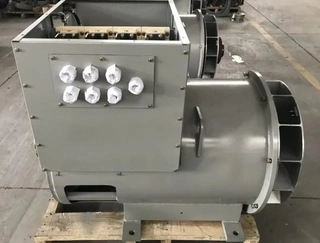
The market offers a wide variety of alternator models for diesel generator sets, with differences in voltage, design, regulator type, number of poles, terminal board configuration, and more. The core goal of selection is to find an alternator that matches the engine power, meets load requirements, complies with local grid standards, and suits the operating environment. This article will systematically review the key steps and considerations for alternator selection based on practical applications.
Confirm Four Fundamental Parameters
Before contacting any supplier or consulting any product catalog, you must first clarify four fundamental parameters. These parameters determine the basic direction of selection. If any of them are incorrectly determined, all subsequent choices may deviate.
1. Output Power Requirement
Output power is the most important parameter for selection. The alternator’s rated power must match the power of the connected engine. A commonly used rule of thumb is:
Alternator rated power ≈ Engine power × 0.8–0.9
This factor considers mechanical transmission loss and alternator efficiency loss.
Example: If the engine’s rated power is 100 kVA, the alternator should be rated between 80 kVA and 90 kVA. Selecting an alternator with much lower power than the engine will not fully utilize the engine’s output, while selecting an alternator that is too large can lead to low efficiency during long-term low-load operation, carbon buildup, and shortened lifespan.
It is also crucial to leave power reserves. It is recommended to maintain at least 20% additional capacity to handle current surges caused by motors, compressors, and other equipment during startup. The instantaneous current during startup may reach 3–7 times the normal operating current. Without sufficient margin, the alternator may trip or be damaged.
2. Voltage Rating
Voltage rating directly determines the alternator model and connection method. Common alternator voltages on the market include 230 V single-phase and 400 V three-phase. Low-voltage alternators (such as 24 V, 35 V, 48 V, 72 V) exist but are less common and more expensive, usually for special applications.
- 50 Hz systems: The most common low-voltage three-phase connection is 400/230 V three-phase with neutral.
- 60 Hz systems: Common voltages include 480/277 V, 440/254 V, 380/220 V, and 220/127 V three-phase with neutral.
Before selection, confirm the rated voltage of the electrical equipment to avoid operation failure or damage due to voltage mismatch. For replacement applications, it is ideal to provide the serial number of the original alternator. Suppliers can precisely trace the voltage characteristics of the original model using the serial number, ensuring the new alternator is fully compatible with the existing system.
3. Frequency Standard
Frequency is determined by engine speed and the number of poles. Common frequencies are 50 Hz and 60 Hz.
- 50 Hz markets: China, Europe, Africa, the Middle East, South America, Southeast Asia
- 60 Hz markets: United States, Canada, Japan, and parts of Latin America
Frequency selection must comply with the local grid standard. Using equipment with the wrong frequency may result in malfunction at best or direct damage at worst. Note that some alternators can be adjusted for frequency conversion. For example, a 2-pole alternator operating at 3000 rpm and 50 Hz can be adjusted to operate at 3600 rpm and 60 Hz. However, this adjustment requires professional operation, and selection should follow the target market’s standard frequency.
4. Phase Requirement
Single-phase power is suitable for residential and small commercial loads such as lighting, household appliances, and small power tools. Three-phase power is used for industrial equipment and high-power loads, including motors, large machinery, and factory production lines.
Before selection, confirm the phase requirements of the load. If the load is single-phase but a three-phase alternator is chosen, single-phase output can be obtained through wiring, but this will cause phase imbalance, reduce alternator efficiency, and potentially damage equipment. Conversely, if the load is three-phase, a single-phase alternator cannot provide power at all. Confirming equipment voltage and phase requirements before ordering avoids on-site rewiring and additional costs.
In-Depth Power Matching
Power matching is not simply a numerical comparison; it is a systematic engineering process that requires considering multiple factors.
1. Load Type Analysis
Different types of loads impose different demands on alternators.
- Resistive loads: (e.g., heaters, incandescent lamps) Current is in phase with voltage; power factor close to 1; relatively simple alternator requirements.
- Inductive loads: (e.g., motors, transformers, welders) Current lags voltage; power factor usually 0.7–0.9; startup generates large inrush currents.
For example, a motor rated at 10 kW may draw 5–7 times its rated current during direct startup. Without sufficient instantaneous power reserve, voltage drops during startup may prevent the motor from starting and affect other equipment on the same circuit. For such loads, besides reserving 20% extra margin, soft starters or variable frequency drives can be used to reduce alternator stress.
2. Combined Load Calculation
If the alternator supplies multiple devices simultaneously, simply summing their rated powers is insufficient. Consider diversity factors and startup sequences. For example, a construction site may have multiple welders and tower cranes, but they rarely operate at full load simultaneously.
Recommended calculation method:
List all devices that may operate simultaneously along with their rated power.
Multiply each by its usage factor.
Sum the adjusted values and multiply by a safety factor of 1.2–1.3 to determine the minimum alternator output requirement.
3. Pole Count and Connection Method
Pole Count: Most alternators are designed as 2-pole or 4-pole. 2-pole: Suited for engines at 3000 rpm; 4-pole: Suited for engines at 1500 rpm. Pole selection is dictated by engine speed because of the fixed mathematical relationship between frequency, speed, and pole count. In diesel generator sets, 1500 rpm 4-pole alternators are more common due to lower wear, reduced noise, and longer lifespan. 3000 rpm 2-pole alternators are typically used where volume and weight are strictly limited, such as mobile generator sets.
Connection Method: The alternator’s connection method determines voltage flexibility and application range.12-wire alternators: Most common and flexible; support star and delta reconfiguration, allowing a wider range of nominal voltages. 6-wire alternators: Allow star-delta reconnection but with less flexibility; suitable for single-voltage applications with no frequent adjustments.
Voltage Regulator Selection
Modern alternators are usually equipped with voltage regulators to stabilize output voltage and protect connected electronic devices.
Compound or capacitor regulators: Low precision; suitable for non-critical applications such as basic lighting or heating.
Automatic Voltage Regulators (AVR) or Digital Voltage Regulators (DSR): High precision; voltage fluctuation controlled within ±1%; suitable for computers, precision instruments, medical devices, and sensitive electronics.
For loads containing a large number of electronic devices or precision instruments, an AVR- or DSR-equipped alternator is required. Although more expensive, it prevents equipment damage and data loss due to voltage instability.
Brand and Environmental Adaptability
When selecting a brand, it is equally important to consider the environmental conditions in which the alternator will operate. Even a high-quality industrial or marine alternator can underperform or fail if it is not suited to the specific climate, altitude, humidity, or corrosive conditions of the installation site. Therefore, brand choice and environmental adaptation should be evaluated together to ensure reliable performance and longevity.
1. Brand Selection
Internationally recognized alternator brands include Stamford, Leroy-Somer, Mecc Alte, and Marathon Electric. Choice should consider application severity, after-sales support availability, and budget.
- Industrial applications: Require maximum reliability and durability; industrial-grade brands recommended.
- Marine applications: Require corrosion and moisture resistance; choose marine-treated models.
- Commercial backup: Require low noise and aesthetic considerations; choose low-noise models.
2. Environmental Adaptation
Alternators are affected by external environmental factors.
- High altitude: thinner air, reduced cooling; select derated power or improved cooling design.
- Extreme dry or humid climates: affect insulation performance; tropicalized models recommended.
- Marine environment: salt spray accelerates aging of windings and insulation; marine-treated models required.
Always provide suppliers with environmental conditions including temperature, humidity, altitude, and corrosive factors to ensure appropriate protection levels.
3. Special Considerations for Replacement
When replacing an alternator in an existing generator set, in addition to the general selection principles, the following points must be considered:
Provide the original alternator serial number – This is the most precise way to trace the characteristics of the original model and avoid mistakes caused by similar models with different parameters.
Confirm installation dimensions and interface types – Different brands may vary in base size, shaft diameter, or coupling type. Even if electrical parameters match, mechanical incompatibility may prevent installation.
Check the original alternator’s terminal board configuration – The number and arrangement of terminals may differ across models, requiring new wiring after replacement.
Verify the excitation system type – Brushed and brushless alternators use different excitation methods, and their voltage regulators are not interchangeable. Mixing types may lead to excitation failure.
Common Selection Errors and Pitfalls
Focusing only on rated power while ignoring startup current: Many users choose an alternator based on the sum of rated powers, ignoring the inrush current of motors. This can lead to overload trips or voltage collapse during actual operation. The solution is to reserve sufficient power margin or use soft starters.
Neglecting power factor: Alternator rated power is usually expressed in kVA (apparent power), while equipment power is expressed in kW (active power). The relationship is kW = kVA × power factor. For a load with a power factor of 0.8, a 100 kVA alternator can only drive an 80 kW load. When selecting, convert load kW to kVA using the power factor before comparison.
Mixing frequency and voltage standards: Attempting to use a 50 Hz alternator on a 60 Hz grid or adjusting voltage to fit a different system carries high risk and may damage equipment. Frequency and voltage are rigid selection criteria and cannot be compromised.
Ignoring environmental factors: Using an alternator selected for ordinary conditions in high-altitude, high-temperature, high-humidity, or marine environments may result in derated output, insulation aging, or corrosion damage. Environmental adaptation is a necessary part of the selection process.
Summary
Alternator selection is a systematic engineering task that involves multiple dimensions:
- Power matching
- Voltage rating
- Frequency standard
- Phase requirements
- Connection method
- Regulator precision
- Brand choice
- Environmental adaptation
Neglecting any aspect can lead to unstable operation, low efficiency, or equipment damage.
The core principle is: the alternator’s rated power must match the engine power, output parameters must match load requirements, and protection levels must suit the operating environment.
It is recommended to:
- List all technical requirements and environmental conditions in detail before selection
- Communicate fully with the supplier
- Request technical datasheets and performance curves for verification if necessary
Understanding the key points of alternator selection is the prerequisite for safe, stable, and efficient operation of diesel generator sets. Only by choosing the correct alternator can the engine’s mechanical energy be reliably converted into electrical energy, providing continuous and stable power to all connected equipment.
Send your message to this supplier
Related Articles from the Supplier
How to Select Alternators in Diesel Generator Sets
- Apr 27, 2026

How to Protect Diesel Generator Radiators?
- Mar 27, 2024
How to Reduce Wear on Diesel Generator Sets?
- Apr 08, 2024

How to Assess the Quality of Diesel Generator Sets?
- May 16, 2024
Related Articles from China Manufacturers

How to select Kids backpacks
- Jul 29, 2016

How to Select a Bag
- Dec 29, 2015

How to Select a Handle Lock for the Cabinet?
- Mar 05, 2021


How to Select Gate Valves and Globe Valves?
- Jul 12, 2017
Related Products Mentioned in the Article

Supplier Website
Source: https://genset-generator-suppliers.com/news/how-to-select-alternators-in-diesel-generator-sets.html