What is Open Die Forging: Process, Advantage & Application
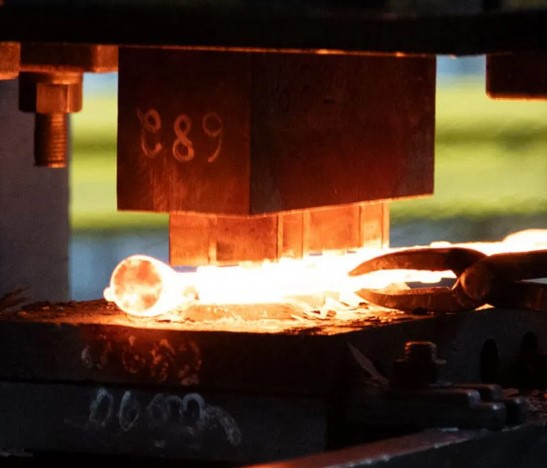
Open die forging is a metal forming process in which a heated metal billet is placed between two dies that do not fully enclose the material. Under controlled pressure, the billet is gradually shaped through repeated hammering or pressing until it reaches the desired form.
A defining characteristic of this process is that the metal can flow relatively freely during deformation, unlike closed die forging, where the material is strictly confined within a mold cavity.
The term “open die forging” originates from this very feature—the dies are open, allowing greater freedom of metal flow. Operators can flexibly control deformation through successive blows or compressions, enabling the production of a wide variety of shapes. These range from standard profiles such as square, round, rectangular, and hexagonal bars to complex components including solid shafts, hollow cylinders, sleeves, pressure vessel shells, hubs, discs, plates, and large blocks.
From a process classification perspective, open die forging belongs to hot forging. Metals are typically heated to approximately 1800°F to 2300°F (980°C to 1260°C), a temperature range that ensures sufficient plasticity without compromising the material’s internal structure. Once heated, the metal undergoes plastic deformation under forging equipment, with shaping achieved through positioning and repeated pressure application.
The open die forging process consists of five tightly integrated stages: heating, forging, cooling and heat treatment, secondary machining, and quality inspection. Each stage plays a critical role in determining the final properties of the forged component.
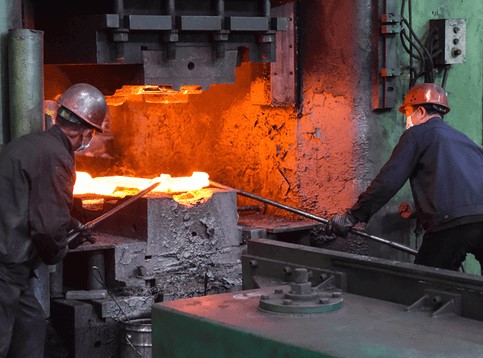
The process begins by heating the metal billet to an appropriate forging temperature. This serves two main purposes: enhancing plasticity for easier deformation and reducing deformation resistance to lower energy consumption.
Temperature control is critical at this stage. Excessively high temperatures may cause overheating or burning, degrading material properties, while insufficient temperatures can reduce ductility and increase the risk of cracking.
The heated billet is placed between open dies and shaped through repeated hammering or progressive pressing. During this stage, operators or automated systems continuously monitor dimensions, surface quality, and grain flow.
Each deformation step not only changes the external shape but also refines the internal structure. Controlled pressure causes metal grains to align along the geometry of the part, forming a continuous grain flow that significantly enhances strength.
After forging, the component undergoes controlled cooling to prevent thermal stress and cracking. This is typically followed by heat treatment processes such as quenching, tempering, or annealing.
- Quenching improves hardness and strength
- Tempering reduces brittleness and enhances toughness
- Annealing relieves internal stress and improves machinability
These treatments further optimize the mechanical properties of the forged part.
Following forging and heat treatment, components usually require machining operations such as turning, milling, and drilling to achieve precise dimensions and surface finishes.
Modern manufacturing commonly utilizes CNC machining centers to ensure high accuracy and compliance with assembly requirements.
To ensure structural integrity and traceability, critical forgings undergo comprehensive quality inspection. Non-destructive testing (NDT) is essential, including:
- Ultrasonic testing (UT): Detects internal defects such as cracks, inclusions, and porosity
- Magnetic particle testing (MT): Identifies surface and near-surface defects
Additionally, metallographic analysis verifies grain structure, while dimensional inspection ensures tolerance compliance. Full documentation is maintained throughout the process to meet quality standards such as ISO 9001.
Open die forging has remained indispensable in heavy manufacturing for over a century due to its unique technical advantages. Compared with casting and machining, it reshapes the internal structure of metals through controlled plastic deformation, delivering unmatched benefits in performance, scale, flexibility, and cost-effectiveness.
One of the most significant advantages is the substantial improvement in mechanical performance. Repeated plastic deformation compacts internal defects such as porosity and shrinkage cavities, resulting in a denser structure.
More importantly, grain flow is aligned along the shape of the component, enhancing tensile strength, fatigue resistance, and toughness.
Compared to castings, open die forgings exhibit finer and more uniform grain structures with fewer defects. Compared to machined parts, they retain continuous grain flow, whereas machining often disrupts these beneficial structures.
Open die forging is particularly well-suited for producing large and ultra-large components. Because it uses open dies, it is not constrained by mold size. Products can range from a few kilograms to over 100,000 pounds (approximately 45 tons).
Critical components such as aircraft engine shafts, wind turbine main shafts, hydraulic press columns, and turbine shafts are typically manufactured using this process.
The tooling used in open die forging is relatively simple and versatile. Changing product specifications usually requires only process adjustments rather than new molds, making it ideal for custom and small-batch production.
This flexibility also extends to material compatibility. Open die forging can process a wide range of materials, including carbon steel, alloy steel, stainless steel, tool steel, nickel-based alloys, and titanium alloys, meeting diverse performance requirements such as corrosion resistance and high-temperature strength.
Compared with casting, open die forging generates less material waste. Casting requires risers and gating systems and often involves larger machining allowances. Open die forging, through precise billet calculation and near-net shaping, minimizes material loss.
Although energy consumption may be higher, the overall cost efficiency is often better for large components when considering material and machining savings.
- Aerospace Industry: Aerospace demands extreme material performance. Key rotating components such as engine shafts, turbine discs, and compressor discs must operate reliably under high temperatures, high speeds, and high stress.These parts are typically made from superalloys or titanium alloys and rely on open die forging to achieve optimized grain structures and superior fatigue resistance.
- Energy Industry: Open die forging is widely used in energy applications, including: Steam turbine and generator rotors for thermal and nuclear power plants; Main shafts and bearing housings for wind turbines; Turbine shafts and runners for hydropower systems; In the oil and gas sector, drill collars, drill pipes, and wellhead components also depend on open die forging for reliability under high pressure and corrosive conditions.
- Heavy Machinery and Construction Equipment: This is a traditional application area for open die forging. Components such as hydraulic press columns, rolling mill rolls, crusher hammers, and excavator bucket teeth must withstand extreme impact and wear. Forged parts offer the strength and toughness required for these demanding environments.
- Transportation Industry: Typical products include ship crankshafts, rudder stocks, anchor chains, railway axles, gear blanks, and heavy truck components. These parts experience cyclic loads and require high fatigue strength, making open die forging an ideal solution.
Open die forging and closed die forging are two primary forging methods, each with distinct characteristics.
- Die Structure: Open die forging uses non-enclosing dies, allowing free metal flow; closed die forging uses enclosed cavities for higher precision.
- Applications: Open die forging is suited for large, complex, and low-volume components; closed die forging is ideal for smaller, high-volume standardized parts.
- Precision: Closed die forging offers better dimensional accuracy and surface finish; open die forging requires larger machining allowances.
- Cost: Open die forging has lower tooling costs but higher labor input, making it suitable for small batches; closed die forging has higher tooling costs but greater efficiency for mass production.
The performance of open die forgings depends not only on process design but also on strict end-to-end quality control. From raw material intake to final delivery, any lapse can introduce hidden defects and compromise reliability under extreme conditions. Therefore, a systematic quality control system—covering raw materials, process parameters, and defect prevention—is essential.
Material quality is fundamental. Steel ingots or billets must meet strict requirements for chemical composition, purity, and internal integrity to minimize defects such as inclusions and segregation.
Critical parameters include forging temperature, deformation rate, deformation ratio, and forging ratio (typically >3). Improper control can lead to overheating, insufficient deformation, or cracking.
- Porosity or insufficient consolidation: Caused by low deformation; resolved by increasing forging ratio
- Surface defects (folds, cracks): Due to improper operation or temperature control
- Segregation and inclusions: Related to raw material quality
- Delamination: Occurs in large sections; prevented through proper deformation strategies
Selecting the right supplier is critical for ensuring product quality and project success. Key factors include:
- Raw material assurance: Stable sourcing and inspection capabilities
- Technical expertise and equipment: Adequate forging capacity and experienced engineers
- Delivery reliability: Effective production planning and scheduling
- Inspection and certification: Availability of NDT equipment and ISO 9001 certification
- Industry experience: Proven track record in relevant applications
A comprehensive evaluation helps establish long-term, reliable partnerships.
As a classic metal forming process, open die forging remains indispensable in modern manufacturing. Through the coordinated application of heat, pressure, and precise process control, it transforms raw metal into high-strength, high-reliability engineering components.
For industries requiring large, high-performance parts, open die forging provides a proven and dependable solution. While technologies such as closed die forging, casting, and additive manufacturing each offer unique advantages, open die forging continues to stand out in scenarios involving ultra-large components, custom production, and extreme operating conditions.
With ongoing advancements in technology and process optimization, open die forging will continue to play a vital role in supporting critical sectors such as aerospace, energy, and heavy machinery.
