The selection of a metal casting process is a critical step in product manufacturing, as it directly affects the final product’s performance and production cost. Different process routes determine the internal density, mechanical properties, and dimensional accuracy of metal components, all of which are crucial for product reliability, service life, and market competitiveness.
The chosen process also dictates material consumption, energy usage, mold investment, and subsequent machining allowances, making it a key lever for controlling overall costs. Careful process analysis and selection during the design and production stages are essential for both technical and economic optimization, and they strategically influence a company’s overall profitability.
In industrial manufacturing, investment casting (also known as lost-wax casting) and sand casting are two of the most commonly used metal forming techniques. Understanding the differences and application scopes of these two metal casting processes helps companies make informed decisions during the product development phase.
Before diving into the specifics of each process, it is important to grasp the fundamental distinctions between investment casting and sand casting. These two methods differ significantly in terms of precision, cost, and applicable component types. A clear understanding of these differences forms the basis for making informed process choices. The following sections compare the two processes across three key dimensions.
Investment casting delivers extremely high dimensional accuracy, typically ranging from CT7 to CT9, with smooth surfaces and roughness values between Ra 1.6–6.3 μm. This process often requires little or no draft angle, making it ideal for producing complex, small-to-medium-sized components.
In contrast, sand casting has looser dimensional tolerances, generally falling within CT10–13, and surface roughness ranges from Ra 12.5–50 μm. Sand-cast parts require draft angles and parting line considerations, making this method better suited for large, relatively simple components.
Investment casting has a higher unit cost but lower subsequent machining expenses. This process is suitable for medium-to-high volume production, where mold costs can be amortized over the batch, and secondary machining requirements are minimized.
Sand casting, on the other hand, has low unit costs but higher post-processing expenses. The low mold fabrication cost makes it well-suited for small batches or single-piece production, though cleaning and machining allowances are larger.
Investment casting is ideal for producing intricate, high-precision components such as turbine rotors, medical devices, and aerospace blades. Sand casting is better suited for large structural parts such as machine tool beds, pump housings, and engine blocks.
Comparative analysis reveals that investment casting excels in precision and complexity. But how is this high level of accuracy achieved, and what are the process steps, advantages, and limitations? This section provides a detailed overview.
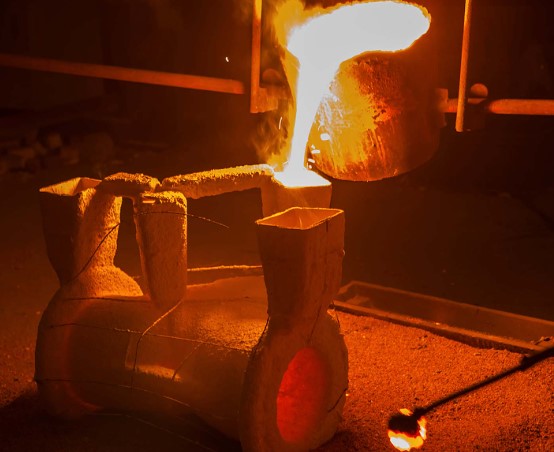
Investment casting, also known as lost-wax casting, follows these steps:
A disposable wax pattern is created.
The wax pattern is coated with a refractory material to form a ceramic shell.
The wax is melted out through heating, leaving a cavity.
Molten metal is poured into the cavity.
After the metal solidifies, the ceramic shell is broken away to retrieve the casting, which then undergoes finishing and machining.
The term “investment” derives from the English meaning of “covering or coating,” referring to the process of encasing the wax pattern in a ceramic shell.
The primary strengths of investment casting are its high dimensional accuracy and surface finish. It can produce highly intricate cavities and thin-walled structures, with wall thicknesses as low as 0.12 inches or even thinner, enabling lightweight designs.
Another advantage is broad material adaptability. Investment casting can accommodate nearly all alloys, particularly excelling in high-performance stainless steels, superalloys, and other specialized materials.
This method has become the go-to choice for manufacturing aerospace turbine blades, medical implants, and high-quality complex equipment parts.
Investment casting involves relatively high mold costs and a long upfront preparation cycle. It is mainly suitable for small to medium-weight components, typically not exceeding 200 pounds. For very large components, the process is constrained by the limitations of wax patterns and ceramic shell capacity.
Unlike investment casting, which prioritizes precision, sand casting is known for its flexibility and cost-effectiveness. As one of the oldest metal casting techniques, it has a long history and wide application. This section details the workflow, main advantages, and limitations of sand casting.
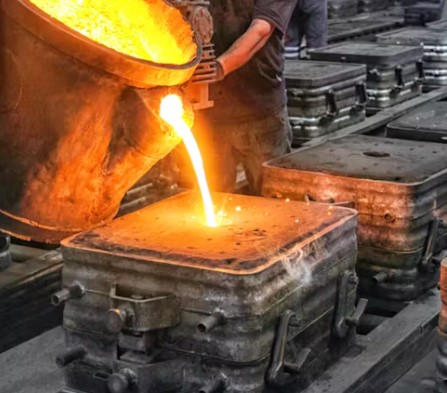
Sand casting involves creating a mold from sand packed around a pattern. The main steps include:
Filling a mold box with sand mixed with a binder to hold the pattern.
Forming the mold’s upper and lower halves around the pattern.
Adding cores to create internal cavities.
Pouring molten metal into the sand mold.
Allowing the metal to solidify, followed by cleaning and finishing operations.
The primary benefits of sand casting are low cost and flexibility. Sand molds are inexpensive and quick to make, making the process suitable for one-off or small-batch production without significant upfront investment.
Sand casting imposes minimal restrictions on component size, weight, or structural complexity. Large machine beds, engine blocks, and heavy equipment components can be cast as single units. It accommodates a wide range of materials, including cast iron, cast steel, and non-ferrous metals.
In industries such as heavy machinery, large-scale power equipment, and construction machinery, sand casting remains indispensable.
Sand casting struggles to achieve tight dimensional tolerances and results in relatively rough surfaces, often necessitating secondary machining. Thin-walled structures are prone to defects, with a minimum wall thickness typically ranging from 0.25 to 0.5 inches.
For parts requiring high precision, sand casting’s dimensional control is limited, and critical surfaces must often be machined to meet specifications.
While theoretical comparisons are useful, actual process selection depends on specific components and industry contexts. This section illustrates suitable applications by comparing pump impeller manufacturing and extending to aerospace and heavy machinery sectors.
Both sand and investment casting are commonly used for pump impellers, but their suitability varies:
Sand Casting: Suitable for very large or heavy impellers, low-volume or prototype production, and thicker-walled designs with lower precision requirements. It is cost-effective but produces rough surfaces, limits thin-wall structures, and offers lower dimensional accuracy.
Investment Casting: Ideal for medium-to-small impellers with complex geometries, such as thin blades or intricate hubs. It offers superior performance and efficiency for medium-to-high batch production. Limitations include high upfront mold costs and unsuitability for very large impellers.
In terms of size, sand casting can handle massive impellers weighing thousands of pounds, while investment casting is generally limited to small-to-medium impellers. Surface finish and accuracy: sand-cast surfaces typically range from 250–500 RMS, requiring secondary machining for critical surfaces, whereas investment-cast surfaces can achieve 125 RMS or better, with tight tolerances suitable for high-performance impellers.
Material adaptability: sand casting supports a wide variety of alloys, including cast iron, stainless steel, and nickel-based alloys, suitable for heavy components. Investment casting is also compatible with stainless steel and high-performance alloys, particularly for small, corrosion-resistant impellers.
In aerospace, investment casting is used for turbine blades, jet engine components, and other critical parts requiring extreme dimensional accuracy, surface finish, and high-temperature alloy materials.
In heavy machinery, sand casting is employed for machine tool beds, large engine blocks, and structural components of construction equipment. These components are large, relatively simple, cost-sensitive, and allow for machining allowances.
After understanding the characteristics and applications of both processes, a systematic method is needed to guide decision-making. This section outlines five key decision dimensions and a recommended workflow to help companies choose the optimal process based on product requirements.
When selecting a casting process, evaluate the following dimensions:
- Precision Requirements: High tolerances and surface finish favor investment casting; looser tolerances can be met by sand casting.
- Component Size and Weight: Large, heavy components suit sand casting; small-to-medium precision components suit investment casting.
- Structural Complexity: Complex internal cavities, thin walls, and fine geometries favor investment casting; simple, thick-walled components favor sand casting.
- Production Volume: High-volume production allows investment casting to amortize mold costs and achieve consistent quality. Low-volume or single-piece production favors sand casting to minimize upfront investment.
- Budget: Investment casting has high upfront costs but low post-processing costs; sand casting has low initial costs but higher post-processing requirements.
Define the product performance priorities. For extreme performance and complexity, prioritize investment casting. For cost-effectiveness and rapid batch production, prioritize sand casting.
Assess specific part parameters: size, weight, wall thickness, geometric complexity, and material type.
Calculate total costs, including mold investment, unit production cost, post-processing, and material utilization.
Consider production cycle and delivery requirements. Sand casting allows shorter cycles and fast response; investment casting has longer upfront preparation but higher efficiency in batch production.
Investment casting and sand casting represent two distinct technical paths. Investment casting excels in precision, surface quality, complex structure fabrication, and material compatibility. Sand casting is advantageous in cost efficiency, production speed, and flexibility for rapid response.
The final choice should be based on product priorities: whether extreme performance and complexity are sought, or if economic efficiency and rapid batch production are equally important. Sand casting dominates the heavy-component market due to its cost-effectiveness and adaptability to large sizes, while investment casting is the preferred choice for high-performance small-to-medium components with intricate geometries.
Both processes require high-temperature-resistant molds made from oxides of silicon, aluminum, magnesium, calcium, and zirconium, capable of withstanding temperatures exceeding 3,000°F while maintaining durability and shape stability.
Companies selecting a casting process should consider component complexity, size, material requirements, production volume, and budget to ensure optimal alignment between casting technology and product design goals, achieving both performance and economic efficiency.
