
Opportunities, Development and Challenges of FPV Solutions
Floating Photovoltaic Solutions Are Ready to Take Off
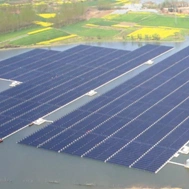
In 2007, the world's first floating photovoltaic power station was built in Aichi Prefecture, Japan.
In 2016, China successfully built its first large-scale floating photovoltaic power station on water in Huainan, Anhui Province.
In 2025, China's first floating photovoltaic project in a full seawater environment for industrial operation was completed and put into use in Qingdao.
Over the past decade, FPV solutions has evolved from being a "marginal technology" that was heavily questioned to being recognized by the market as an efficient form of photovoltaic application, taking root in lakes, reservoirs, and even coastal waters in many countries around the world. Especially in the current era where land resources are scarce and the offshore photovoltaic market is poised for growth, the floating photovoltaic market is about to embrace a significant opportunity for large-scale growth.
Guojia Dian Tou Shangyu Floating Project
Global market demand surges, and floating photovoltaics emerge as a new choice for energy transformation.
Currently, the contradiction between the rapid growth of photovoltaic (PV) installed capacity and the increasingly scarce land resources has gradually become the core bottleneck restricting the development of the industry. To break through this shackle, PV application scenarios are continuously extending to unconventional areas such as mountains, deserts, water surfaces, and oceans. Among them, the technological breakthrough and large-scale application of floating PV perfectly meet the urgent needs of current energy development.
Compared to traditional terrestrial photovoltaics, floating photovoltaic solutions have set their sights on water areas such as coal mining subsidence areas, power plant cooling ponds, wastewater treatment plant ponds, irrigation reservoirs, and fish ponds, without occupying valuable land resources. Compared to pile-based offshore photovoltaic solutions, floating photovoltaic solutions have a wider range of adaptability, are less restricted by geographical and water area conditions, and are more economical in deeper water areas. At the same time, they also have added values such as fish farming, water pollution control, and water quality improvement, making them rapidly recognized globally.
Not only that, floating photovoltaic solutions also perform impressively in terms of power generation efficiency. According to internationally recognized data, photovoltaic power generation on water is 5% to 8% higher than that on land. This is attributed to the natural cooling effect of water on photovoltaic modules. Furthermore, the floating design of floating photovoltaic solutions can shorten the distance between the panel and the water surface, providing a better cooling effect on photovoltaic modules compared to the pile-based design. This means that, with the same installed capacity, floating photovoltaic solutions can generate more clean electricity.
Crucially, the reduction in the cost of floating photovoltaic solutions in recent years has laid a solid foundation for its large-scale promotion. In the early days, due to factors such as immature technology and dependence on imported floating bodies, the cost per watt of floating photovoltaic mounting structure was as high as over 3 yuan. However, with the iterative maturity of technology, the cost per watt of the floating body anchoring mounting system has dropped below 0.5 yuan. In some areas with deeper water, its cost is even lower than that of ground power stations requiring piling, further highlighting its economic advantages.
The dual optimization of efficiency and cost has transformed floating photovoltaic (FPV) solutions from an "optional" to a "preferred" option, leading to its increasingly robust growth momentum globally. According to Wood Mackenzie's "Floating Photovoltaic Market Outlook 2024" report, the global installed capacity of floating photovoltaic solutions continues to grow and is expected to reach 77GW by 2033.
In Europe, countries such as Italy and the Netherlands have successively launched large-scale floating photovoltaic power generation projects, with a planned installed capacity exceeding 100 megawatts. The European Photovoltaic Industry Association believes that the development prospects of floating photovoltaic solutions in Europe are promising, and it is expected to become the world's second largest floating photovoltaic market.
In the Americas, Mexico, Chile, and Brazil have initiated large-scale floating photovoltaic (PV) projects. The United States has also constructed multiple floating PV projects in New Jersey, Florida, and other places. Furthermore, research conducted by the National Renewable Energy Laboratory (NREL) indicates that the floating PV power capacity of reservoirs across the United States could increase by 861GW to 1,042GW, with the potential electricity generation from floating modules on reservoirs reaching up to 1,476TWh.
In Asia, the Malaysian government has incorporated floating photovoltaics (PV) into its national energy transformation plan. Indonesia has accelerated the approval process, improved the electricity price subsidy mechanism, and encouraged foreign and local enterprises to participate in the bidding and implementation of floating PV projects. According to data from the Ministry of Energy and Mineral Resources of Indonesia, there are as many as 257 reservoirs and lakes in the country where floating PV power generation projects can be built, with a potential installed capacity of 14.7GW.
Safety, lifespan, and environmental protection. Floating photovoltaic solutions still face multiple challenges.
If market demand is the external driving force behind the development of floating photovoltaic solutions, technological innovation serves as the internal engine propelling its advancement.
Floating photovoltaic solutions, as an innovative product in the photovoltaic field, has undergone multiple upgrades and iterations of its floating system. Considerable practical experience has been accumulated in project design and construction. However, it cannot be ignored that the project development process still faces multiple challenges such as safety, weather resistance, and environmental friendliness.
Send your message to this supplier
Related Articles from the Supplier
Related Articles from China Manufacturers


Opportunities and challenges
- Dec 07, 2022
New Opportunities for Stainless Steel Valves
- May 22, 2014
New Opportunities for Stainless Steel Valves
- Sep 23, 2016
Five Clean Energy and Opportunities for Valves
- Mar 27, 2023

Related Products Mentioned in the Article

Supplier Website
Source: https://www.floatingsolarmounting.com/news/opportunities-development-and-challenges-of-fpv-solutions.html