
Working Principle and Selection Guide for Wedge Gate Valves
Wedge gate valves are among the most widely used valve types in industrial piping systems. Their primary function is to fully open or completely shut off the flow of media in a pipeline. They are designed for on–off service only and are not suitable for throttling or flow regulation. Thanks to this clear functional positioning, wedge gate valves are extensively applied in industries such as petrochemical processing, thermal power generation, municipal water supply, and wastewater treatment.
Compared with other types of gate valves, the defining feature of a wedge gate valve lies in the shape of its gate. The gate has two sealing faces set at a certain angle, forming a wedge-shaped structure. Instead of relying on simple flat-to-flat contact, sealing is achieved through a wedging action between inclined surfaces, hence the name wedge gate valve. In practical engineering applications, whether for oil transport, steam service, or high-temperature and high-pressure media, wedge gate valves are a common and reliable choice.
Sealing Principle and Operating Mechanism
The sealing performance of a wedge gate valve depends on the tight engagement between the wedge-shaped gate and the valve body seats. The gate has two sealing faces, and the valve body provides corresponding seat surfaces. When the valve is closed, the inclined faces of the gate wedge into the seats, generating sufficient contact pressure to prevent leakage.
The practical purpose of this wedge design is to increase auxiliary sealing load. By using the mechanical advantage of inclined planes, a relatively small operating force applied by the stem can generate a much higher sealing pressure. As a result, metal-seated wedge gate valves can handle high-pressure conditions while still maintaining good sealing performance at low pressures.
Operation is straightforward: rotating the stem clockwise drives the gate downward, pressing the gate sealing faces tightly against the valve body seats to achieve shutoff. Rotating the stem counterclockwise lifts the gate and opens the valve.
It is important to note that metal-seated wedge gate valves exhibit a characteristic known as single-direction forced sealing. At the inlet side, the sealing specific pressure generated by the wedging action alone is often insufficient and must be assisted by the pressure of the medium itself. As the medium pressure increases, it pushes the gate more firmly against the downstream seat, improving the sealing effect. Under low-pressure conditions, sealing mainly relies on the force applied by the stem, which presses the gate against the guide grooves and seat surfaces.
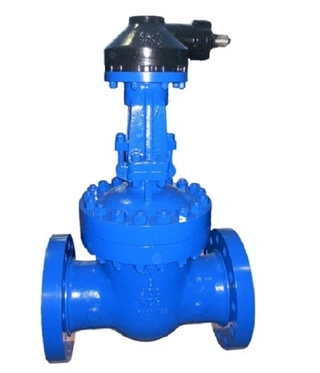
Types of Gate Structures and Their Characteristics
Depending on the gate structure, wedge gate valves are generally classified into three types: flexible wedge, solid (rigid) wedge, and double disc wedge. Each type has its own advantages, limitations, and suitable applications.
1. Flexible Wedge
A flexible wedge uses a single-piece gate design in which the two sealing faces are supported by a central cantilever structure. An annular groove is machined along the vertical center plane of the gate, allowing a certain degree of elastic deformation.
When the valve is closed, the flexible wedge undergoes slight elastic deformation. This deformation serves two purposes. First, it compensates for manufacturing tolerances and minor misalignments, allowing both sealing faces to mate fully with the seats on each side. Second, it generates sealing specific pressure to ensure reliable shutoff. Importantly, this sealing force is derived from the elastic load of the gate itself rather than directly from the wedging force applied by the stem.
Flexible wedges offer several clear advantages. The structure is relatively simple, yet sealing reliability is high. When temperature changes cause thermal expansion or contraction, or when the valve body experiences minor deformation, the elasticity of the gate can absorb these changes, reducing the risk of jamming. In addition, the machining accuracy requirements for the wedge angle are relatively moderate, keeping manufacturing costs under control.
However, certain precautions are necessary. The closing torque should not be excessive; otherwise, the elastic deformation limit of the gate may be exceeded, resulting in permanent damage. For this reason, such valves are often equipped with travel limit mechanisms. In addition, the medium should not contain excessive solid particles, as these may accumulate in the annular groove and impair the gate’s elastic performance.
Flexible wedges are suitable for small- and medium-diameter gate valves across a wide range of pressures and temperatures and represent the most widely used gate structure.
2. Solid (Rigid) Wedge
A solid wedge is a one-piece, rigid structure with no elastic deformation capability. The design is simple and robust, but it requires very high machining accuracy for the wedge half-angles of both sealing faces, making manufacturing and maintenance more demanding.
Because it lacks elastic compensation, a solid wedge cannot readily adapt to seat displacement caused by pipeline loads or thermal fluctuations. During operation, wear between the sealing surfaces is more likely to occur, and temperature changes may cause the gate to become wedged tightly in the valve body, leading to difficult or impossible opening.
Due to these limitations, solid wedges are generally used only for small valve sizes. For valves larger than DN50 (NPS 2), the use of solid wedges is typically not recommended at temperatures above 121 °C (250 °F). For valves with DN50 and below, solid wedges are often the most economical option and are suitable for relatively low-temperature and low-pressure services.
3. Double Disc Wedge
A double disc wedge consists of two independent gate discs connected by a central spherical hinge, forming an adjustable wedge structure.
The greatest advantage of this design is its self-adaptive capability. The two discs can automatically adjust their angles to match the positions of the seats on both sides. After wear occurs on the sealing faces, shims can be added at the central hinge to compensate, simplifying maintenance. When temperature changes or slight valve body distortion occurs, the independent discs can move along their respective seats without jamming or scoring the sealing surfaces.
The double disc design places relatively lower demands on machining accuracy, as the wedge angle is automatically adjusted by the central spherical hinge. However, the structure is more complex, with more components, leading to higher manufacturing costs. In addition, because the discs are movably connected, long-term operation in viscous media may cause corrosion at the hinge, potentially resulting in disc detachment if not properly managed.
This structure is commonly used in water and steam pipelines, typically in the size range of DN50 to DN600 (NPS 2 to 24). Valve body materials may include carbon steel, chrome-moly steel, stainless steel, or duplex stainless steel.
Wedge Half-Angle and Self-Locking Conditions
An important design parameter of wedge gate valves is the wedge half-angle, denoted by θ. This is the angle between each sealing face of the gate and the vertical centerline of the gate.
Two wedge half-angles are commonly used: 2°52′ and 5°. From trigonometric calculations, a half-angle of 2°52′ corresponds to a tangent value of approximately 0.05, while 5° corresponds to a tangent value of about 0.09.
The wedge half-angle has a direct impact on valve performance. A smaller angle requires less force to close the valve, making operation easier. However, if the angle is too small, pipeline deformation caused by temperature changes can increase the risk of the gate becoming jammed inside the valve body, preventing reopening.
To avoid jamming, the theoretical condition for non-self-locking must be satisfied: the friction coefficient must be less than the tangent of the wedge half-angle (f < tan θ). In practice, however, the friction coefficient of metal sealing surfaces is often greater than 0.05 or 0.09. As a result, wedge gate valves typically operate under self-locking conditions. This means that once fully closed, the gate remains tightly sealed, but sufficient force is required to reopen the valve.
Applications and Selection Recommendations
Wedge gate valves have an extremely broad range of applications. They are widely used in the power industry, oil refining, petrochemical processing, and offshore oil and gas operations. They are also commonly found in municipal water supply systems, wastewater treatment plants, and various chemical process installations.
Typical situations where wedge gate valves are selected include: applications with high sealing performance requirements; high-pressure or high differential pressure shutoff conditions; low-pressure shutoff service; requirements for low-noise operation; pipelines prone to cavitation or flashing; high-temperature media transport; and low-temperature or cryogenic environments.
Valve selection should be based on operating conditions and appropriate gate type. For high-temperature, high-pressure, and demanding services requiring long-term reliable sealing, flexible wedges or double disc wedges are preferred. For small-diameter, low-pressure, and low-temperature applications where cost efficiency is important, solid wedges can meet basic requirements. In conditions involving temperature fluctuations or potential pipeline deformation, solid wedges should be avoided in favor of flexible or double disc designs with compensation capability.
Regarding media characteristics, flexible wedges are not recommended for fluids containing a large amount of solid particles, as these may clog the annular groove. For viscous media, double disc designs should be carefully evaluated due to the potential risk of corrosion and disc detachment over long-term operation.
Installation and Operating Considerations
When installing a wedge gate valve, flow direction is critical. Because metal-seated wedge gate valves rely on single-direction forced sealing, installation should ensure that medium pressure assists sealing at the inlet side. Flow direction is usually indicated on the valve body and should be strictly followed.
During operation, attention should be paid to operating torque, especially for valves with flexible wedges, to avoid over-tightening and permanent deformation of the gate. Sealing surface wear should be inspected regularly. For double disc designs, wear can be compensated by adjusting shims at the hinge.
Valves that remain unused for long periods should be periodically operated to prevent the gate from sticking to the seats. In systems where thermal stress may occur, pipeline supports should be properly designed to avoid excessive external loads being transmitted to the valve body.
Conclusion
Thanks to their simple and reliable sealing principle, wedge gate valves have become one of the most widely used valve types in industrial piping systems. The wedge-shaped gate enhances sealing force through mechanical wedging action, allowing the valve to operate effectively over a wide pressure range, from low to high pressure.
Each of the three gate structures has its own ideal application: flexible wedges offer an excellent balance of reliability and adaptability and are the preferred choice for most industrial services; solid wedges are economical and simple, suitable for small-diameter, low-pressure conditions; double disc wedges address deformation and wear in complex operating environments, albeit at a higher cost.
A clear understanding of wedge half-angle, self-locking behavior, and single-direction forced sealing is essential for proper selection, installation, and operation of wedge gate valves. In practical engineering, the most suitable structure should be chosen based on media properties, pressure and temperature conditions, valve size, and maintenance requirements to ensure long-term safe and stable operation of the piping system.
Send your message to this supplier
Related Articles from the Supplier
Related Articles from China Manufacturers

Related Products Mentioned in the Article

Supplier Website
Source: https://www.magpievalves.com/media-hub/working-principle-and-selection-guide-for-wedge-gate-valves.html