
How PTFE Gaskets Improve Flange Sealing Efficiency
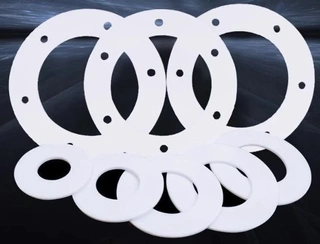
PTFE gaskets are widely used non-metallic sealing materials in industrial applications. PTFE is a synthetic polymer composed of carbon and fluorine atoms. This unique molecular structure gives the material a range of exceptional physical and chemical properties. In flange connections, one of the most outstanding characteristics of PTFE gaskets is their extremely low coefficient of friction—among the lowest of all solid materials.
This low-friction property is not the result of added lubricants or surface coatings; it is an inherent characteristic of the material itself. Within the PTFE molecule, the carbon–fluorine bonds are exceptionally strong and stable. Fluorine atoms are tightly arranged around the carbon backbone, forming a uniform protective layer. This structure makes the surface of PTFE extremely smooth, resulting in minimal friction when in contact with other materials. It is precisely this “non-stick” nature that enables PTFE gaskets to deliver distinctive performance in flange sealing applications. When used in flange assemblies, PTFE gaskets form effective seals between flanges made of metal, plastic, enamel, and other materials. In particular, when paired with stainless steel, the friction coefficient between PTFE and stainless steel is one of the lowest known among solid material combinations, allowing the flange faces to compress the gasket smoothly during installation.
How PTFE Gaskets Manage Friction in Flange Connections
The Basic Principle of Friction: In traditional flange connections, the tightening force applied to bolts must overcome several resistances before an effective seal is formed. One of the largest resistances is the friction between the gasket and the flange faces. If friction is excessive, part of the bolt load is consumed in overcoming friction rather than compressing the gasket to create a seal. This is similar to pushing a heavy object uphill—the steeper the slope, the more effort is required, leaving less force available to move the object forward. PTFE gaskets solve this problem in a straightforward way: they minimize the slope. Because the PTFE surface is extremely smooth, the resistance encountered during compression is very low. As a result, the force applied by the bolts is almost entirely converted into compressive force on the gasket, enabling an effective seal.
Efficient Energy Transfer: During actual installation, the low-friction characteristic offers significant advantages. When tightening bolts with a wrench, the input torque is converted into three main components: overcoming friction between the gasket and flange faces, compressing the gasket material itself, and generating the surface pressure required for sealing. With PTFE gaskets, very little energy is lost to friction. This means more of the applied torque is used to compress the gasket and establish sealing pressure. The direct benefit is that the same sealing performance can be achieved with lower bolt loads. Conversely, if the same bolt load is applied, PTFE gaskets can generate higher sealing pressure. This is critical in engineering practice, as excessive bolt loads often introduce additional risks and complications.
Practical Advantages of Low-Friction Performance
The low-friction property of PTFE is not merely a theoretical parameter; it translates into tangible and measurable engineering benefits. These advantages directly affect flange reliability, equipment service life, and maintenance costs.
1. Protection of Precision Flange Surfaces
Many industrial systems use precision flanges made from plastic, rubber, glass-lined enamel, or other sensitive materials. These materials are susceptible to damage under excessive mechanical stress—plastics may crack, enamel may chip, and rubber may permanently deform.
Traditional gasket materials often require high surface pressure to achieve reliable sealing, necessitating higher bolt loads. For precision flanges, such loads pose significant risks. Because PTFE gaskets seal effectively under lower compressive forces, they significantly reduce the likelihood of surface damage.
In high-value equipment such as glass-lined reactors or precision plastic piping systems, this protective capability is crucial.
2. Adaptability to Surface Imperfections
In reality, flange faces are rarely perfect. Machining marks, minor scratches, and slight surface irregularities are common in industrial settings. An ideal gasket material should adapt to these imperfections rather than demand mirror-finish surfaces.
The low-friction characteristic of PTFE enhances its flowability during compression. The gasket material can more easily deform and flow into micro-indentations and surface irregularities. Flowability and low friction complement each other—if friction were too high, material flow would be restricted. Because PTFE surfaces are smooth, the material can move freely to fill gaps and create a reliable seal.
This adaptability reduces the need for excessive bolt force or additional surface finishing.
3. Prevention of Flange Surface Damage
During operation, flange connections experience thermal expansion and contraction, pressure fluctuations, and vibration. These factors may cause slight relative movement between the flange faces and the gasket. If friction is high, this movement can result in “stick-slip” behavior—surfaces adhere and then suddenly slide apart, causing wear or damage.
PTFE's low-friction property effectively prevents this issue. Even when relative movement occurs, the gasket maintains smooth sliding contact, minimizing adhesive wear. This protects the integrity of the sealing surfaces, extends equipment life, and reduces maintenance costs.
Limitations of PTFE Gaskets and Engineering Solutions
Despite their advantages, PTFE gaskets have certain limitations that must be understood to ensure reliable performance.
1. Creep and Cold Flow
The primary weakness of PTFE is its tendency toward creep, or “cold flow,” under sustained load. Creep refers to the gradual plastic deformation of a material over time under constant mechanical stress.
In flange applications, continuous bolt compression—especially under elevated temperatures—may cause the gasket to thin and spread laterally. This deformation reduces bolt preload because as the gasket becomes thinner, bolt elongation decreases, lowering clamping force. Severe creep can even create leak paths at the gasket edges.
The problem becomes more pronounced at temperatures above 200°C, where increased molecular mobility accelerates deformation. Pure PTFE gaskets must therefore be used cautiously in high-temperature applications.
2. Filled PTFE as a Solution
To address creep, filled PTFE gaskets have been developed. These materials incorporate fillers such as glass fiber, carbon fiber, graphite powder, or silica microspheres into the PTFE matrix. The fillers create a rigid internal reinforcement network that significantly restricts material flow.
Filled PTFE offers substantially improved creep resistance while retaining most of PTFE’s excellent chemical resistance, temperature stability, and low friction. Although the addition of fillers slightly increases the friction coefficient, it remains far lower than that of traditional gasket materials.
The choice between pure and filled PTFE depends on application conditions. Pure PTFE is suitable for moderate temperatures and pressures where maximum chemical inertness and sealing performance are required. For high-temperature, high-pressure, or long-term critical service, filled PTFE provides greater reliability.
Selection Recommendations for Different Applications
Precision or uneven flange sealing: For plastic, glass-lined, or irregular flange surfaces, PTFE’s ability to seal under low compression makes it an ideal choice. Even with some creep risk, periodic maintenance can effectively manage long-term performance.
Food, pharmaceutical, and high-purity chemical applications: PTFE’s chemical inertness ensures it does not contaminate process media, while its non-stick nature allows clean removal without residue, reducing cross-contamination risks and simplifying maintenance.
High-temperature and high-pressure critical equipment: Steam systems, reactors, and other demanding environments should use filled PTFE or specialized PTFE composites to ensure sufficient mechanical strength and creep resistance.
General industrial utilities: For non-critical systems such as cooling water or low-pressure air lines, standard fiber or rubber gaskets may offer lower initial cost. However, PTFE’s longer service life and reduced maintenance often provide superior total lifecycle value.
Comprehensive Value of PTFE Gaskets
- Long-Term Reliability: PTFE gaskets typically outlast conventional materials due to their exceptional chemical resistance and broad temperature range. They remain stable when exposed to most industrial chemicals and resist degradation, swelling, or embrittlement. Longer service life reduces replacement frequency, planned downtime, and the risk of unplanned shutdowns.
- Improved Maintenance Efficiency: The non-stick nature of PTFE simplifies gasket replacement. Old gaskets can usually be removed intact without adhesion or fragmentation, and flange surfaces require minimal cleaning. Compared with rubber or fiber gaskets, this significantly reduces maintenance labor.
- Asset Protection: Flange surfaces—especially large or specialty flanges—are costly to machine and replace. Incorrect gasket selection can lead to surface damage with repair costs many times higher than the gasket itself. PTFE’s low friction fundamentally eliminates this risk, safeguarding valuable assets.
- Safety and Environmental Protection: Reliable sealing is essential for industrial safety. PTFE gaskets provide dependable containment for hazardous chemicals, high-temperature steam, and high-pressure gases, protecting personnel and preventing environmental incidents.
Conclusion
PTFE gaskets provide an efficient and reliable sealing solution for flange connections through their uniquely low friction—an intrinsic property derived from molecular structure, not surface treatment. This stability ensures long-lasting performance.
In practical applications, PTFE gaskets offer multiple advantages: effective sealing under lower bolt loads, protection of precision flange surfaces, adaptability to imperfections, prevention of surface damage during movement, excellent chemical and thermal resistance, long service life, and simplified maintenance. While creep remains a limitation, it can be effectively mitigated through filled PTFE formulations.
Selecting between pure and filled PTFE should be based on operating conditions, including media type, temperature, pressure, flange material, and criticality. For industries seeking long-term reliability, safety, and economic efficiency, PTFE gaskets represent a highly compelling sealing solution. Understanding the principles and practical implications of their low-friction behavior enables engineers to make informed decisions and choose the most suitable sealing strategy for their equipment.
Send your message to this supplier
Related Articles from the Supplier
How PTFE Gaskets Improve Flange Sealing Efficiency
- Mar 04, 2026
How to Deal with PTFE Gasket Creep?
- Nov 06, 2025
Graphite Packing vs. PTFE Packing: How to Choose?
- Oct 10, 2025
How to Select V-Port Ball Valves for Nitrate Media
- Jun 09, 2025

How to Choose the Right Valve Materials
- Jun 10, 2025
How to Select Packing Materials?
- Jun 20, 2025
Related Articles from China Manufacturers


How to Deal With Mildew
- Jul 07, 2016

How to select Kids backpacks
- Jul 29, 2016

How to Choose your Take-out Robots?
- Feb 21, 2019
How Take-out Robots Work?
- Dec 24, 2018

Related Products Mentioned in the Article

Supplier Website
Source: https://www.magpievalves.com/media-hub/how-ptfe-gaskets-improve-flange-sealing-efficiency.html