
An Introduction to Aluminum Bronze Valves
Aluminum bronze valves are a class of industrial valves manufactured using aluminum bronze alloys, where copper serves as the base metal and aluminum is the primary alloying element. Typically, the aluminum content ranges from 5% to 11%, while additional elements such as iron, nickel, manganese, and silicon are introduced to further enhance mechanical strength, corrosion resistance, and overall performance stability. This unique alloy system combines the inherent corrosion resistance of copper with the strengthening effect of aluminum, resulting in a material that performs exceptionally well in harsh and aggressive environments.
Common specifications for aluminum bronze materials include ASTM B148 C95800, while grades such as AB2 are also widely adopted in industrial applications. These alloys are comparable in performance to C95400 and C95500, offering good castability, moderate machinability, and relatively high tensile strength. When nickel is added, aluminum bronze transforms into nickel-aluminum bronze (NAB), which provides significantly improved strength, cavitation resistance, and corrosion resistance, making the aluminum bronze valves particularly suitable for extreme marine and offshore conditions.
Core Material Characteristics of Aluminum Bronze Valves
The widespread use of aluminum bronze valves across multiple industries is primarily attributed to their outstanding combination of mechanical and chemical properties. These properties enable reliable operation even in highly corrosive, high-pressure, and high-wear environments.
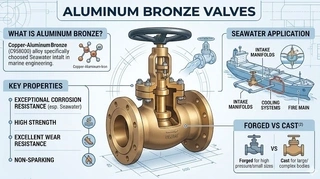
1. Excellent Corrosion Resistance
One of the most important advantages of aluminum bronze valves is their superior corrosion resistance, especially in seawater and chloride-rich environments. This resistance is achieved through the formation of a dense and adherent aluminum oxide (Al₂O₃) protective film on the surface of the material. This passive layer acts as a barrier against aggressive chemical attack and significantly slows down corrosion processes.
Unlike simple surface coatings, this oxide layer is self-repairing in oxygen-containing environments. When the surface is scratched or damaged, a new protective film quickly forms, restoring corrosion resistance. This makes aluminum bronze particularly reliable for long-term submerged applications.
For example, C95800 nickel-aluminum bronze exhibits a corrosion rate of less than 0.025 mm/year in 3.5% NaCl seawater solution, which is better than many austenitic stainless steels such as 316L. This exceptional seawater performance is one of the main reasons it is widely used in marine and offshore engineering systems.
2. High Strength and Excellent Wear Resistance
Aluminum bronze alloys offer significantly higher mechanical strength compared to conventional copper alloys such as brass. The tensile strength can exceed 600 MPa, which is approximately two to three times higher than standard brass materials.
In particular, C95800 nickel-aluminum bronze achieves a tensile strength range of 760–900 MPa in the as-cast condition, with a yield strength of around 345 MPa. Its hardness typically ranges from HB 170 to HB 240. The presence of iron promotes the formation of a κ-phase microstructure, which significantly enhances cavitation and erosion resistance—often up to 1.5 times higher than C95500.
Wear resistance is another critical advantage. With a Brinell hardness range of HB180–220, aluminum bronze performs far better than brass (HB80–100). This makes it ideal for components subjected to repeated friction, such as valve seats, stems, and moving mechanical parts.
3. Anti-Fouling and Biological Resistance
In marine environments, biological fouling is a major operational challenge. Organisms such as algae, barnacles, and mollusks tend to accumulate on submerged metal surfaces, leading to reduced efficiency and increased maintenance costs.
Aluminum bronze naturally resists biological adhesion. The copper content in the alloy plays a key role in inhibiting microbial growth and preventing marine organism attachment. This anti-fouling property helps maintain smoother flow conditions and improves long-term operational stability in seawater systems.
4. Non-Sparking Safety Performance
Aluminum bronze is classified as a non-sparking material, meaning it does not generate sparks upon impact or friction. This characteristic is extremely important in environments where flammable gases, vapors, or liquids are present.
Industries such as oil and gas, petrochemical processing, mining, and offshore drilling rely heavily on non-sparking materials to minimize ignition risks. Aluminum bronze valves therefore provide an added layer of operational safety in hazardous zones.
5. Excellent Casting, Welding, and Machining Properties
Despite its high strength, aluminum bronze maintains good manufacturability. It can be processed using various casting methods, including sand casting, centrifugal casting, continuous casting, and permanent mold casting.
C95800, in particular, is widely used for large marine castings such as propellers, pump housings, and valve bodies. In addition, aluminum bronze exhibits good weldability using standard industrial welding techniques such as Gas Tungsten Arc Welding (GTAW/TIG) and Gas Metal Arc Welding (GMAW/MIG).
This combination of performance and manufacturability makes it highly suitable for complex industrial components.
Comparison of Common Aluminum Bronze Grades
Different aluminum bronze grades are designed for different service requirements, with variations in strength, corrosion resistance, and cost.
|
Grade |
Alloy Type |
Tensile Strength |
Key Characteristics |
Typical Applications |
|
C95200 |
Aluminum Bronze |
~485 MPa |
Balanced general-purpose performance |
General seawater pumps |
|
C95400 |
Aluminum Bronze |
~586 MPa |
Higher strength and corrosion resistance |
High-pressure seawater systems |
|
C95500 |
Nickel Aluminum Bronze |
~655 MPa |
Enhanced mechanical and corrosion performance |
Offshore platforms, marine systems |
|
C95800 |
Nickel Aluminum Bronze |
~760–900 MPa |
Best marine corrosion resistance |
Naval systems, critical valves |
As nickel content and alloy complexity increase, performance improves accordingly. However, cost also increases significantly, which requires careful selection based on actual engineering requirements.
Industrial Applications of Aluminum Bronze Valves
- Marine and Offshore Engineering: Marine environments are among the most aggressive corrosion conditions for metals due to high chloride concentration and continuous exposure to seawater. Aluminum bronze valves are extensively used in such environments because of their long-term reliability.
- Oil and Gas Industry: The oil and gas sector demands materials that can withstand high pressure, corrosive fluids, and harsh environmental conditions. Aluminum bronze meets these requirements effectively in many applications.
- Chemical Processing Industry: In chemical plants, equipment is often exposed to mildly corrosive or non-oxidizing media. Aluminum bronze valves are suitable for handling acidic mine water, industrial process fluids, and certain chemical solutions.
- Power Generation and Water Treatment: In coastal power plants, seawater cooling systems are widely used due to water availability. Aluminum bronze valves are ideal for such applications because of their resistance to seawater corrosion and cavitation damage.
- Aerospace and Defense Applications: Due to strict requirements for strength, durability, and reliability, aluminum bronze is used in aerospace and defense applications where failure is not an option.
Selection Guidelines for Aluminum Bronze Valves
Proper selection of aluminum bronze valves requires careful evaluation of operating conditions and performance requirements.
1. Operating Conditions
- Pressure: Aluminum bronze valves are typically used in systems up to 2.5 MPa, although high-strength variants can handle pressures above 10 MPa in specialized applications.
- Temperature: Long-term operating temperatures generally range between 250°C and 400°C depending on alloy grade. C95800 remains stable below 400°C, but prolonged exposure to elevated temperatures may cause embrittlement.
- Medium: Aluminum bronze performs well in seawater, freshwater, oil, and air. However, it is not suitable for strong acids, strong alkalis, or sulfide-rich environments. In media containing ammonia, hydrogen sulfide, or cyanides, stress corrosion cracking may occur.
2. Grade Selection by Application
- General seawater systems: C95200
- High-pressure seawater systems: C95400
- Offshore oil & gas systems: C95500
- Naval and critical systems: C95800
- Desalination plants: C95400 or C95500 depending on chemistry
3. Cost-Performance Balance
Higher-grade alloys such as C95800 offer superior performance but come at significantly higher cost. In many engineering applications, C95200 or C95400 provides sufficient performance at a more economical price.
A full lifecycle cost analysis, including purchase cost, maintenance cost, and service life, is essential for optimal decision-making.
4. Key Engineering Considerations
- Avoid sulfide-rich environments
- Consider temperature limitations carefully
- Ensure compatibility with system materials
- Evaluate coating or protection requirements when used with steel systems
- Monitor long-term degradation in high-flow or abrasive conditions
Maintenance and Service Recommendations
Although aluminum bronze is highly corrosion-resistant, proper maintenance is still essential for long service life:
- Regular inspection for corrosion, erosion, and mechanical wear
- Removal of marine fouling and deposits
- Application of cathodic protection in seawater systems when necessary
- Use of compatible spare parts with identical material grades
- Routine inspection of seals and sealing surfaces
Comparison with Other Engineering Materials
- Aluminum Bronze Valve vs. Brass Valve: Brass is suitable for low-pressure, low-temperature applications such as municipal water and gas systems. However, aluminum bronze offers much higher strength, corrosion resistance, and temperature tolerance, making it suitable for industrial and marine environments. In chloride environments, aluminum bronze can reduce corrosion rates by more than 50% compared to brass.
- Aluminum Bronze Valve vs. Stainless Steel Valve: Stainless steels such as 316L are prone to pitting and crevice corrosion in seawater environments. Aluminum bronze, particularly C95800, often performs better in long-term seawater exposure.Even duplex stainless steels have limitations in chloride concentration and operating temperature, making aluminum bronze a competitive alternative.
- Aluminum Bronze Valve vs. Monel Alloy Valve: Monel alloys offer excellent corrosion resistance but are significantly more expensive. In many seawater applications, nickel-aluminum bronze provides a cost-effective alternative with comparable performance in low to medium pressure systems. As a result, aluminum bronze is often used as an economical substitute for Monel, duplex stainless steel, and super duplex alloys in appropriate conditions.
Conclusion
Aluminum bronze valves have established themselves as critical components in modern industrial systems due to their exceptional corrosion resistance, high mechanical strength, wear resistance, and anti-fouling properties. With grades ranging from C95200 to C95800, they provide flexible solutions for a wide variety of engineering applications, from general seawater handling to mission-critical offshore and naval systems.
Successful application depends on correct material selection based on pressure, temperature, and media conditions. Engineers must also consider lifecycle cost, maintenance requirements, and environmental compatibility when selecting the appropriate grade.
As marine engineering, offshore energy development, and desalination industries continue to expand globally, aluminum bronze valves will remain a highly valuable and cost-effective solution for corrosion-resistant industrial applications, ensuring reliability, safety, and long service life in the most demanding environments.
Send your message to this supplier
Related Articles from the Supplier
An Introduction to Aluminum Bronze Valves
- Apr 10, 2026

Related Articles from China Manufacturers
An Introduction to Cam Locks
- Jul 12, 2019

An Introduction to the Digital Two Way Radios
- May 16, 2017

An Introduction to 23mn Steel Pipe
- Aug 29, 2020
An Introduction to Coated Steel Pipes
- Jan 06, 2021
An Introduction to the Welding Neck Flange
- Jun 03, 2017
Related Products Mentioned in the Article

Supplier Website
Source: https://www.landee.cn/news/industry-news/an-introduction-to-aluminum-bronze-valves.html