Hollow Shaft Forging: Processes, Methods & Applications

Hollow Shaft Forging is a key forming process for manufacturing high-strength, lightweight shaft components. By means of plastic deformation, it effectively reduces material consumption and structural weight while maintaining load-bearing capacity. This process offers clear advantages in enhancing mechanical properties, refining microstructure, and improving material utilization. As a result, it has become one of the primary technologies for producing critical shaft components in aerospace, automotive, construction machinery, and other industries.
Hollow shaft forging is a specialized forging process used to manufacture hollow shafts. Under the combined effects of pressure and heat, metal materials undergo plastic deformation to form hollow shafts with specific shapes and performance characteristics. This process not only meets the requirements for high strength and lightweight design, but also effectively saves material and reduces production costs. Owing to their light weight, high strength, and good wear resistance, hollow shaft forgings are widely used across many industries.
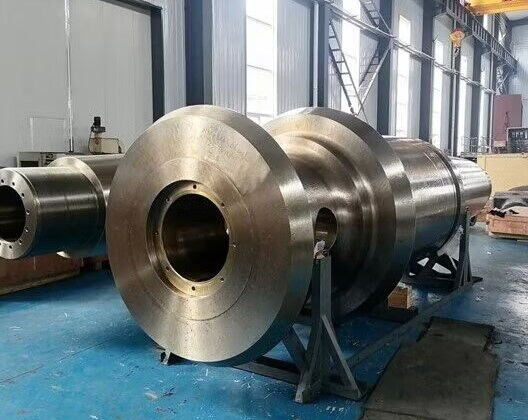
- Raw Material Selection: Selecting suitable raw materials is the first step in hollow shaft forging. Common materials include steel ingots and aluminum ingots. Based on performance requirements such as strength, toughness, and corrosion resistance, appropriate metals are chosen. For example, high-strength steels are typically used for aerospace hollow shafts, while aluminum alloys are commonly used in automotive applications to reduce weight and improve fuel efficiency.
- Heating: Heating the raw material to an appropriate forging temperature is a critical step. Proper temperature reduces internal stresses and improves plasticity, making deformation easier during forging. The heating temperature depends on material characteristics. For instance, the forging temperature of carbon steel is generally between 1100 °C and 1200 °C, while that of aluminum alloys is lower, typically around 400 °C to 500 °C.
- Preforming: The heated material is placed into forging equipment such as hammers, presses, or rolling mills. Under applied force, the metal undergoes plastic deformation to form the preliminary shape of the hollow shaft. During this process, hammering, pressing, or rolling may be used to increase the diameter and length to approach the required dimensions.
- Dimensional Adjustment: After preforming, further dimensional adjustment is required. Through hammering, pressing, or rolling, the initial length of the hollow shaft is extended to meet design requirements. At the same time, parameters such as pressure, speed, and stroke of the forging equipment can be adjusted to optimize dimensional accuracy.
- Forge Welding: The two ends of the hollow shaft are forge-welded to form a complete hollow shaft structure. Precise control of temperature and pressure is essential to ensure the strength and quality of the joint. In some complex hollow shaft designs, welding or other joining techniques may also be required for final assembly.
- Cooling and Heat Treatment: Controlled cooling during forging is crucial. By regulating the cooling rate, the desired microstructure and mechanical properties can be achieved. Rapid cooling increases hardness, while slow cooling helps reduce internal stress. Depending on requirements, subsequent heat treatments such as normalizing, quenching, and tempering may be applied to further enhance mechanical properties and wear resistance.
- Machining: Machining is an indispensable step in hollow shaft manufacturing. Processes such as turning and milling remove surface defects and achieve precise dimensions and geometry. This step ensures surface finish and dimensional accuracy in accordance with design specifications.
- Surface Treatment: To improve wear resistance, corrosion resistance, and appearance, surface treatment is usually required. Common methods include polishing, plating, and coating. For example, hard chromium plating significantly enhances wear resistance, while anti-corrosion coatings improve corrosion performance.
- Quality Inspection: Finally, strict inspections of dimensions, appearance, and performance are carried out to ensure product quality. Equipment such as coordinate measuring machines (CMMs), hardness testers, and metallographic analyzers are used for comprehensive evaluation. Only hollow shafts that pass rigorous inspection are approved for practical application.
Hollow shafts and solid shafts exhibit little difference in transmitting torque, bending moment, or combined bending and torsion. However, hollow shafts offer significant advantages. When the outer diameter is the same, hollow and solid shafts have nearly equivalent mechanical performance, but hollow shafts are substantially lighter. This makes them particularly attractive in aerospace and automotive industries, where lightweight and high performance are critical.
For example, in automotive manufacturing, hollow shafts effectively reduce vehicle weight, thereby improving fuel economy and handling performance. In aerospace applications, hollow shafts reduce aircraft weight, increase payload capacity, and enhance fuel efficiency. In addition, hollow shaft designs save material and lower production costs, which is especially important for large-scale manufacturing.
There are various forming methods for hollow shafts, each with its own principles and characteristics. Common methods include:
- Forging + Machining: The hollow shaft is first roughly formed by forging and then finished by machining. This method offers high dimensional accuracy but lower production efficiency and material utilization.
- Radial Forging: Radial forging applies multiple uniformly distributed forging forces to the shaft in the same plane. It produces uniform microstructures and excellent mechanical properties, making it suitable for complex shaft geometries. Key control parameters include forging force, deformation rate, and billet softening treatment.
- Rotary Forging: Rotary forging induces plastic deformation through combined rotational motion and pressure. It is well suited for hollow shafts with large length-to-diameter ratios and offers high efficiency and material utilization.
- Extrusion or Extrusion + Machining: In extrusion, metal is forced through a die at high temperature and pressure to form a hollow shaft preform. This method enables complex cross-sections but requires high equipment investment and precise dies.
- Cross-Wedge Rolling: Cross-wedge rolling uses wedge-shaped dies to roll metal billets. It is suitable for mass production, offering high efficiency and material utilization, though it demands advanced die design and manufacturing.
- Flow Forming (Power Spinning): Through rotation and applied pressure, the metal gradually deforms to form hollow shafts. This method is ideal for thin-walled hollow shafts, providing high forming accuracy and excellent surface quality.
- Rotary Compression: Rotary compression forms hollow shafts by combined rotational and compressive forces. It is suitable for high-strength, high-precision hollow shafts but requires advanced equipment and strict process control.
- Hydroforming (Internal High-Pressure Forming): High-pressure fluid is applied inside a tubular billet, causing it to expand and conform to the die cavity. This method enables complex cross-sections and high dimensional accuracy but involves high equipment costs and process control requirements.
- Cross Rolling + Axial Piercing: This combined method is suitable for hollow shafts with large length-to-diameter ratios, offering high productivity and material utilization.
- Injection Forging: Metal is injected into a mold under high temperature and pressure to form hollow shafts. It is suitable for small, complex components, providing high efficiency and dimensional accuracy.
- Extrusion + Hydroforming: This hybrid method combines extrusion and hydroforming to achieve complex cross-sections and high precision, while maintaining high efficiency and material utilization.
Thanks to their unique advantages, hollow shaft forgings are widely used in many industries:
- Automotive Industry: Used in drive shafts, steering shafts, and transmission shafts, where high strength, lightweight design, and wear resistance are essential for safety and stability.
- Aerospace Industry: Applied in aircraft, helicopters, and missiles for components such as wing structures, tail assemblies, and propeller shafts, where high strength, corrosion resistance, and lightweight performance are critical.
- Construction Machinery: Used in excavators, cranes, and concrete pump trucks for key components such as booms and sleeves, requiring high load capacity with reduced weight.
- Energy Equipment: Widely applied in wind and hydropower equipment, such as turbine towers and blade supports, requiring high strength, corrosion resistance, and fatigue resistance.
- Petrochemical Industry: Used in pumps, valves, and pipelines operating under high temperature and pressure, where corrosion resistance and mechanical reliability are essential.
- Railway Transportation: Applied in wheelsets and bogies, providing high strength, lightweight characteristics, and wear resistance to ensure safe and efficient rail operations.
- Shipbuilding: Used in marine propellers, rudders, and shafts, requiring excellent corrosion resistance, fatigue strength, and durability to ensure safe and stable navigation.
In summary, hollow shaft forging is an advanced manufacturing process that integrates materials science, plastic forming, and precision manufacturing. Through proper material selection, optimized forging and heat-treatment processes, and the application of suitable forming methods, significant lightweight and cost advantages can be achieved without compromising strength and reliability. With continuous advancements in manufacturing technology, equipment capability, and process control, hollow shafts will continue to offer broad development potential in terms of structural complexity, high performance, and large-scale production.
