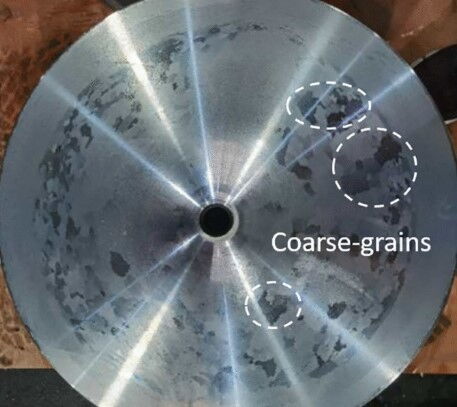
In modern manufacturing, forgings, as core components that bear critical structures and performance, have internal microstructural quality that directly determines material reliability and service life. Grain size and uniformity are important indicators for evaluating the quality of metal microstructure, while coarse-grained structures are a major hidden hazard at the microscopic level. Although difficult to detect with the naked eye, coarse grains can significantly weaken the mechanical properties of materials, reduce fatigue life, and interfere with processing and inspection, and their potential risks cannot be ignored. Especially in aerospace, nuclear power, and high-end equipment manufacturing, the presence of coarse grains may lead to structural failure, becoming a critical issue in industrial safety management. This article will systematically discuss the hazards of coarse grains, their formation causes, and prevention strategies, providing scientific guidance for aluminum alloy forgings and other key materials.
Coarse-grained structures are like time bombs inside metals, not only weakening material strength but also causing catastrophic fractures. Although these microscopic defects are difficult to observe with the naked eye, their impact on forging performance is disastrous. The main hazards of coarse grains are reflected in the following aspects:
The most direct hazard of coarse grains is the comprehensive degradation of key mechanical properties of forgings. For every increase in grain size grade, the material's tensile strength decreases by 7%-12%, yield strength decreases by 10%-15%, and elongation decreases by more than 30%. For example, for a certain type of aerospace engine turbine disk, the room-temperature impact energy of a coarse-grained forging is only one-third that of a qualified product. Cracking occurs at grain boundaries during high-speed rotation, ultimately causing in-flight disintegration of the entire engine. Under stress, coarse-grained areas are prone to concentrated slip bands, becoming the “source points” for crack initiation. Even more dangerous is that the stress concentration coefficient at the boundary between coarse and fine grains can reach three times that of normal areas, and this “soft-hard uneven” structural characteristic accelerates the fatigue failure process.
Under alternating load conditions, the hazards of coarse grains are geometrically amplified. If a nuclear power pressure vessel forging has grade-3 coarse grains, its fatigue life will drop sharply from the design requirement of 40 years to less than 15 years. Large grains reduce resistance to dislocation movement, increasing crack propagation rates by 2-3 times. In a high-speed train axle forging, local coarse grains caused through-thickness cracks after 30,000 km of operation, and testing found that the crack propagation rate reached 2.8 times that of normal microstructure. More critically, coarse grains change the material's fatigue fracture mode, turning originally ductile fractures into brittle fractures, with no warning during the failure process.
The anisotropy caused by coarse grains seriously interferes with subsequent processing. During cutting, tool wear differences between coarse-grained and fine-grained regions can reach 50%, resulting in surface roughness exceeding standards, forcing the scrapping of a titanium alloy forging worth 12 million yuan for an aerospace structural part. Cutting vibrations caused by coarse grains can also lead to dimensional deviations. For a precision gear forging, due to large grains, the tooth profile error reached 0.15 mm after heat treatment, far exceeding the 0.03 mm process requirement. It is estimated that the post-processing repair cost of forgings with coarse-grain defects is 17 times the prevention cost, and 90% of coarse-grain problems cannot be completely eliminated through heat treatment.
The interference of coarse grains with ultrasonic testing is a “technical nightmare.” In the inspection of nuclear power main pipe forgings, coarse grains produce grass-like echoes that completely mask real defect signals. At a nuclear power plant, a forging with a 5 mm crack was put into use due to misjudgment of coarse-grain echoes, ultimately causing radioactive leakage. More troublesome is that coarse grains cause wave attenuation, expanding the blind zones of ultrasonic testing for large forgings over 200 mm thick by 40%. For example, a rudder shaft of a 100,000-ton oil tanker failed to detect internal cracks, resulting in fracture during its maiden voyage. This inspection failure renders quality control meaningless and directly brings safety hazards into service.
The formation of coarse grains is a complex process involving multiple factors, influenced by material characteristics, processing technology, heat treatment conditions, and more. To effectively prevent and control the formation of coarse grains, it is necessary to fully understand the mechanisms of these factors.
Heating temperature and holding time are key factors affecting grain size. As heating temperature increases, atomic diffusion ability increases, and the tendency for grain growth intensifies, with fine grains easily transforming into coarse grains. The longer the high-temperature holding time, the more severe the coarse-grain phenomenon, though its impact is smaller than that of temperature.
The forging process is the key stage for coarse-grain formation. Forging temperature, forging speed, and forging ratio directly affect the grain size of forgings. When forging temperature is too high, aluminum alloy grains easily grow and form coarse grains. At the same time, excessively high forging speed also causes coarse grains during deformation because grains cannot refine in time. In addition, the choice of forging ratio affects aluminum alloy forging grain size. Too small a forging ratio results in insufficient deformation, making it difficult to refine grains; too large a forging ratio helps refine grains but excessive deformation may cause internal stress concentration, affecting forging performance.
Unreasonable die design, such as complex cavity structures and small corner radii, causes poor aluminum alloy flow in the die, leading to local coarse grains. Die material and surface finish also influence aluminum alloy flow and deformation, thereby affecting forging grain size.
Heat treatment is also an important factor affecting coarse grains in aluminum alloy forgings. Heat treatment temperature, holding time, and cooling rate directly affect aluminum alloy grain size. If the heat treatment temperature is too high or holding time too long, grain size easily increases; if the cooling rate is too fast, significant internal stress forms during solidification, causing coarse grains.
Preventing and controlling coarse grains is key to ensuring forging quality and performance. By optimizing process parameters, improving materials and equipment, and strengthening quality control, the formation of coarse grains can be effectively reduced. The following are specific prevention strategies:
Pre-forging heating temperature should be strictly controlled at 150–250°C below the solidus line in the phase diagram. Holding time should not be too long and should be determined according to ingot shape. By precisely controlling heating temperature and holding time, excessive grain growth can be effectively avoided.
Forging deformation can break coarse austenite grains, refine the structure, and eliminate coarse grains. During forging, areas of the forging that are only heated but not deformed should be avoided. When deciding the final heating temperature, it should be based on the remaining deformation to avoid excessive grain growth due to too high final forging temperature and insufficient deformation, which prevents forging force from transmitting to the center of the forging. During deformation, small-step deformation processes should be avoided.
Strengthen die design and manufacturing quality control to ensure rational die structure and high surface finish, reducing aluminum alloy flow resistance in the die. Reasonable die design can effectively reduce local coarse grains.
Through optimizing the heat treatment process, aluminum alloy grain size can be further refined. Reasonably controlling heat treatment temperature, holding time, and cooling rate prevents excessive grain growth and internal stress formation.
Aluminum alloy forgings, due to their lightweight, high strength, and corrosion resistance, are widely used in aerospace, automotive manufacturing, and machinery. However, coarse-grain issues in aluminum alloy forgings are particularly complex and require special attention.
Material Itself: The chemical composition, grain size, and distribution of aluminum alloys affect coarse-grain formation. When alloy element content is uneven or grain size is large, coarse grains easily form during forging. In addition, aluminum alloy smelting and casting processes also influence coarse-grain formation. Improper temperature control during smelting or uneven cooling during casting leads to grain coarsening.
Forging Process: Forging temperature, forging speed, and forging ratio directly affect aluminum alloy forging grain size. Excessively high temperature causes grain growth and coarse grains. Excessive forging speed also causes coarse grains during deformation. Forging ratio affects grain size: too small ratio results in insufficient deformation and coarse grains; too large ratio aids refinement but may cause internal stress concentration.
Die Design: Unreasonable die design, such as complex cavity structures and small corner radii, causes poor aluminum alloy flow, resulting in local coarse grains. Die material and surface finish also influence aluminum alloy flow and deformation, affecting grain size.
Heat Treatment Process: Heat treatment temperature, holding time, and cooling rate directly affect aluminum alloy grain size. Excessive temperature or long holding time promotes coarse grains, while rapid cooling generates internal stresses, causing coarse grains.
Optimize Smelting and Casting Process: Ensure uniform composition and fine grain size by controlling smelting temperature and cooling rate, effectively preventing grain coarsening.
Reasonably Select Forging Process Parameters: Precisely control forging temperature, speed, and reduction ratio to refine grains and improve forging performance.
Strengthen Die Design and Manufacturing Quality Control: Ensure rational die structure and high surface finish to reduce flow resistance and minimize local coarse grains.
Optimize Heat Treatment Process: Control heat treatment temperature, holding time, and cooling rate to refine grain size, avoiding excessive growth and internal stress.
The hazards of coarse grains far exceed traditional understanding. They are not just a metallurgical defect but a systemic risk to modern industrial safety. Leading enterprises have established a full-chain control system from “forging process – grain evolution – service performance,” such as using finite element simulation to predict critical deformation zones and developing intelligent temperature control systems to maintain final forging temperature fluctuations within ±15°C. By thoroughly exploring the causes of coarse grains and adopting corresponding control measures, their formation can be effectively reduced, improving forging quality and performance and ensuring safe operation in modern industry.
In actual production, enterprises should pay attention to coarse-grain issues, comprehensively controlling their formation through optimized heating processes, reasonable forging process design, optimized die design, and heat treatment. Only in this way can forging quality and performance be ensured, providing a solid guarantee for the safe operation of modern industry.
